From the free course AP Comparative Government and Politics on Lykke
2.4 Executive Term Limits
Key concepts: Executive term limits · Advantages of term limits · Focus on governing rather than winning elections · Opportunities for new leaders · New ideas and policies · Political institutions reflect the allocation of power · Defensible claim or thesis about executive term limits
Executive term limits determine whether a successful executive may keep seeking office—or must eventually hand power to someone else. The central question is not simply whether limits are “good” or “bad,” but whether replacing leaders improves accountability and policy stability more than it disrupts effective…
2.4 Executive Term Limits
Executive term limits determine whether a successful executive may keep seeking office—or must eventually hand power to someone else. The central question is not simply whether limits are “good” or “bad,” but whether replacing leaders improves accountability and policy stability more than it disrupts effective government.
Investigative question: Do executive term limits protect political systems, or prevent effective leaders from finishing their work?
Formal definition and political purpose
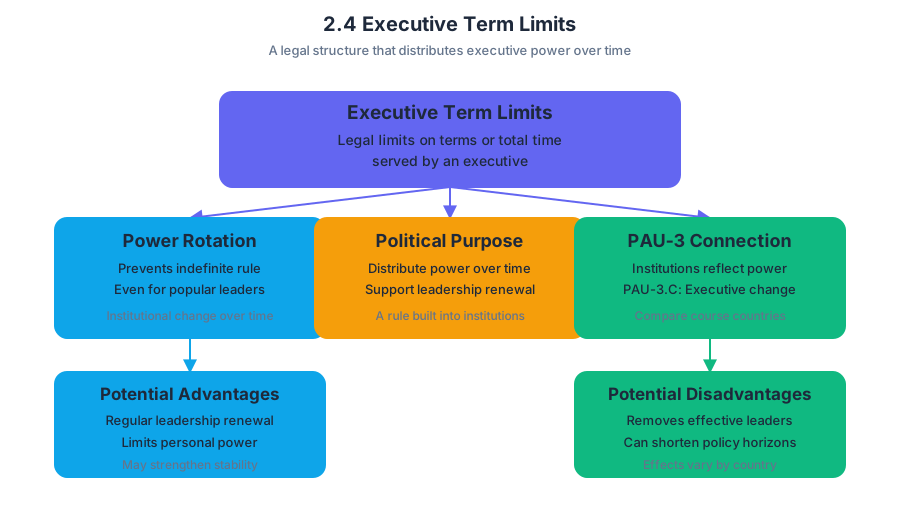
Executive term limits are legal restrictions on the number of terms, or total amount of time, an executive may serve in office. They are an institutional way to distribute power over time: even a popular executive cannot legally remain in office forever.
The enduring understanding PAU-3 states that the structure and function of political institutions reflect the allocation of power within a political system. The relevant learning objective is PAU-3.C: Explain the structure, function, and change of executive leadership in course countries. Essential knowledge PAU-3.C.3 requires analysis of both the advantages and disadvantages of executive term limits in promoting stability and effective policies.
Advantages: limiting power and opening political space
Term limits can check executive power by preventing one officeholder from converting repeated electoral victories into permanent personal rule. They inhibit the emergence of dictators and personality rule, in which loyalty to an individual becomes more important than loyalty to political institutions.
A second advantage is that term limits can help an officeholder focus on governing rather than winning elections. If reelection is impossible, the executive has less reason to shape every policy around campaign advantages, donors, polling, or short-term popularity. The executive may instead devote attention to implementing difficult policies whose benefits appear only after several years.
Term limits also create opportunities for new leaders to enter office. New leaders may bring different ideas, policies, or goals, allowing institutions to respond to changing social conditions. Leadership turnover can broaden representation and prevent political offices from becoming the permanent property of one family, faction, or personality.
Disadvantages: turnover can weaken effective government
The same rule that prevents a harmful executive from staying can force a capable executive to leave. Term limits may therefore remove a good leader even when citizens still support that leader’s performance.
They may also allow insufficient time to achieve major goals. A policy requiring long-term investment—such as institutional reform, infrastructure construction, or economic restructuring—may be interrupted when a new executive takes office. This can impede policy continuity, especially when the successor wants to reverse the predecessor’s agenda.
Term limits can weaken accountability because citizens cannot use reelection to reward or punish the executive directly. Near the end of a final term, a lame-duck period may develop: the executive remains in office but has reduced political influence because cannot seek another term. The executive may also have less incentive to respond to public preferences.
Frequent turnover can prevent an executive from building experience as chief executive. It can also encourage poorly designed policy if new leaders prioritize visible, rapid changes over careful administration. A new executive may need to spend valuable time learning how to manage institutions rather than pursuing substantive goals.
Pros and cons at a glance
| Advantages of executive term limits | Disadvantages of executive term limits |
|---|---|
| Check executive power | Force good executives to leave office |
| Inhibit dictators and personality rule | Allow insufficient time to achieve goals |
| Encourage governing rather than constant reelection campaigning | Impede policy continuity |
| Provide opportunities for new leaders | Weaken electoral accountability |
| Introduce new ideas, policies, and goals | Create a lame-duck period |
| Reduce the risk of permanent personal rule | Limit the development of executive experience |
| — | Can contribute to poorly designed policy |
Worked argument: making a defensible claim
Imagine Country A limits its president to two terms. During the first term, the president begins an education reform program that requires a decade to produce results. The president cannot seek a third term, so reelection pressure will not distort the final years of the administration. However, a successor may cancel the program before its effects appear, producing policy instability.
A defensible thesis must answer the question while recognizing the competing consequence:
Claim: Executive term limits are generally beneficial because they check executive power, discourage personality rule, and create opportunities for new leaders; however, they can reduce policy continuity and remove effective executives before long-term goals are completed.
This claim satisfies PAU-35.A: Articulate a defensible claim/thesis because it takes a clear position and identifies a condition that complicates it. A weak response merely lists advantages and disadvantages; a strong response explains why the institutional trade-off matters.
Misconception check
Misconception: “Term limits automatically make a country democratic.” Term limits can restrain executive power, but they do not by themselves guarantee competitive elections, an independent legislature, an independent judiciary, or meaningful political participation. They are one institutional limit on power—not a complete democratic system.
Retrieval check
If an executive cannot seek reelection, identify one reason that executive might govern more effectively and one reason the country might experience less effective policy. Then write a one-sentence thesis deciding whether the advantages outweigh the disadvantages. Tie your answer to PAU-3.C.3 and the idea that institutions reflect the allocation of power.



Source Materials
- AP Comparative Government and Politics Course and Exam Description
- AP Comparative Government and Politics Course and Exam Description Clarifications and Corrections
- AP Comparative Government and Politics Course Overview
- AP Comparative Government and Politics Course at a Glance
- AP Comparative Government and Politics Course at a Glance Poster
- AP Comparative Government and Politics
- AP Comparative Government and Politics
- AP Comparative Government and Politics Sample Syllabus 1
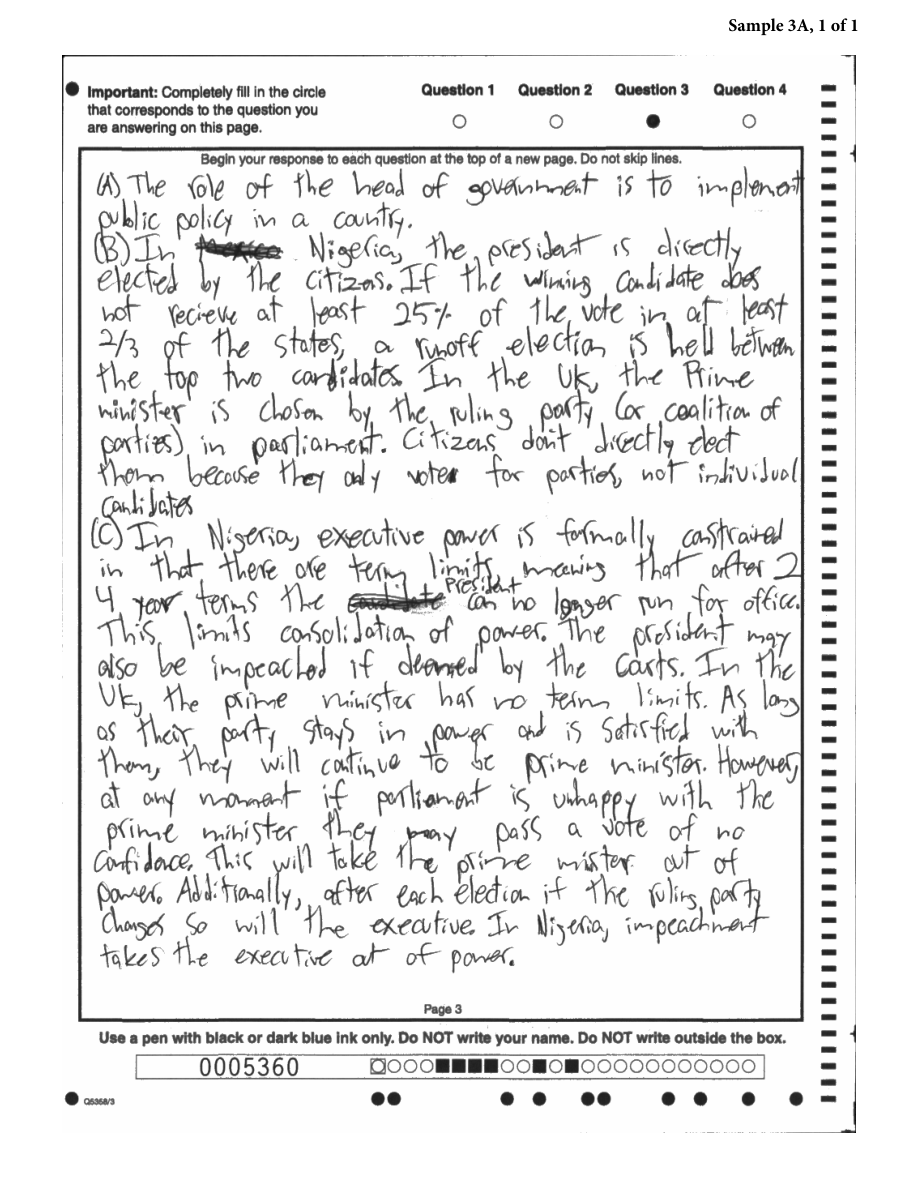
- Figure — Sample Responses Q3 - Set 1 (p. 5)
- Figure — Sample Responses Q3 - Set 1 (p. 6)
- Figure — Sample Responses Q3 - Set 1 (p. 7)