From the free course AP Comparative Government and Politics on Lykke
5.2 Political Responses to Global Market Forces
Key concepts: Global market forces · Political responses to economic globalization · Economic liberalization · Private ownership of industry · State ownership and re-nationalization · Joint ventures with foreign companies · Domestic economic conditions · Domestic demands · State control or influence over domestic politics · Oil and natural-gas industries
Governments do not respond to global market forces in one uniform way: they may privatize state industries, invite foreign investment, form partnerships with international companies, or reclaim industries for the state.
5.2 Political Responses to Global Market Forces
Governments do not respond to global market forces in one uniform way: they may privatize state industries, invite foreign investment, form partnerships with international companies, or reclaim industries for the state. The central question is: Who should control economically important resources when domestic needs and international market pressures collide?
Enduring Understanding — IEF-3: Economic globalization and economic liberalization have positively and negatively affected political policies and behaviors.
Learning Objective — IEF-3.B: Compare political responses to global market forces.
The policy choice: open, share, or reclaim control
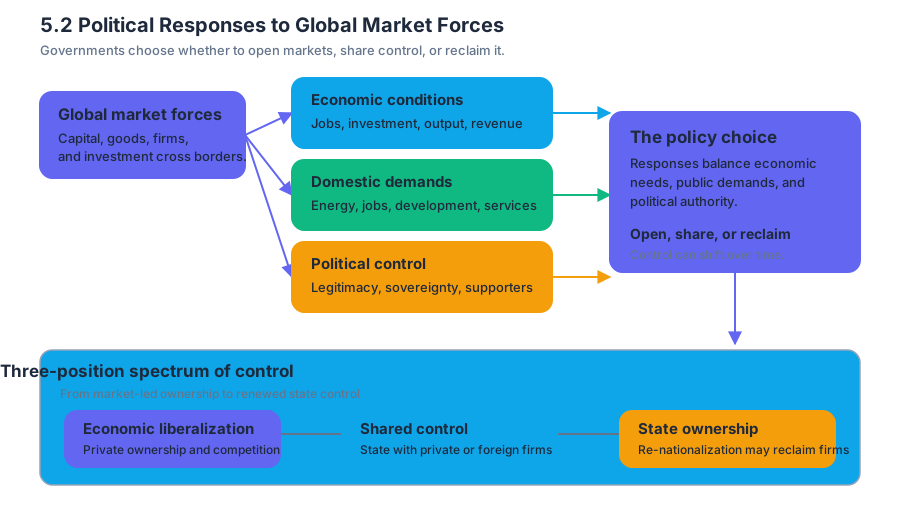
Global market forces are pressures created by the movement of capital, goods, companies, and investment across national borders. Governments respond to these forces for at least three connected reasons:
- to improve domestic economic conditions, such as employment, investment, production, or government revenue;
- to address domestic demands, including demands for affordable energy, jobs, development, or public services; and
- to control or influence domestic politics by strengthening legitimacy, rewarding supporters, limiting opposition, or protecting national sovereignty.
A useful way to visualize the policy problem is as a three-position spectrum:
At one end, economic liberalization expands private ownership and competition. In the middle, the state shares control with private or foreign firms. At the other end, the government increases state ownership, sometimes through re-nationalization, meaning that industries previously transferred to private or foreign control are brought back under state control.
IEF-3.B.1 — Countries experiment with private ownership and capital
Essential Knowledge IEF-3.B.1 requires comparison of country responses involving private ownership of industry and capital. These policies differ because governments balance economic goals against political control and sovereignty.
| Country or case | Political-economic response | What the government is trying to do |
|---|---|---|
| China | Special economic zones along the coast | Attract investment and encourage production while maintaining broader state authority |
| Mexico | Privatization and increased competition in the oil industry, including Pemex | Reduce exclusive state control and use competition to improve efficiency and investment |
| Nigeria | State-owned Nigerian National Petroleum Corporation, or NNPC, forms joint ventures with foreign companies | Combine state control of a strategic resource with foreign capital and expertise |
| Russia under Putin | Re-nationalization of oil and natural-gas industries and limits on foreign investment | Increase state control over strategic industries and restrict outside influence |
China: selective openness
China’s special economic zones illustrate selective economic liberalization. The government creates designated areas where businesses may face different investment and operating rules, making it easier to attract foreign capital and expand production. The key point is that openness can be geographically and politically managed rather than applied equally throughout the country.
Mexico: privatization and competition
Mexico’s movement toward privatization—the transfer of an industry or enterprise from state ownership to private ownership—and increased competition in the oil industry represents another response. The government uses private participation and competition to seek investment and improved performance, but the policy also changes who controls an important national resource.
Nigeria: joint ventures
Nigeria demonstrates a hybrid response. The state-owned NNPC collaborates with foreign companies in joint ventures, in which two or more organizations share investment, production, risks, and returns. Nigeria therefore does not simply choose between total state ownership and total privatization; it retains a state enterprise while using foreign companies to help extract and produce oil.
Worked comparison: Suppose all three governments want to increase oil or industrial production. Mexico may emphasize privatization and competition; Nigeria may preserve a state-owned corporation but cooperate with foreign firms; China may concentrate liberalized activity in special economic zones. The shared goal is economic improvement, but the political mechanism differs: competition, partnership, or geographically limited openness.
IEF-3.B.2 — Liberalization can help and constrain governments
Essential Knowledge IEF-3.B.2 states that economic globalization and economic liberalization can affect political policies and behaviors both positively and negatively. Foreign investment may bring jobs, technology, production, and revenue, helping a government claim that its policies improve living conditions. However, greater foreign participation can also reduce a government’s control over strategic industries or create political pressure from companies and investors.
Russia under Putin illustrates the opposite direction from liberalization. Re-nationalization of oil and natural-gas industries, combined with limitations on foreign investment, represents state intervention designed to increase government control over resources and reduce foreign influence. This policy may support political authority and sovereignty, but it can also restrict competition and access to outside capital.
Common misconception: “Globalization always means privatization”
Misconception check: Globalization does not require a government to privatize every industry. A country can welcome foreign investment through a special economic zone, cooperate through a joint venture, privatize part of an industry, or restrict foreign ownership while re-nationalizing strategic resources. The AP comparison is not about labeling a country “open” or “closed”; it is about explaining which policy it adopted and why.
AP skill: Country Comparison
The suggested skill for this topic is Country Comparison. To earn comparison credit, identify a meaningful similarity or difference and connect it to a political or economic consequence. For example: Nigeria and Mexico both involve non-state firms in oil production, but Nigeria uses joint ventures with a state-owned corporation, whereas Mexico emphasizes privatization and increased competition; therefore, Nigeria retains more direct state participation in the industry.
A weak comparison merely lists countries. A strong comparison explains the implication: who owns the industry, who receives investment, how much control the state retains, and how the policy may affect legitimacy, sovereignty, or domestic political authority.
Retrieval check
A government keeps its national petroleum company but signs contracts with foreign firms to extract and produce oil. What policy response is this, and how does it differ from Russia’s response under Putin?
Answer: It is a joint venture, like Nigeria’s NNPC collaborations. Unlike Russia’s re-nationalization and foreign-investment limitations, the joint-venture model preserves state participation while inviting foreign capital and expertise.

Source Materials
- AP Comparative Government and Politics Course and Exam Description
- AP Comparative Government and Politics Course and Exam Description Clarifications and Corrections
- AP Comparative Government and Politics Course Overview
- AP Comparative Government and Politics Course at a Glance
- AP Comparative Government and Politics Course at a Glance Poster
- AP Comparative Government and Politics
- AP Comparative Government and Politics
- AP Comparative Government and Politics Sample Syllabus 1