From the free course AP Comparative Government and Politics on Lykke
2.9 Independent Judiciaries
Key concepts: Independent judiciaries · Separation of powers · Checks and balances · Fundamental rights and liberties · Judicial independence · Corruption and judicial reform · Striking down unconstitutional laws · Political stability · Government control of the judiciary · Judicial rulings strengthening government power
A court can exist without being independent: the decisive question is whether judges can apply the law even when their ruling threatens the interests of the executive, legislature, ruling party, or military.
2.9 Independent Judiciaries
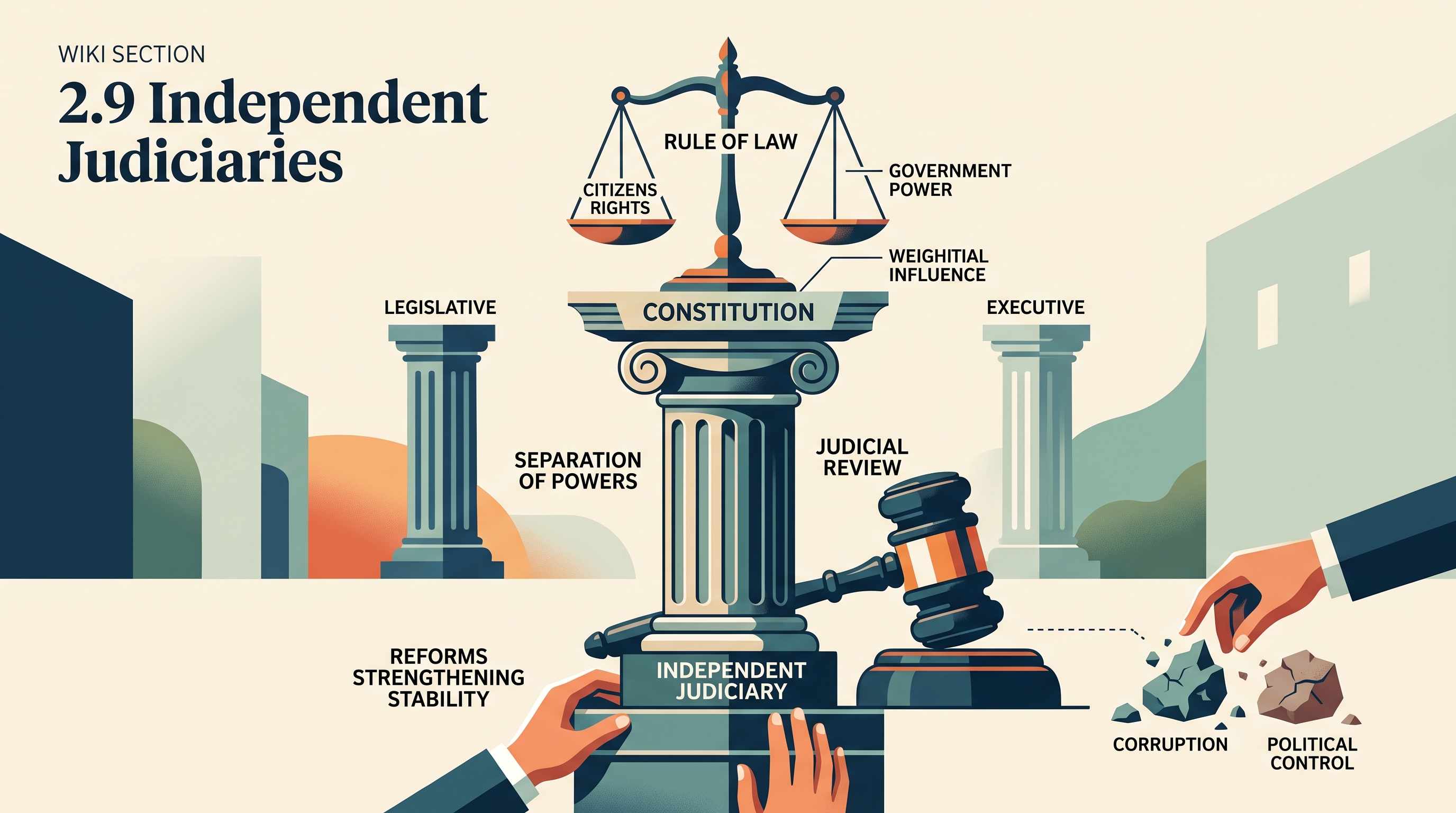
A court can exist without being independent: the decisive question is whether judges can apply the law even when their ruling threatens the interests of the executive, legislature, ruling party, or military. Judicial independence means that courts possess meaningful freedom from political control when interpreting law, reviewing government action, and protecting rights.
Learning Objective 2.9.A: Explain how judicial independence impacts the political system.
Essential Knowledge 2.9.A: Independent judiciaries can check the power of other branches of government.
Essential Knowledge 2.9.B: Judicial independence helps ensure that government action does not infringe on fundamental rights and liberties.
The institutional logic: courts as a counterweight
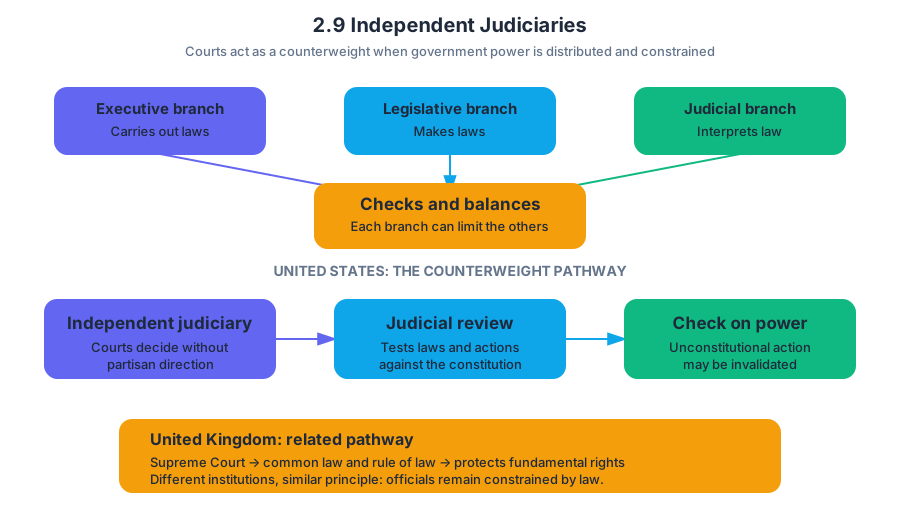
The United States uses separation of powers, a system that distributes governmental authority among executive, legislative, and judicial branches. Checks and balances then give each branch tools to limit the others. Judicial review—the power to assess whether a law or government action violates a constitution—allows an independent court to invalidate unconstitutional action.
The key relationship is:
$$ \text{Independent judiciary} \rightarrow \text{judicial review} \rightarrow \text{check on other branches} $$
The United Kingdom illustrates a related but distinct pathway. Its Supreme Court uses common law to enforce the rule of law and help ensure that government does not infringe on fundamental rights and liberties. The institutional arrangements differ from those of the United States, but the political principle is similar: government officials are constrained by law rather than permitted to act solely according to personal or partisan power.
Independence and rights
An independent judiciary matters because political majorities can violate rights. If judges depend on the government for their jobs, salaries, or legal authority, they may hesitate to protect unpopular individuals or groups. Judicial independence therefore supports fundamental rights and liberties, such as fair legal treatment, freedom from arbitrary government action, and protection against unconstitutional laws.
A useful test is to ask what happens when a court’s decision conflicts with the government’s preferences. If the government must obey the ruling, the judiciary has demonstrated a meaningful check. If judges instead use rulings to enforce the government’s preferred outcome, the courts may function as instruments of control rather than as independent protectors of rights.
Comparative evidence: independence varies
Mexico provides an example of judicial independence strengthening political stability. An independent Mexican judiciary has been used to strike down unconstitutional laws. This kind of ruling can increase stability because political actors have a lawful mechanism for resolving institutional conflict, and citizens can see that constitutional limits have practical force.
Nigeria has worked to enhance judicial independence by addressing corruption and implementing reforms. Corruption can weaken independence when judges or court officials are vulnerable to bribery, political pressure, or unequal access to justice. Reform efforts seek to make judicial decisions more credible and reduce the ability of powerful actors to purchase outcomes.
China, Iran, and Russia do not have independent judiciaries. In these countries, judicial rulings are used to strengthen government control rather than consistently counter the power of other branches or protect the rights of people. This is an example of rule by law, in which authorities use legal institutions to govern and control society, rather than rule of law, in which the law meaningfully constrains government itself.
| Judicial independence | Political use of courts without independence |
|---|---|
| Courts can check executive or legislative action | Courts reinforce government decisions |
| Unconstitutional laws may be struck down | Laws are applied to strengthen government control |
| Rights can be protected against political majorities | Rights protection depends heavily on government preferences |
| Supports rule of law | Illustrates rule by law |
Misconception check
Misconception: “A country has an independent judiciary whenever it has courts or a supreme court.” Courts are formal institutions; independence is a condition of their decision-making. China, Iran, and Russia have judicial branches, but the source evidence identifies them as lacking independent judiciaries because their rulings strengthen government control rather than constrain it.
Worked comparison
Suppose two legislatures pass laws restricting public criticism of the government. In Mexico, an independent judiciary could review the laws and strike them down as unconstitutional, creating a lawful check and potentially increasing stability. In a country without an independent judiciary, courts may uphold the restrictions because the ruling strengthens government control. The comparison is not simply “court versus no court”; it is independent legal constraint versus politically controlled enforcement.
AP skills and reasoning processes
This topic develops the following official skills:
- Skill 1.A — Describe and explain political concepts and processes: Define judicial independence, separation of powers, checks and balances, rule of law, and rule by law.
- Skill 1.B — Explain how political concepts and processes relate to one another: Connect judicial independence to judicial review, rights protection, legitimacy, and political stability.
- Skill 2.A — Describe causes and effects of political phenomena: Explain how corruption and political control weaken judicial independence, and how reforms or independent rulings can strengthen stability.
- Skill 3.A — Compare political concepts and processes: Compare Mexico or Nigeria with China, Iran, or Russia by identifying how judicial independence changes the relationship between courts and government.
- Skill 5.A — Use evidence to support a claim: Pair a country-specific example with a precise claim, such as “Mexico’s courts striking down unconstitutional laws demonstrates a judicial check.”
Retrieval check: Why is Mexico’s example evidence of both judicial independence and political stability? Why would the same legal ruling in China, Iran, or Russia be less likely to function as a check on government power? A strong answer must identify the court’s action, its independence from political control, and its effect on constitutional limits or government authority.
Source Materials
- AP Comparative Government and Politics Course and Exam Description
- AP Comparative Government and Politics Course and Exam Description Clarifications and Corrections
- AP Comparative Government and Politics Course Overview
- AP Comparative Government and Politics Course at a Glance
- AP Comparative Government and Politics Course at a Glance Poster
- AP Comparative Government and Politics
- AP Comparative Government and Politics
- AP Comparative Government and Politics Sample Syllabus 1