From the free course AP Comparative Government and Politics on Lykke
1.9 Sustaining Legitimacy
Key concepts: Sustaining legitimacy · Thesis about sustaining legitimacy · Alternate perspective · Simplifying complex issues · Providing people with answers
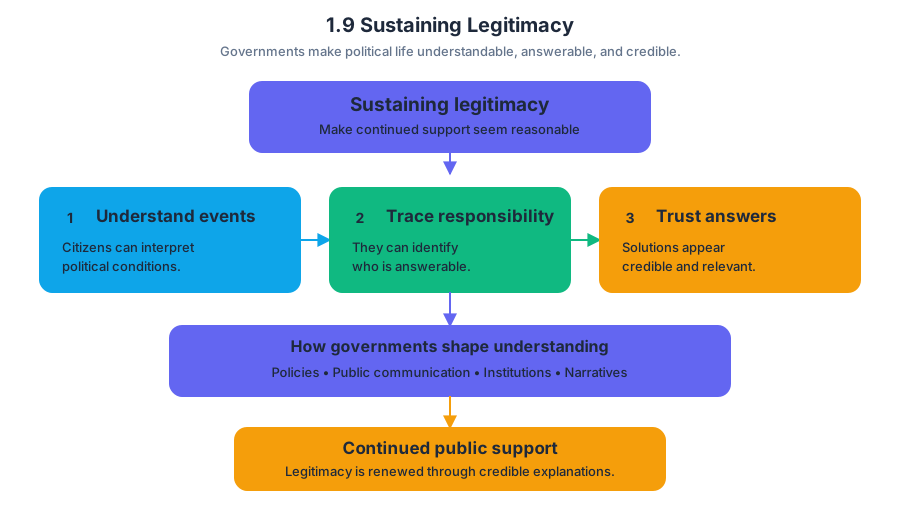
A government can sustain legitimacy not only by being effective, but by making political life feel understandable and answerable: citizens must be able to interpret events, identify who is responsible, and believe that the system offers credible answers to major problems.
1.9 Sustaining Legitimacy
A government can sustain legitimacy not only by being effective, but by making political life feel understandable and answerable: citizens must be able to interpret events, identify who is responsible, and believe that the system offers credible answers to major problems.
Learning Objective 1.9.A: Explain how governments sustain legitimacy.
The central thesis is that governments sustain legitimacy by shaping how people understand political conditions and by providing explanations or solutions that make continued support seem reasonable. This can occur through policies, public communication, institutions, or narratives that connect government action to citizens’ expectations.
The legitimacy-maintenance cycle
The process can be represented as a cycle:
Problem or uncertainty → Government simplifies the situation → Government provides an explanation or answer → Citizens interpret the government as capable or necessary → Support for the political system is reinforced
The cycle does not require every citizen to be satisfied with every policy. Sustaining legitimacy means preserving enough acceptance that people continue to recognize the government’s authority rather than treating it as fundamentally unacceptable.
Simplifying complex issues
Simplifying complex issues means presenting difficult political, economic, or social conditions in a form that people can quickly understand. Governments may identify a clear cause, assign responsibility, emphasize a shared national goal, or frame a complicated choice as a straightforward decision.
Simplification can help sustain legitimacy because uncertainty is politically costly. When citizens cannot understand why prices rise, why security threats occur, or why reforms take time, they may conclude that the government is incompetent or indifferent. A simple narrative can reduce confusion and make government action appear purposeful.
Worked example: Imagine that a government faces a sudden shortage of food. The actual causes may include drought, disrupted transportation, international prices, poor planning, and corruption. If the government explains the shortage only as the result of an external crisis and announces a national distribution program, it has simplified the issue and provided a recognizable response. Some citizens may therefore view the government as protecting the public during an emergency, even though the underlying causes are more complicated.
The analytical point is not that simplification proves the government is effective. It shows how controlling the explanation of a problem can influence whether citizens regard the government as competent, necessary, or responsible.
Providing people with answers
Governments also sustain legitimacy by providing people with answers—clear accounts of what is happening and what the government intends to do. Answers may take the form of policy announcements, public explanations, official statistics, speeches, or visible action.
Answers matter because political legitimacy depends partly on expectations. If citizens ask, “Who is responsible?” or “What will happen next?” and the government responds clearly, the state can appear more capable and predictable. If officials remain silent, contradict one another, or offer no remedy, the same crisis may weaken confidence in the political system.
In the food-shortage example, announcing where supplies will be distributed, who qualifies for assistance, and when the program will begin gives citizens specific answers. The government is not merely communicating; it is demonstrating that it can define a problem and organize a response.
Alternate perspective: simplification can weaken legitimacy
An alternate perspective challenges the thesis: simplification and official answers do not always sustain legitimacy. They can also damage it when citizens recognize that the explanation is misleading, when promised solutions fail, or when the government uses a simple narrative to avoid responsibility.
For example, blaming the food shortage entirely on foreign actors may initially produce unity, but continued shortages can expose the explanation as incomplete. Citizens may then interpret simplification as propaganda rather than competent leadership. In this view, legitimacy is sustained more securely by accurate information and effective outcomes than by persuasive presentation alone.
Exam-ready contrast: A strong alternate perspective does not merely say “some people disagree.” It explains why the opposing view could be valid and identifies the condition under which it becomes stronger.
Named misconception — “Simplification equals manipulation.” Simplification can be manipulative, but it can also make complex conditions understandable and permit coordinated action. The key question is whether the simplified explanation helps citizens evaluate government performance or hides failures and suppresses competing interpretations.
AP skills and reasoning processes
Skill 3.C — Explain the significance of a source’s point of view, purpose, audience, and/or context. When analyzing a government statement about a crisis, ask who produced it, what audience it targets, and how its purpose may shape the explanation. A speech aimed at reassuring citizens may emphasize unity and progress rather than uncertainty.
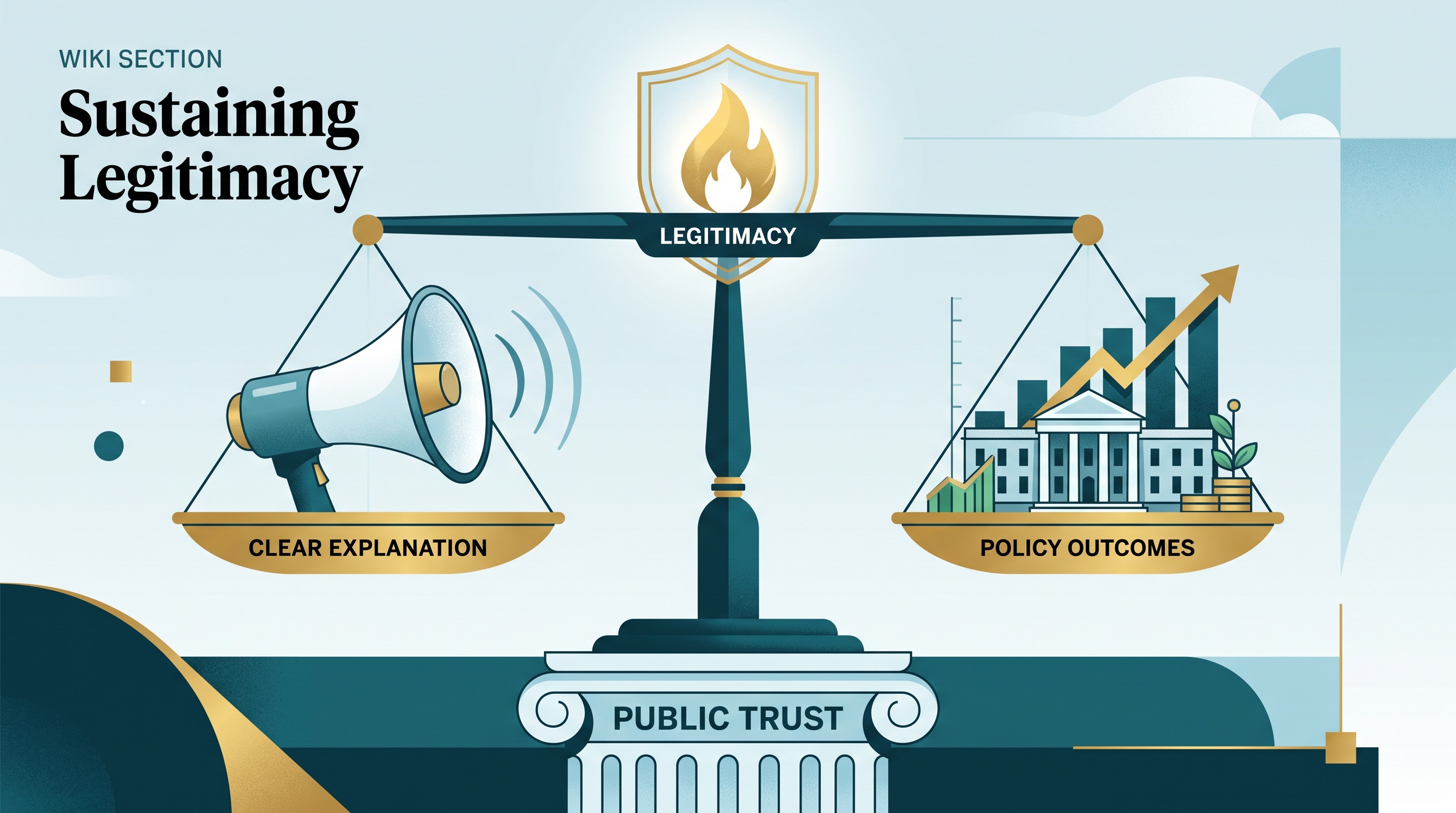
Skill 1.E — Compare political concepts and processes. Compare sustaining legitimacy through clear explanations with sustaining legitimacy through successful policy results. Both can reinforce acceptance, but they operate differently: communication shapes interpretation, while outcomes shape citizens’ direct experience.
Retrieval check: A government gives citizens a simple explanation for a crisis and announces a detailed response, but the crisis continues. Explain one way this could sustain legitimacy and one way it could weaken legitimacy. Which answer identifies the alternate perspective, and why?
Source Materials
- AP Comparative Government and Politics Course and Exam Description
- AP Comparative Government and Politics Course and Exam Description Clarifications and Corrections
- AP Comparative Government and Politics Course Overview
- AP Comparative Government and Politics Course at a Glance
- AP Comparative Government and Politics Course at a Glance Poster
- AP Comparative Government and Politics
- AP Comparative Government and Politics
- AP Comparative Government and Politics Sample Syllabus 1