From the free course AP Comparative Government and Politics on Lykke
4.1 Electoral Systems and Rules
Key concepts: Electoral systems and election rules · Competitive versus restrictive electoral regimes · Direct and indirect elections · Proportional representation · Single-member district plurality systems · Party-system formation · Representation of minority and women candidates · Constituency accountability and geographic representation · Ballot-access and candidate-selection rules · Term-limit policies
An election can look competitive on paper while the rules quietly decide who may compete, how votes become seats, and whether voters can hold one identifiable representative accountable.
4.1 Electoral Systems and Rules
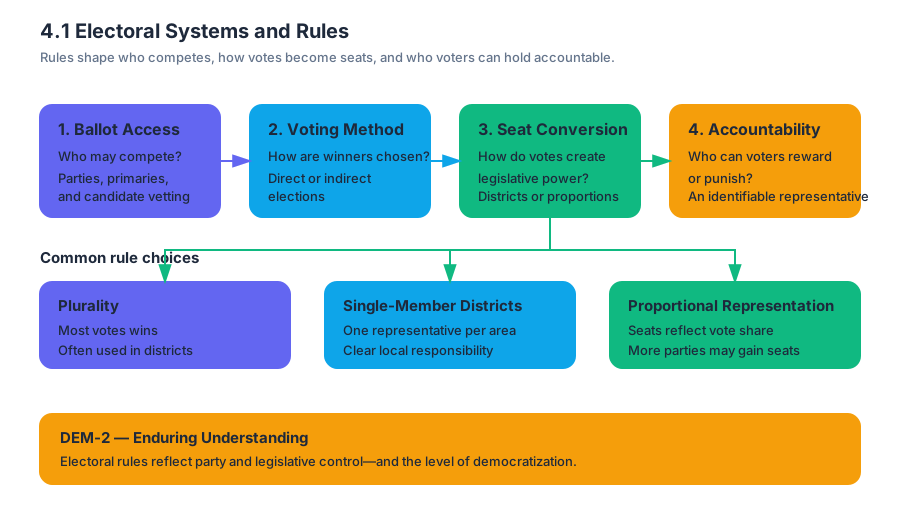
An election can look competitive on paper while the rules quietly decide who may compete, how votes become seats, and whether voters can hold one identifiable representative accountable. Electoral systems and rules are the procedures that determine ballot access, election winners, legislative representation, and the connection between citizens and elected officials.
DEM-2 — Enduring Understanding: The rules of electoral systems reflect party and legislative control and the level of democratization.
A useful first question is: Who gets onto the ballot, how are votes converted into political power, and who can voters reward or punish? The answer may involve direct or indirect elections, candidate vetting, proportional representation, single-member districts, plurality rules, or combinations of these systems.
Competitive and restrictive electoral regimes
A competitive electoral regime allows multiple candidates or parties a meaningful opportunity to campaign, compete, and win. A restrictive electoral regime limits competition through mechanisms such as candidate disqualification, party-registration barriers, ballot-access thresholds, or indirect selection procedures.
Iran illustrates how elections can be direct but still restricted. Voters directly elect members of the Majles in single-member or multimember districts, yet candidates must first be vetted by the Guardian Council. The election determines among the approved candidates—not necessarily among all citizens who wish to run.
China illustrates a different mechanism. Some national-level representation is selected indirectly through local and regional peoples’ congresses rather than by a single nationwide popular vote. Indirect election can create additional layers of political control between ordinary voters and national representatives.
Misconception check — “Direct” means fully democratic: Direct voting describes how representatives are selected, not how open or fair the competition is. A direct election with extensive candidate vetting may be less competitive than an indirect process with broader internal contestation.
Direct and indirect elections
In a direct election, voters cast ballots for the candidates or party lists that will immediately fill an office or legislative seat. In an indirect election, voters select intermediaries—such as local representatives or an electoral body—that then choose the national official or representative.
The distinction matters because it changes accountability. In a direct election, citizens can more easily connect their vote to a particular officeholder. In an indirect election, responsibility is distributed across several stages, making the chain between voter preference and national representation less immediate.
Two major ways votes become seats
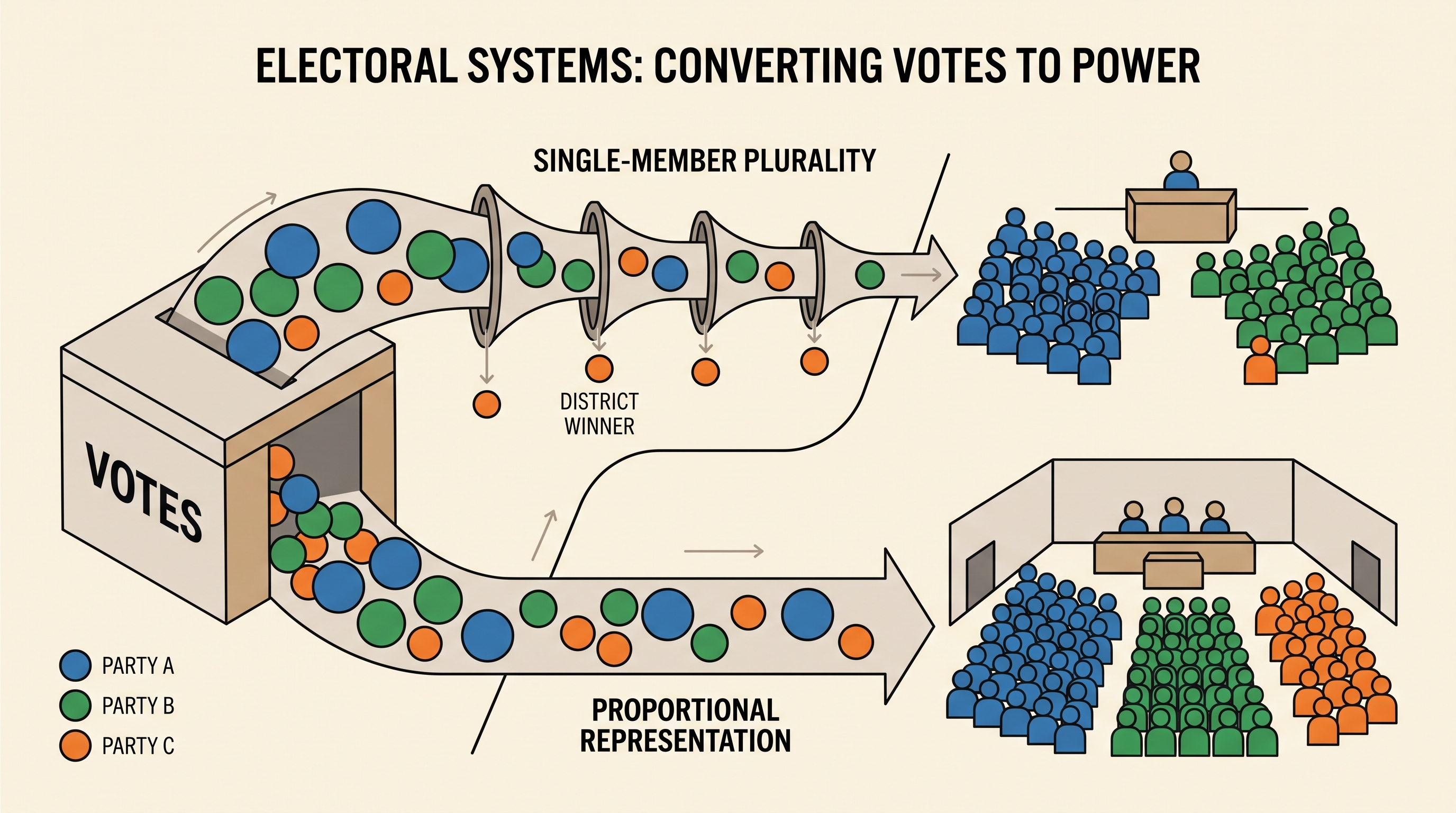
Proportional representation allocates legislative seats in approximate proportion to the votes parties receive. If several parties each win substantial support, several parties may gain seats rather than only the largest party or the candidate who finishes first in each district.
Under single-member district plurality, each geographic district elects one representative, and the candidate with the most votes wins—even without receiving more than half of all votes. This system is also called first-past-the-post.
| Electoral rule | Typical political effect |
|---|---|
| Proportional representation | More parties represented in the legislature; can increase representation of minority and women candidates |
| Single-member district plurality | Tends to promote two-party systems; creates a single identifiable district representative |
| Plurality presidential election | The candidate with the most votes wins, even without an absolute majority |
| Runoff system | A second round may be used to produce a majority winner |
These differences are captured in the required content for DEM-2.B — Explain how election rules serve different regime objectives regarding ballot access, election wins, and constituency accountability. Under DEM-2.B.1, proportional representation can increase both the number of political parties represented in national legislatures and the election of minority and women candidates.
Under DEM-2.B.2, single-member district plurality systems tend to promote two-party systems. Because each district has one representative, voters know whom to contact for constituency service and whom to hold accountable. The system also guarantees geographic representation: every district sends a particular person to the legislature.
Under DEM-2.B.3, presidential systems differ in how they determine winners. Some require a second-round or runoff election to obtain a majority; others use plurality rules. Mexico provides the required example: its president is elected by a plurality of the national popular vote, so the candidate with the most votes wins rather than needing an absolute majority.
Party-system formation
Electoral rules help shape the party system, meaning the number and relative strength of political parties that compete and win representation. Proportional representation lowers the penalty for smaller parties because a party can gain seats by winning a share of the vote. Single-member plurality raises that penalty: a party may receive many votes nationally but win few districts.
For example, Nigeria’s electoral competition has included the People’s Democratic Party, the All Progressives Congress, and a third party with some electoral success. This illustrates that party systems are not determined by electoral rules alone; rules interact with party organization, regional support, political cleavages, and the level of democratization.
Worked interpretation
Suppose Party A wins $42%$ of the national vote, Party B wins $35%$, and Party C wins $23%$. In a proportional system, all three could receive legislative seats roughly reflecting those vote shares. In a single-member plurality system, Party A and Party B might win most districts while Party C finishes second repeatedly and receives few or no seats.
That comparison connects the mechanism to DEM-2: electoral rules reveal who controls access, who can convert votes into legislative power, and how strongly representatives depend on identifiable local constituencies.
Retrieval check: Why might proportional representation produce more parties, while single-member district plurality tends to produce two? Name one advantage of each system and identify one rule that can restrict competition before votes are counted.
Source Materials
- AP Comparative Government and Politics Course and Exam Description
- AP Comparative Government and Politics Course and Exam Description Clarifications and Corrections
- AP Comparative Government and Politics Course Overview
- AP Comparative Government and Politics Course at a Glance
- AP Comparative Government and Politics Course at a Glance Poster
- AP Comparative Government and Politics
- AP Comparative Government and Politics
- AP Comparative Government and Politics Sample Syllabus 1
- AP Comparative Government and Politics-AP Students-College Board
- AP Comparative Government and Politics-Wikipedia
- AP Comparative Government and Politics Cheat <http://sheets-albert.io>Sheets-Albert.io
- AP Comparative Government and Politics-GOA