From the free course AP Comparative Government and Politics on Lykke
3.9 Challenges from Political and Social Cleavages
Key concepts: Political cleavages · Social cleavages · Government legitimacy · Voting behavior · Party systems · Informal political networks · Ethnicity and identity politics · Religious radicalism and terrorism · Migration and demographic change · Economic liberalization and social divisions
Political and social cleavages become dangerous when governments cannot manage the relationships they create among citizens, groups, and regions. A division that once shaped voting or informal political networks can become a crisis of government legitimacy—the belief that a government has the right to rule—when…
3.9 Challenges from Political and Social Cleavages
Political and social cleavages become dangerous when governments cannot manage the relationships they create among citizens, groups, and regions. A division that once shaped voting or informal political networks can become a crisis of government legitimacy—the belief that a government has the right to rule—when groups experience exclusion, repression, or unequal treatment.
Learning Objective LEG-2.B: Explain how political and social cleavages in course countries affect citizen relationships and political stability.
The key causal chain is:
$$ \text{social division} \rightarrow \text{political competition} \rightarrow \text{state response} \rightarrow \text{legitimacy or instability} $$
LEG-2.B.1 requires attention to consequences, not merely identification. Cleavages differ across countries, so they influence voting behavior, party systems, and informal political networks in different ways. LEG-2.B.2 then asks how governments respond, while LEG-2.B.3 emphasizes the double edge: governments may use cleavages to strengthen legitimacy and retain power, but poorly managed divisions can produce conflict and undermine legitimacy.
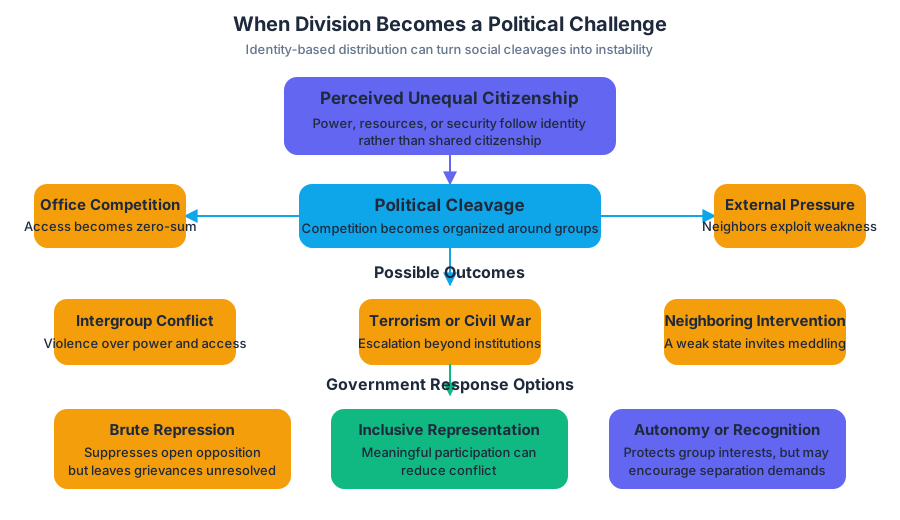
When division becomes a political challenge
A cleavage becomes especially destabilizing when citizens believe that political power, public resources, or security are distributed according to identity rather than shared citizenship. Possible outcomes include competition for offices, intergroup conflict, terrorism, civil war, or intervention by neighboring states that perceive a weak or vulnerable government.
Governments have several broad response options. At one extreme is brute repression, which may suppress open opposition without resolving the underlying grievance. Other governments recognize ethnic or religious minorities, create autonomous regions, or provide representation in governmental institutions. These strategies can reduce conflict when groups view participation as meaningful, but they can also formalize identities and encourage further demands for separation.
Nigeria and Mexico: why colonial history matters
Ethnicity is generally a more potent political force in Nigeria than in Mexico because colonial history politicized identity differently. Nigeria’s colonial experience consolidated many distinct ethnic and regional communities within one state while leaving political competition strongly connected to group identity. As a result, ethnic affiliations can shape voting behavior, access to informal networks, and struggles over state resources.
Mexico also contains ethnic and regional differences, but national political institutions and a long period of dominant-party rule historically organized more political competition around national parties and regime structures than around ethnicity alone. The comparison demonstrates an important rule: the existence of an identity difference does not automatically determine its political impact; institutions and historical experiences help convert social difference into political cleavage.
Misconception check: “A country with more ethnic groups must have more ethnic conflict.”
Not necessarily. Conflict depends on politicization, institutional representation, resource competition, and government responses—not simply on the number of identities present.
Russia and the United Kingdom: different routes to stability
Russia illustrates how a government may manage cleavages through centralized authority, selective accommodation, and repression. Regional, ethnic, and religious divisions can challenge the state when groups demand greater autonomy or reject central control. A government may preserve short-term stability by restricting opposition, but repression can weaken legitimacy if citizens interpret state power as coercion rather than rightful authority.
The United Kingdom shows a different pattern. Scottish, English, Welsh, and Irish identities, along with Protestant-Catholic divisions in Northern Ireland and racial tensions connected to colonial history, have influenced party competition and demands for territorial autonomy. Devolution and representation can acknowledge distinct identities while keeping them inside the state’s political system. Institutional recognition may therefore strengthen legitimacy by making citizenship appear more inclusive.
New pressures: migration and economic liberalization
Demographic change and migration can deepen preexisting cleavages. New migration patterns may intensify debates over national identity, religion, employment, public services, and citizenship. Political actors can mobilize these concerns into support for exclusionary parties or policies, especially when economic insecurity makes groups more receptive to identity-based explanations.
Economic liberalization—policies such as privatization, reduced regulation, and expanded market competition—can also reshape cleavages. It may create growth and opportunity for some groups while producing unemployment, regional inequality, or reduced social protections for others. The resulting conflict may be expressed through parties, protests, ethnic networks, or opposition to the national government.
Governments sometimes respond with welfare-state or social-protection policies. By providing income support, health care, education, or targeted assistance, the state can improve citizens’ well-being and bolster political legitimacy. However, if benefits appear to favor one ethnic, regional, or religious group, social policy may reduce one cleavage while intensifying another.
Radical religious elements and regime legitimacy
Even stable regimes can face challenges from radical or terrorist religious elements emerging from long-standing cleavages. Violence directly threatens security, but the larger political danger is legitimacy: if the government cannot protect citizens, or if its counterterrorism response appears indiscriminate, citizens may question its competence or fairness.
For an AP explanation, connect the actor, mechanism, and consequence: a radical group exploits a religious or regional division; the government responds through repression, accommodation, or representation; and that response either strengthens stability and legitimacy or produces further alienation and conflict.
In-flow retrieval check
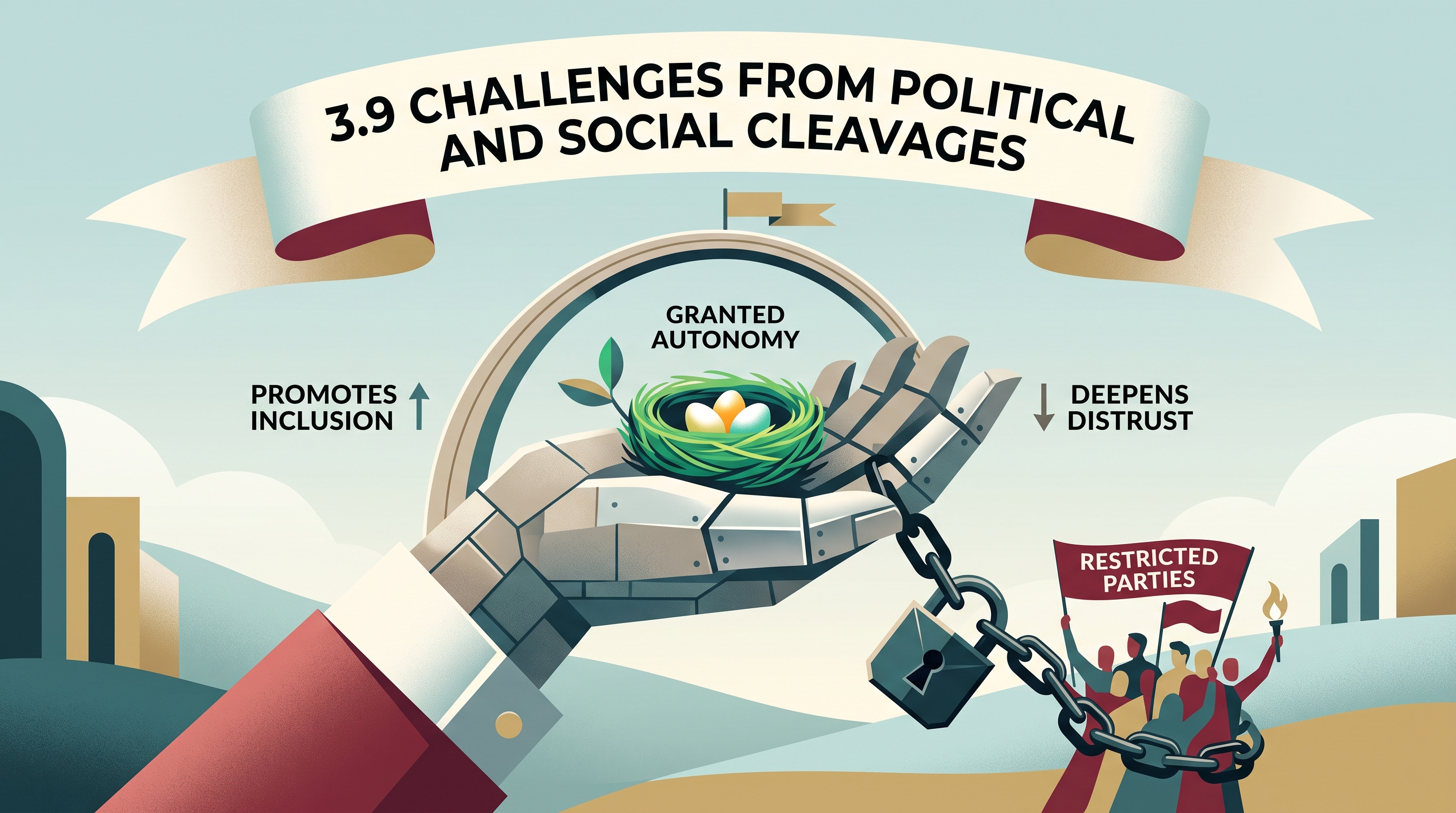
A government grants an autonomous region to a minority group but simultaneously restricts the group’s political parties. Identify one way the policy could strengthen legitimacy and one way it could undermine legitimacy. A strong answer explains the mechanism: autonomy may recognize identity and improve inclusion, while restrictions may make representation seem symbolic and deepen distrust.
AP skills and reasoning processes: This topic most directly develops Concept Application (1.A: Define and compare political concepts) through legitimacy and stability; Country Comparison (2.A: Describe and explain political concepts and processes in different countries) through Nigeria, Russia, and the United Kingdom; and Argumentation (5.A: Make a claim and support it with evidence and reasoning) by evaluating whether a state response reduces or intensifies conflict. The essential evidence is keyed to LEG-2.B.1, LEG-2.B.2, and LEG-2.B.3.
Source Materials
- AP Comparative Government and Politics Course and Exam Description
- AP Comparative Government and Politics Course and Exam Description Clarifications and Corrections
- AP Comparative Government and Politics Course Overview
- AP Comparative Government and Politics Course at a Glance
- AP Comparative Government and Politics Course at a Glance Poster
- AP Comparative Government and Politics
- AP Comparative Government and Politics
- AP Comparative Government and Politics Sample Syllabus 1