From the free course AP Comparative Government and Politics on Lykke
2.5 Removal of Executives
Key concepts: Removal of Executives · Forces
A president can lose office without losing an election, and a prime minister can fall without a national vote. Removal of executives means ending an executive’s authority before the normal end of the officeholder’s term through a constitutional or political procedure.
2.5 Removal of Executives
A president can lose office without losing an election, and a prime minister can fall without a national vote. Removal of executives means ending an executive’s authority before the normal end of the officeholder’s term through a constitutional or political procedure. The central question is not simply who leads, but who has the power to force that leader out—and under what conditions?
The removal toolkit
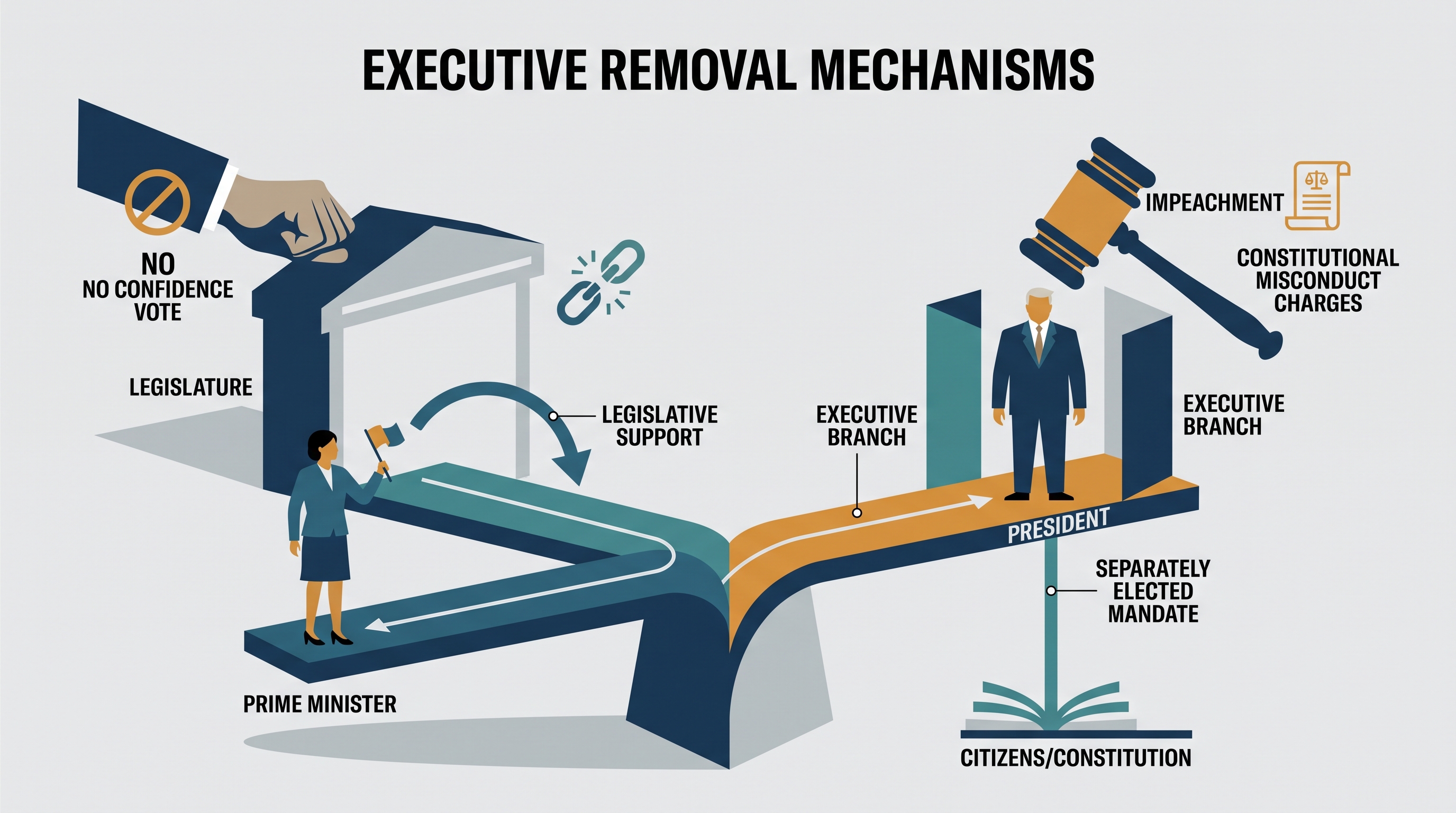
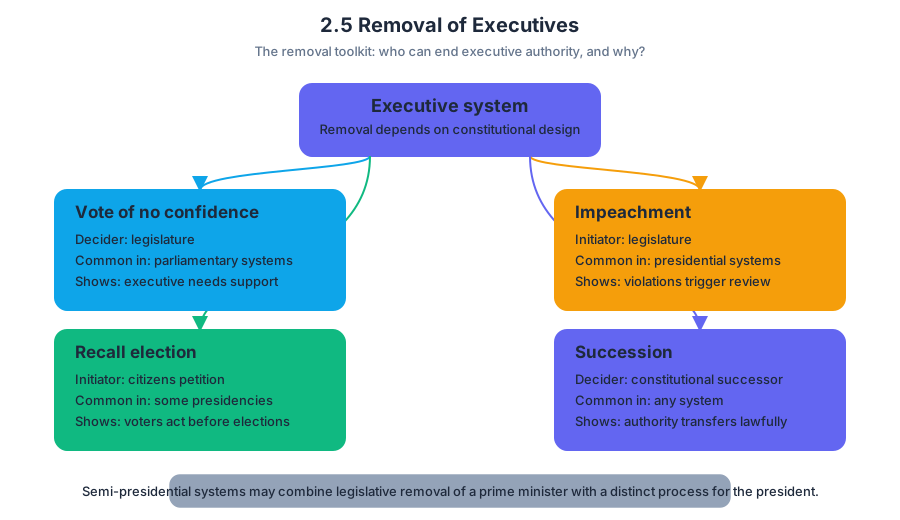
The mechanism depends heavily on the executive system. In a parliamentary system, the executive usually depends on legislative confidence; in a presidential system, the executive normally has a separately defined term and cannot be removed merely because legislators dislike a policy. Semi-presidential systems combine these possibilities: a prime minister may be vulnerable to legislative removal while a president faces a distinct constitutional process.
| Removal mechanism | Who initiates or decides? | Most associated with | What it demonstrates |
|---|---|---|---|
| Vote of no confidence | Legislature | Parliamentary systems | The executive must retain legislative support |
| Impeachment | Legislature, often with judicial or upper-chamber involvement | Presidential systems | Constitutional violations can trigger formal removal |
| Recall election | Citizens through a petition and vote | Some presidential or subnational systems | Voters can terminate an official before the next election |
| Succession | Constitutional successor or designated institution | Any system | Authority transfers when an executive resigns, dies, or is removed |
Learning Objective 2.5.A — Explain how executives can be removed from office.
Essential Knowledge 2.5.A.1: Executives can be removed through constitutional procedures, including legislative votes of no confidence, impeachment processes, and recall elections. These procedures differ in their legal thresholds, political actors, and consequences for the broader political system.
Parliamentary removal: confidence is the hinge
In a parliamentary system, the prime minister and cabinet are politically connected to the legislature. A vote of no confidence is a legislative decision declaring that the government no longer has sufficient support to continue. If the motion passes, the prime minister may resign, a new government may be formed from the existing legislature, or parliament may be dissolved and new elections held, depending on the constitution.
Worked example — the United Kingdom: Imagine the government loses the support of enough members of the House of Commons that an opposition motion of no confidence succeeds. The prime minister cannot simply insist on completing a fixed presidential-style term. The government must respond through resignation, the formation of an alternative government, or an election under the applicable rules. The removal mechanism therefore reinforces legislative accountability: executive survival depends on maintaining a parliamentary majority or governing coalition.
Presidential removal: a formal constitutional breach
In a presidential system, the president usually receives an independent electoral mandate and serves a constitutionally specified term. Legislators therefore cannot ordinarily remove the president through an ordinary disagreement over legislation. Impeachment is a formal accusation that the executive committed serious constitutional or legal wrongdoing; it is not automatically the same as removal. A legislature may impeach, but another institution—often a senate or constitutional court—may conduct the trial or make the final determination.
Worked example — Nigeria: Nigeria’s president operates within a presidential system in which removal is tied to a constitutional process rather than an ordinary parliamentary confidence vote. The legislature must follow formal steps and meet a high threshold. This design makes removal possible when grave misconduct is alleged while making it difficult for a temporary legislative majority to overturn the result of a presidential election.
Recall: direct popular removal
A recall election allows citizens to petition for a vote on whether an elected executive should leave office before the regular election date. Recall differs from impeachment because the decisive actor is the electorate rather than the legislature. It also differs from a regular election because it is triggered during the official’s current term and focuses on early termination rather than routine succession.
Why removal rules matter
Removal procedures balance two competing goals. Accountability requires a way to punish abuse of power, corruption, or serious constitutional violations. Stability requires protection against constant attempts to remove an executive whenever opponents lose a policy dispute. A low threshold may encourage legislative responsiveness but produce unstable governments; a high threshold may protect continuity but allow an executive to remain in office despite declining legitimacy.
Practice 2: Country Comparison
Practice 2: Country Comparison is assessed when you identify a relevant similarity or difference between countries and explain it with accurate political reasoning. Compare the United Kingdom and Nigeria: a successful no-confidence vote can directly threaten the United Kingdom’s prime minister because the government depends on parliamentary support, whereas Nigeria’s president is protected by a fixed presidential mandate and requires a formal constitutional removal process. The strongest comparison names the mechanism, identifies the institutional difference, and explains the causal connection.
Key insight: Removal rules reveal where executive authority comes from. If authority depends on the legislature, legislative confidence is central; if authority comes from a separately elected mandate, removal usually requires a special constitutional threshold.
Misconception check
Misconception: “Impeachment means the executive has been removed.”
Correction: impeachment is generally the charging or accusing stage. Removal requires the next constitutionally required decision, such as conviction by a legislative chamber or judgment by another authorized institution. Also avoid treating every resignation as impeachment: an executive may resign because of scandal, coalition collapse, protest, or declining support without completing a formal removal proceeding.
Retrieval check
A prime minister loses a legislative confidence vote, while a president is accused of serious constitutional misconduct. Which removal mechanism best fits each case, and why would applying the parliamentary mechanism to the president produce an inaccurate comparison? A complete answer identifies no confidence for the prime minister, impeachment for the president, and connects the difference to parliamentary dependence versus a separately elected presidential mandate.
Source Materials
- AP Comparative Government and Politics Course and Exam Description
- AP Comparative Government and Politics Course and Exam Description Clarifications and Corrections
- AP Comparative Government and Politics Course Overview
- AP Comparative Government and Politics Course at a Glance
- AP Comparative Government and Politics Course at a Glance Poster
- AP Comparative Government and Politics
- AP Comparative Government and Politics
- AP Comparative Government and Politics Sample Syllabus 1