From the free course AP Comparative Government and Politics on Lykke
AP Practice 3
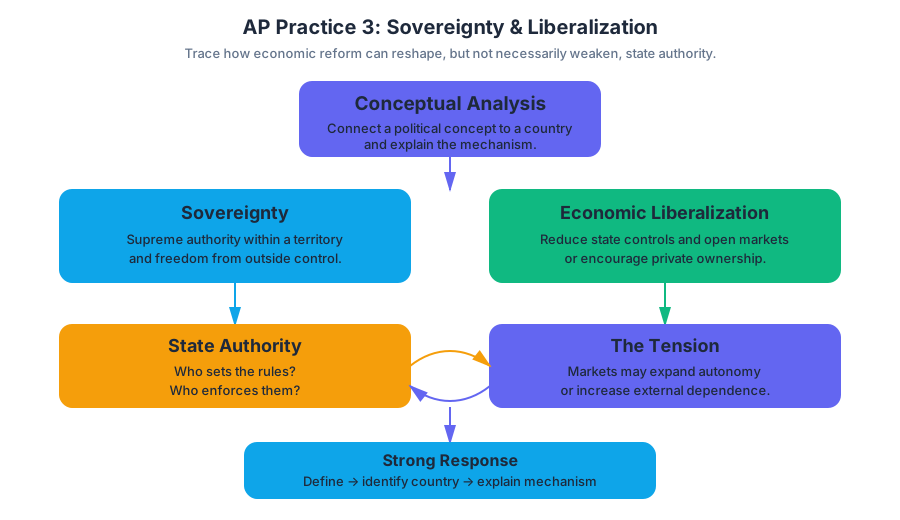
A government can liberalize its economy—reducing state controls, opening markets, or encouraging private ownership—while still trying to preserve sovereignty, the state’s supreme authority to govern its territory and make decisions without being controlled by another state.
AP Practice 3
A government can liberalize its economy—reducing state controls, opening markets, or encouraging private ownership—while still trying to preserve sovereignty, the state’s supreme authority to govern its territory and make decisions without being controlled by another state. That tension makes sovereignty and economic liberalization an excellent Conceptual Analysis task: the strongest responses do not merely define terms; they connect a political concept to a specific country and explain a mechanism.
Task profile: Conceptual Analysis
This original, unofficial practice question models one current AP Comparative Government and Politics free-response task type. Allow about 20 minutes. The task rewards precise concept application, country-specific knowledge, and explanations that show how or why a relationship exists.
Core scoring habit: A description tells what happened. An explanation identifies the political process that connects the event to the concept.
Original practice prompt
Use China as the country context.
A. Define sovereignty.
B. Describe one way a government can demonstrate sovereignty while participating in the global economy.
C. Explain how economic liberalization can create a challenge for state sovereignty.
D. Explain one reason a government might pursue economic liberalization even when it could create that challenge.
Pause here before reading the model response. For each part, underline the task verb: define, describe, or explain. The verb determines the kind of evidence the examiner needs.
Worked response with rubric logic
A. Define sovereignty.
Sovereignty is the supreme authority of a state to make and enforce decisions within its territory and to conduct its affairs without being subject to another state’s control.
Why this earns the point: The definition identifies both dimensions that make the concept politically meaningful: authority inside the territory and independence from external control. A vague answer such as “having power” is insufficient because it could describe a political party, legislature, or individual leader rather than a state.
China can demonstrate sovereignty by deciding for itself which foreign companies may operate in China and what regulations those companies must follow. For example, the Chinese government can require firms to comply with national rules on investment, data, or market access.
Why this earns the point: The response gives one concrete action by a government. It does not merely state that China is “powerful” or “independent”; it identifies a visible policy choice showing that the state controls access to its own economy.
Economic liberalization can allow foreign companies, international lenders, or global markets to influence domestic economic decisions. If China becomes dependent on foreign investment or export markets, government leaders may face pressure to change regulations or policies in ways that protect investor confidence rather than fully reflecting domestic priorities. The challenge arises because external economic actors gain leverage over choices that the state would otherwise make independently.
Why this earns the point: This is a causal chain:
$$ \text{liberalization} \rightarrow \text{greater external economic influence} \rightarrow \text{pressure on domestic policy} \rightarrow \text{reduced policy autonomy} $$
The answer explains a mechanism rather than claiming that liberalization automatically destroys sovereignty. That distinction matters: sovereignty may be constrained without disappearing.
China might pursue economic liberalization to attract investment, expand production, and increase economic growth. Higher growth can create jobs and raise government revenue, which may strengthen the state’s capacity to provide services and maintain political stability. Therefore, leaders may accept some external economic influence because the material benefits can reinforce the government’s authority at home.
Why this earns the point: The response identifies a reason and explains its political consequence. It does not stop at “economic growth”; it connects growth to jobs, revenue, state capacity, and stability.
Examiner-rewarded reasoning
A high-scoring response consistently moves from concept → country action → mechanism → consequence. The most common weak pattern is concept-dropping: mentioning China, sovereignty, and globalization in the same paragraph without explaining how one affects another.
| Task verb | What the response must do | Common failure |
|---|---|---|
| Define | State the essential meaning of the concept | Giving an example instead of a definition |
| Describe | Identify or characterize one specific action or feature | Offering a broad claim with no concrete action |
| Explain | Establish a causal or logical connection | Repeating the prompt or using “because” without a mechanism |
This practice develops Disciplinary Practice 1: Concept Application, Disciplinary Practice 2: Country Comparison when multiple cases are used, and Disciplinary Practice 5: Argumentation when a claim is supported with reasoning. It also reinforces the AP reasoning process of distinguishing related concepts: economic influence is not identical to foreign control, and a challenge to sovereignty is not necessarily the loss of sovereignty.
Timing and error review
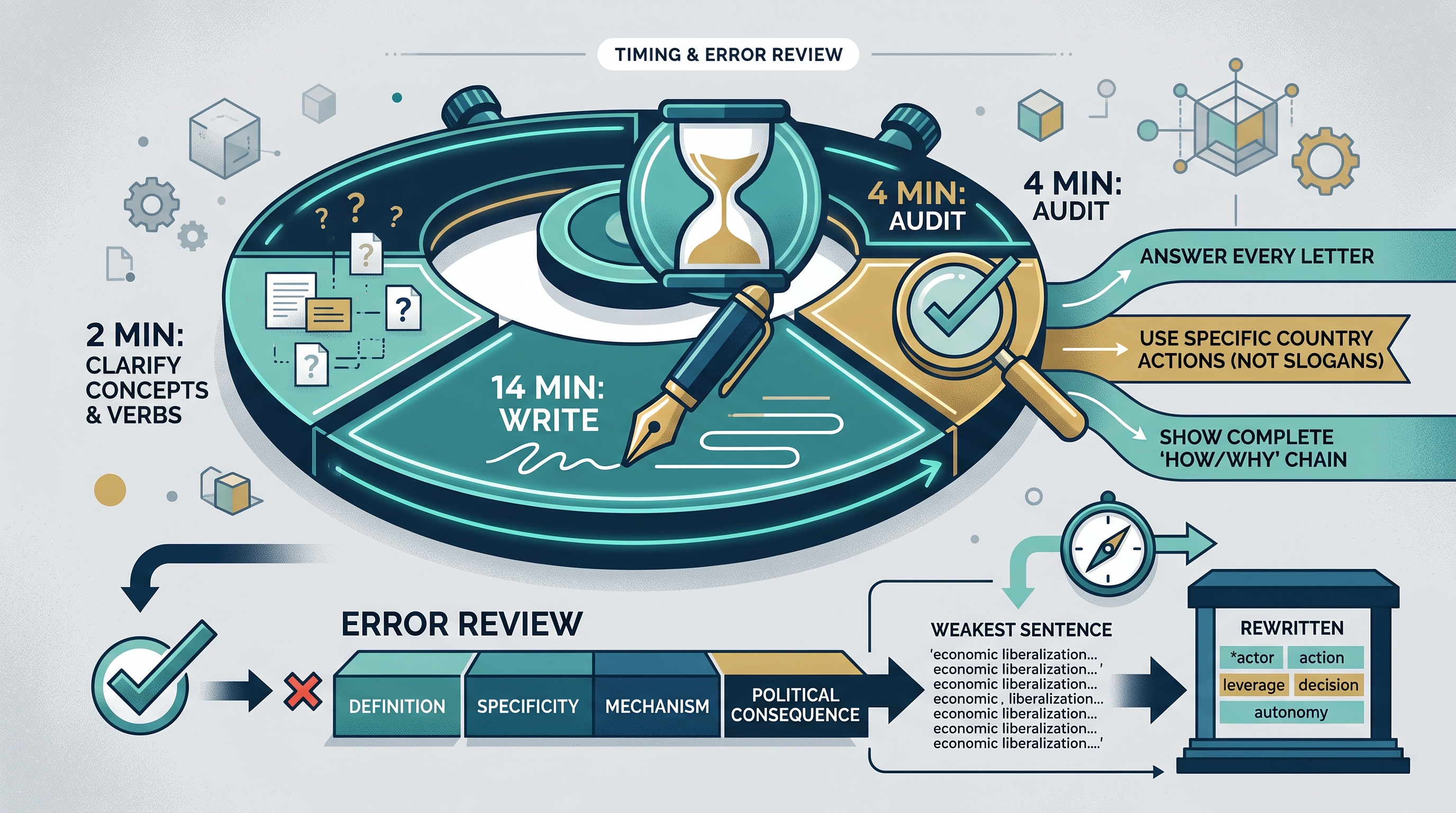
Use the first 2 minutes to identify the concepts and task verbs, 14 minutes to write, and 4 minutes to audit. During the audit, ask three questions:
- Did I answer every lettered part?
- Did I use a specific country action rather than a slogan?
- Did every explanation show a complete how or why chain?
For error review, label each missed point as definition, specificity, mechanism, or political consequence. Rewrite only the weakest sentence, adding the missing link. If your sentence says “economic liberalization affects sovereignty,” revise it to state which actor gains leverage, what decision is pressured, and why that changes state autonomy.
Source Materials
- AP Comparative Government and Politics Course and Exam Description
- AP Comparative Government and Politics Course and Exam Description Clarifications and Corrections
- AP Comparative Government and Politics Course Overview
- AP Comparative Government and Politics Course at a Glance
- AP Comparative Government and Politics Course at a Glance Poster
- AP Comparative Government and Politics
- AP Comparative Government and Politics
- AP Comparative Government and Politics Sample Syllabus 1
- AP Comparative Government and Politics-AP Students-College Board
- AP Comparative Government and Politics-Wikipedia
- AP Comparative Government and Politics Cheat <http://sheets-albert.io>Sheets-Albert.io
- AP Comparative Government and Politics-GOA