From the free course AP Comparative Government and Politics on Lykke
4.3 Political Party Systems
Key concepts: Political party systems · Proportional representation · Multiparty systems · Political party representation in legislatures · Degree of competition · Party structure · Laws regulating political parties · Citizen participation · Political movements · National Electoral Institute (IFE)
A legislature can contain dozens of registered parties yet still be dominated by only two powerful organizations. Nigeria illustrates this distinction: its multiparty system includes about 30 registered parties, but the People’s Democratic Party (PDP) and the All Progressives Congress (APC) have historically been…
4.3 Political Party Systems
A legislature can contain dozens of registered parties yet still be dominated by only two powerful organizations. Nigeria illustrates this distinction: its multiparty system includes about 30 registered parties, but the People’s Democratic Party (PDP) and the All Progressives Congress (APC) have historically been the strongest competitors. The key question is therefore not simply how many parties exist, but how parties compete, win representation, organize citizens, and share governmental power.
What makes a political party system?
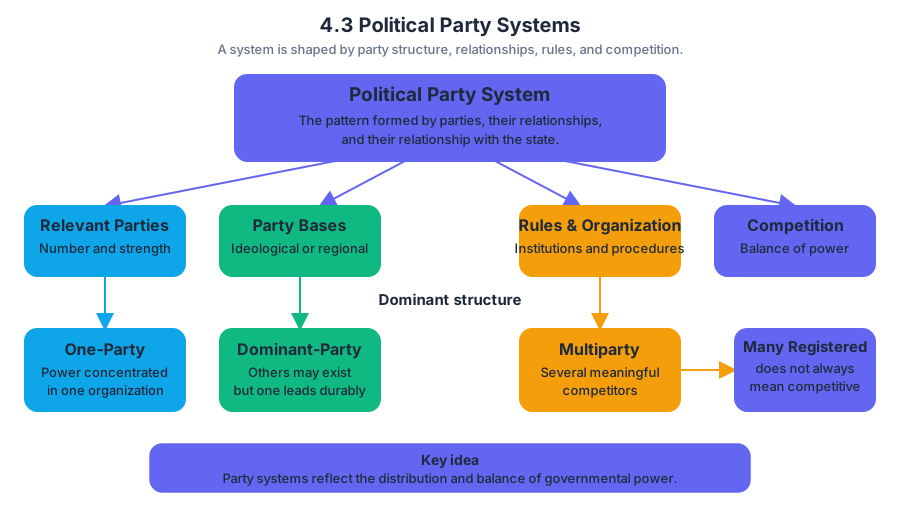
A political party system is the pattern formed by the parties that operate in a country and by their relationships with one another and with the state. It includes the number of relevant parties, their ideological or regional bases, their organization, the rules governing them, and the degree of competition among them.
Political party systems reflect the distribution and balance of governmental power.
A one-party system concentrates political power in a single organization. A dominant-party system permits other parties to exist but gives one party a durable advantage. A multiparty system contains several meaningful competitors, although those parties may not possess equal strength. A system with many registered parties can therefore be less competitive than its label suggests.
Representation: why proportional representation matters
Proportional representation is an electoral arrangement in which legislative seats are allocated approximately according to each party’s share of the vote. If a party receives about $20%$ of the vote, it may receive roughly $20%$ of the seats, subject to the country’s specific rules and any electoral threshold.
Because proportional representation can translate smaller vote shares into legislative seats, it can increase the number of political parties represented in a national legislature. By contrast, winner-take-all rules often reward the leading candidate in each district and can make it difficult for smaller parties to gain seats even when they receive substantial support across the country.
Worked example: Imagine a legislature with $100$ seats. Under proportional representation, Party A wins $45%$ of the vote, Party B wins $35%$, and Party C wins $20%$. A plausible result is approximately $45$, $35$, and $20$ seats. Party C becomes part of lawmaking rather than remaining merely an unsuccessful electoral movement.
The important distinction is between votes received and seats won. A party may attract citizens but gain little institutional influence if electoral rules convert its support inefficiently. Political institutions and electoral rules therefore shape both political competition and accountability: voters have more meaningful alternatives when parties can realistically win representation, while governing parties face greater pressure when opposition parties can scrutinize and challenge them.
Competition inside multiparty systems
The degree of competition describes how seriously parties can challenge one another for votes, legislative seats, and control of government. A country may have many parties on the ballot but limited competition if one organization controls state resources, media access, electoral administration, or the rules of participation.
Nigeria provides a useful comparison. Its many registered parties create formal choice, but the presence of two strong parties—the PDP and APC—means that competition is concentrated around major organizations. Smaller parties may represent particular communities or viewpoints without having a realistic path to national power.
Competition affects representation and formal political participation—participation through voting, campaigning, party membership, and candidacy. Strong competition can motivate citizens to vote because electoral outcomes appear consequential. Weak competition can produce withdrawal, especially when citizens believe that opposition parties cannot overcome structural advantages held by the dominant organization.
Misconception check: “A multiparty system is automatically highly democratic.”
Not necessarily. Multiparty describes the number of parties, not the fairness of competition. The decisive issue is whether parties can organize, campaign, obtain votes, and convert those votes into political influence.
Party structure, regulation, and citizen participation
Party structure refers to how a party is organized: who selects candidates, how leaders communicate with local branches, how members participate, and whether decision-making is centralized or internally democratic. Laws regulating political parties may govern registration, campaign finance, ballot access, party membership, advertising, and reporting requirements.
These arrangements influence whether citizens can participate effectively. A party with strong local branches may mobilize voters and connect community concerns to national leaders. A highly centralized party may coordinate campaigns efficiently but give ordinary members little influence over candidates or policies.
Political movements can face two separate obstacles. First, they may struggle to attract and mobilize support among fellow citizens. Second, even after building public support, they may struggle to negotiate with governmental representatives if they lack seats, legal recognition, funding, or access to decision makers.
Mexico’s National Electoral Institute (IFE) is an example of an electoral institution associated with organizing and strengthening electoral competition. An electoral institution can affect party systems by setting registration procedures, supervising elections, and helping establish rules under which parties compete. Its importance depends on how independently and effectively it performs those functions.
Comparative reasoning in one glance
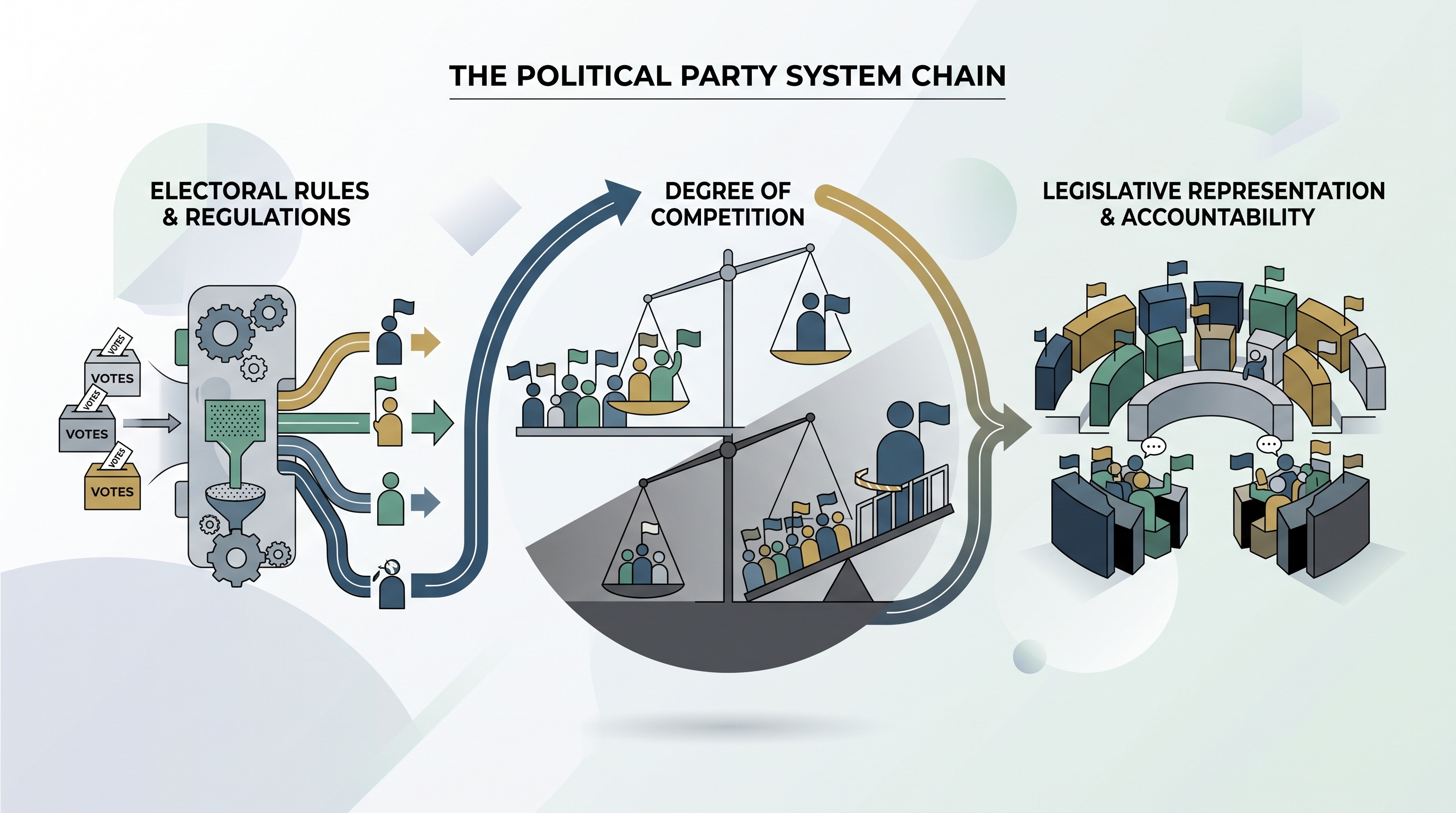
To analyze a party system, connect three layers rather than naming a system and stopping:
| Layer | Question to ask | Political consequence |
|---|---|---|
| Electoral rules | How are votes converted into seats? | Smaller parties may gain or lose representation. |
| Party structure and regulation | Who may organize, compete, and participate? | Citizen influence and accountability may expand or contract. |
| Competition | Can opposition parties realistically challenge governing parties? | Governmental power may be more balanced—or concentrated. |
This is the central analytical chain: rules shape competition; competition shapes representation; representation shapes accountability and participation. The same formal label—“multiparty system”—can therefore describe very different political realities.
Retrieval check: A country has 30 registered parties, but one party controls most legislative seats and opposition parties face severe barriers to campaigning. Is the system multiparty? Yes. Is it highly competitive? Not necessarily. Explain your answer using party number, degree of competition, and legislative representation.

Source Materials
- AP Comparative Government and Politics Course and Exam Description
- AP Comparative Government and Politics Course and Exam Description Clarifications and Corrections
- AP Comparative Government and Politics Course Overview
- AP Comparative Government and Politics Course at a Glance
- AP Comparative Government and Politics Course at a Glance Poster
- AP Comparative Government and Politics
- AP Comparative Government and Politics
- AP Comparative Government and Politics Sample Syllabus 1
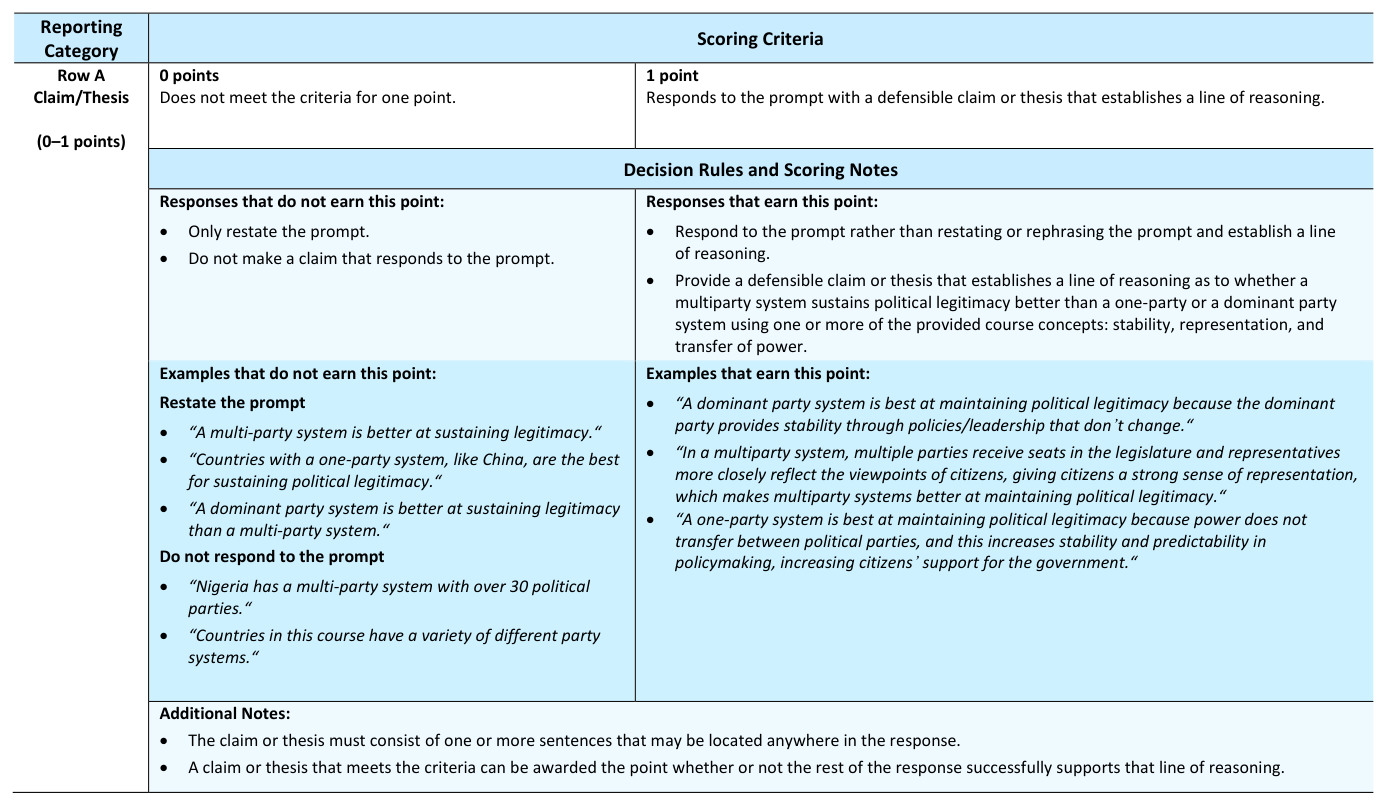
- Figure — Sample Responses Q4 - Set 1 (p. 2)
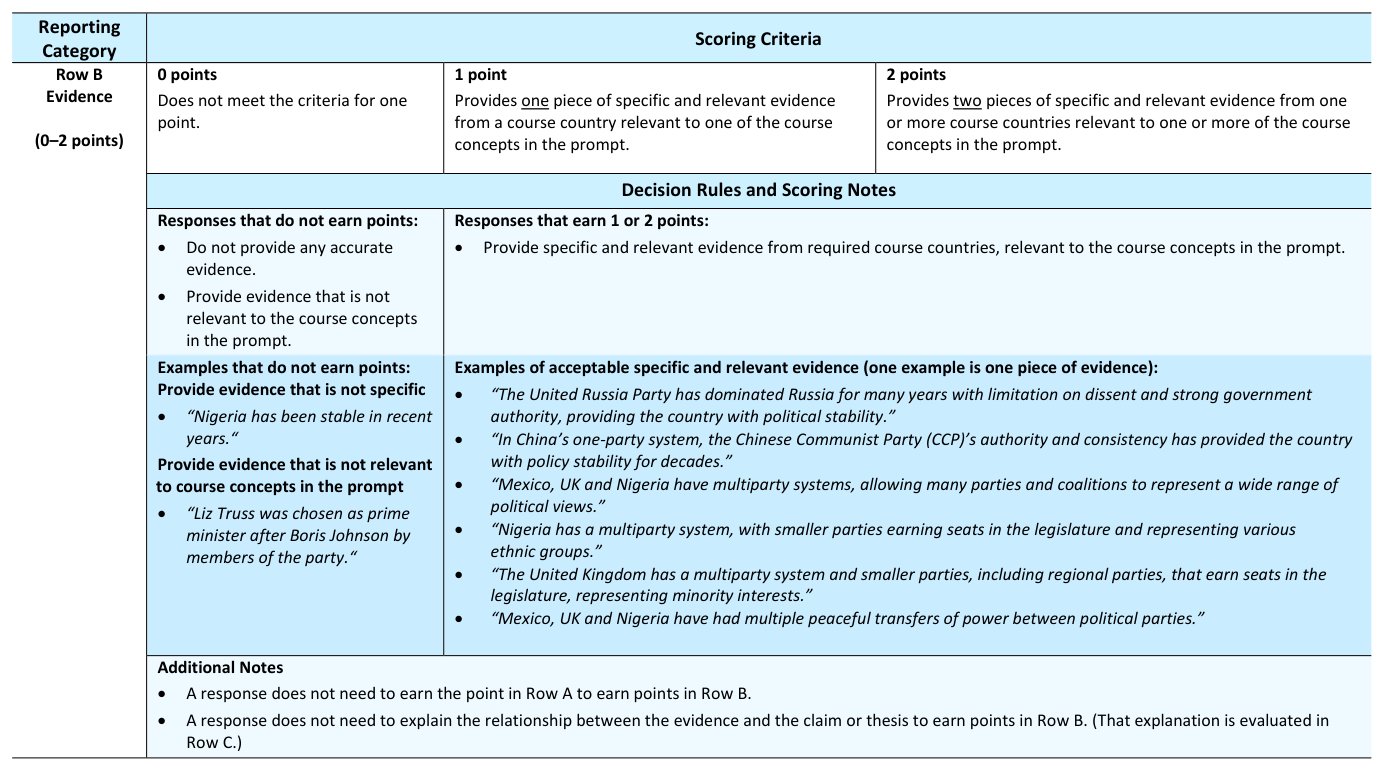
- Figure — Sample Responses Q4 - Set 1 (p. 3)
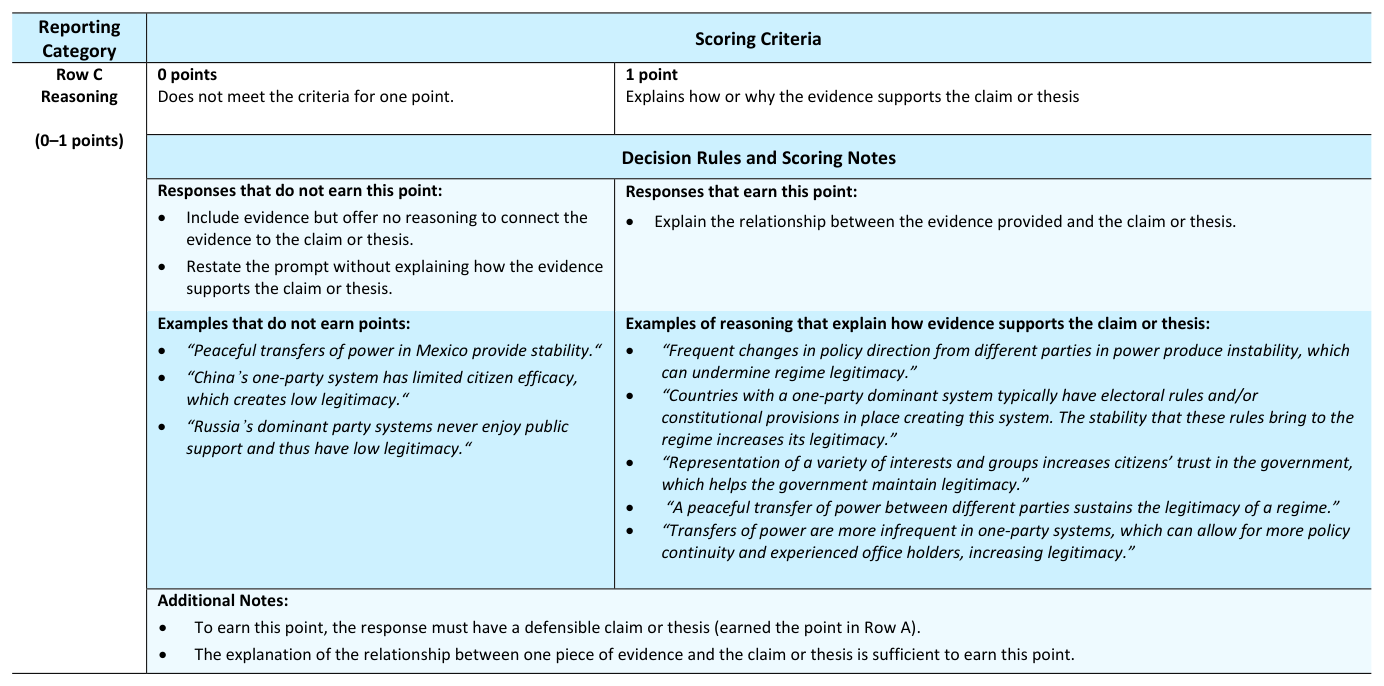
- Figure — Sample Responses Q4 - Set 1 (p. 4)
- Figure — Sample Responses Q4 - Set 1 (p. 5)