From the free course AP Comparative Government and Politics on Lykke
3.2 Political Culture
Key concepts: Political Culture · Political Culture and Participation · Political Socialization · Citizen Behavior · The State · Political Systems
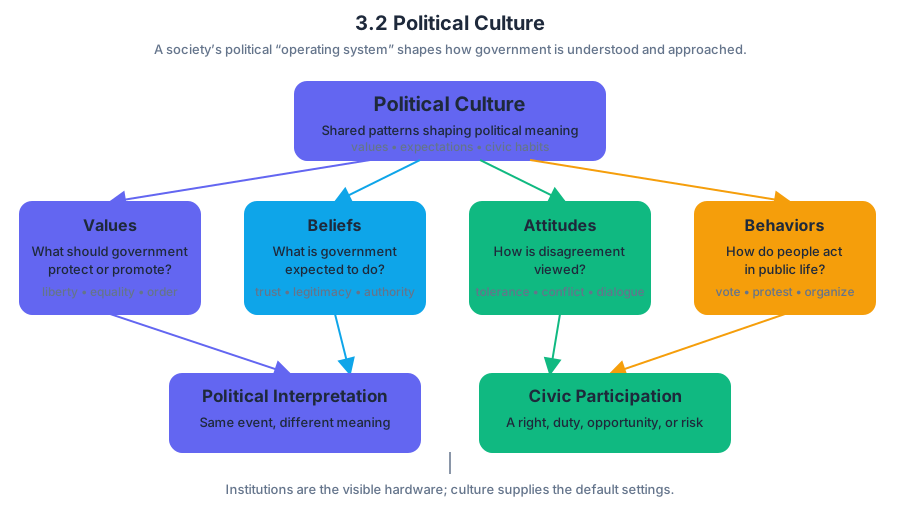
Political culture is the pattern of political values, beliefs, attitudes, and behaviors that shapes how people understand government and decide whether—and how—to participate in politics.
3.2 Political Culture
Political culture is the pattern of political values, beliefs, attitudes, and behaviors that shapes how people understand government and decide whether—and how—to participate in politics. Two citizens may face the same election, law, or protest but interpret it differently because their political cultures teach them different expectations about authority, rights, and civic responsibility.
A useful analogy is a society’s political “operating system.” Formal institutions are the visible hardware—constitutions, legislatures, courts, and executives—but political culture supplies many of the default settings: whether citizens expect government to listen, whether disagreement is viewed as legitimate, and whether political participation feels like a right, a duty, or a risk.
Political socialization: how political culture is learned
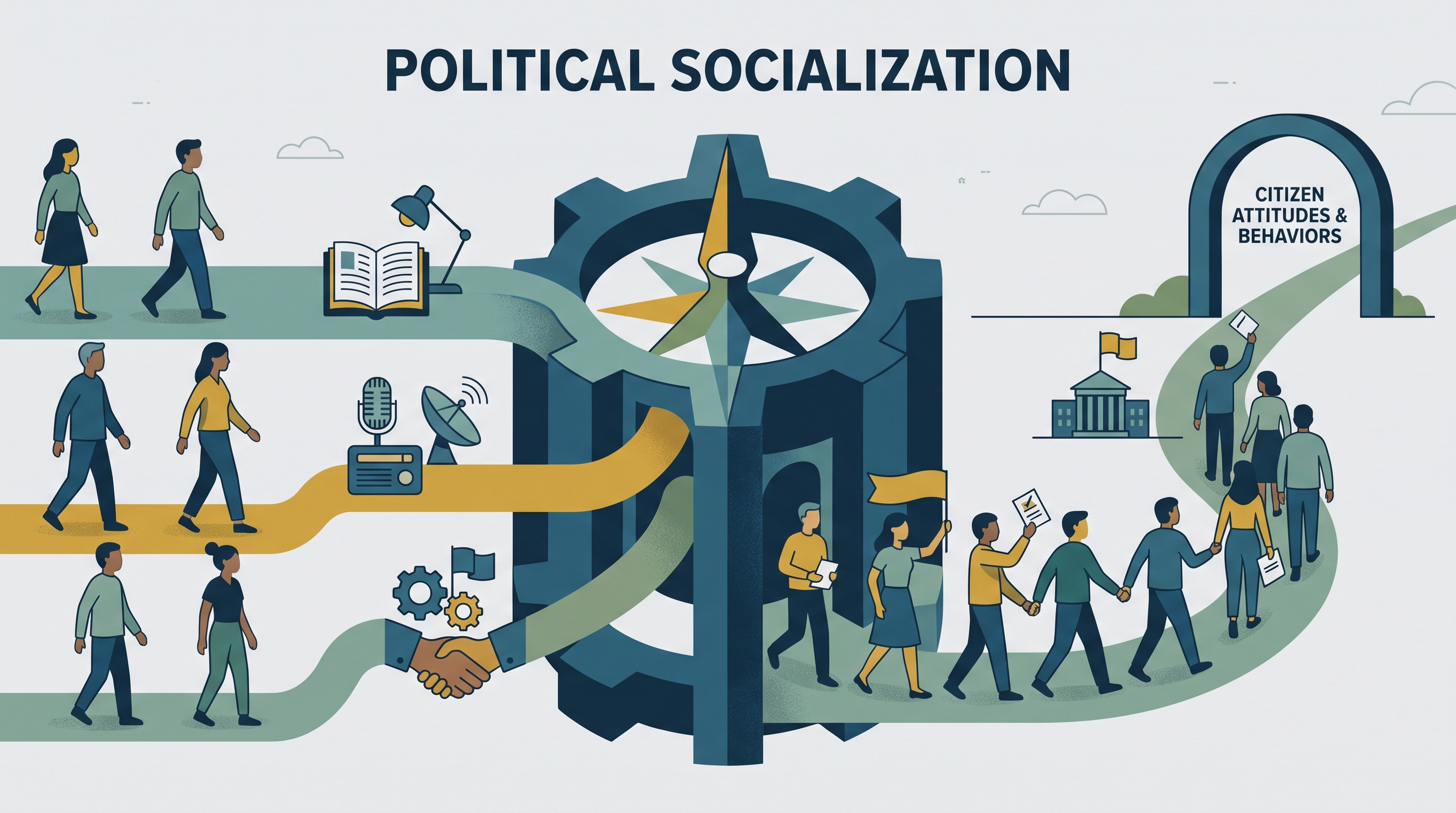
Political socialization is the process through which individuals develop political values, beliefs, attitudes, and behaviors. It explains how political culture connects to both citizen behavior and the state: people learn what government is, what it should do, and how they should respond to it.
The major agents of political socialization include family, schools, peers, media, religion, and government. These agents do not necessarily communicate the same message. A family may emphasize obedience, a school may stress constitutional rights, peers may normalize protest, and media may portray government as either protective or corrupt.
| Agent | Political messages it may transmit | Possible behavioral effect |
|---|---|---|
| Family | Trust, loyalty, obedience, or skepticism | Support for or distrust of authorities |
| Schools | Civic duties, national identity, rights | Voting, civic engagement, or conformity |
| Peers | Group expectations and shared grievances | Protest, activism, or political withdrawal |
| Media | Narratives about leaders and institutions | Opinion formation and agenda-setting |
| Religion | Moral duties and social priorities | Support for policies or movements |
| Government | Ideology, national identity, acceptable conduct | Compliance, participation, or fear |
The agents exist in both democratic and authoritarian regimes, but the state’s role differs. In a democratic regime, schools and government may promote constitutional values while citizens retain space for competing beliefs. In an authoritarian regime, the government may take a more concerted role in directing education, media, public symbols, and political messaging so that citizens’ beliefs conform to the state’s ideology.
Political culture and participation
Political culture is connected to political participation, meaning the ways citizens attempt to influence government. Participation can include voting, joining parties or interest groups, contacting officials, attending demonstrations, discussing politics, or supporting government campaigns. The same action can have different meanings in different political systems.
For example, imagine two governments organizing a large public rally. In a democratic system, attendance might reflect voluntary support, party mobilization, or organized civil society. In an authoritarian system, attendance might demonstrate genuine approval, but it could also result from state pressure, employment requirements, or fear of appearing disloyal. Therefore, visible participation does not automatically prove that citizens freely support the regime.
Key distinction: Political participation measures what citizens do; political culture helps explain why they do it and what they believe participation means.
Worked contextual example: Suppose a government introduces a national service program. In a society where political culture emphasizes collective responsibility, citizens may interpret service as a civic duty and participate willingly. In a society shaped by distrust of government, citizens may view the same program as coercive and resist it. The policy is identical, but political socialization produces different citizen responses.
Applying the concept to political systems
To apply political culture to a political system, trace a three-step relationship:
$$ \text{Agents of socialization} \rightarrow \text{Political beliefs} \rightarrow \text{Citizen behavior and state legitimacy} $$
A state that successfully socializes citizens into accepting its authority may gain compliance and political stability. However, political socialization is not permanent or uniform. Economic crisis, generational change, new media, migration, repression, or exposure to alternative ideas can alter political attitudes and produce new forms of participation.
Misconception check
Misconception: “High participation means a government is democratic.” Not necessarily. Authoritarian regimes may permit, encourage, or compel mass political participation, while restricting meaningful competition, dissent, or independent organization. The key question is whether participation is voluntary and capable of influencing political decisions—not merely whether many people appear politically active.
AP skill connection and retrieval check
This topic develops Concept Application, especially 1.A: Describe concepts and processes and 1.E: Explain how political systems, principles, institutions, processes, policies, and behaviors apply in a course country. A strong response defines political socialization, identifies an agent, and explains the resulting effect on behavior within a specific political system rather than merely naming a country.
Retrieval check: A government controls school curricula, state media, and youth organizations to promote loyalty, while opposition groups are discouraged from organizing. Identify the process involved, name two agents of political socialization, and explain one likely effect on citizen behavior. A complete answer should connect political socialization to a political attitude or behavior and then to the regime’s effort to sustain authority.
Source Materials
- AP Comparative Government and Politics Course and Exam Description
- AP Comparative Government and Politics Course and Exam Description Clarifications and Corrections
- AP Comparative Government and Politics Course Overview
- AP Comparative Government and Politics Course at a Glance
- AP Comparative Government and Politics Course at a Glance Poster
- AP Comparative Government and Politics
- AP Comparative Government and Politics
- AP Comparative Government and Politics Sample Syllabus 1