From the free course AP Comparative Government and Politics on Lykke
5.8 Causes and Effects of Demographic Change
Key concepts: Demographic change · Political causes of demographic change · Political consequences of demographic change · Environmental consequences of climate change · Conflict · Nigeria · Economic development · Unit 5: Political and Economic Changes and Development · Enduring Understanding LEG-4 · Defensible claims and lines of reasoning
Demographic change is a shift in the size, distribution, or composition of a population over time. A population may grow, shrink, move from rural to urban areas, or cross national borders; each change alters the demands placed on government.
5.8 Causes and Effects of Demographic Change
Demographic change is a shift in the size, distribution, or composition of a population over time. A population may grow, shrink, move from rural to urban areas, or cross national borders; each change alters the demands placed on government.
Enduring Understanding LEG-4: Demographic changes have political causes and consequences, and they can present challenges to a government’s legitimacy.
From population movement to political pressure
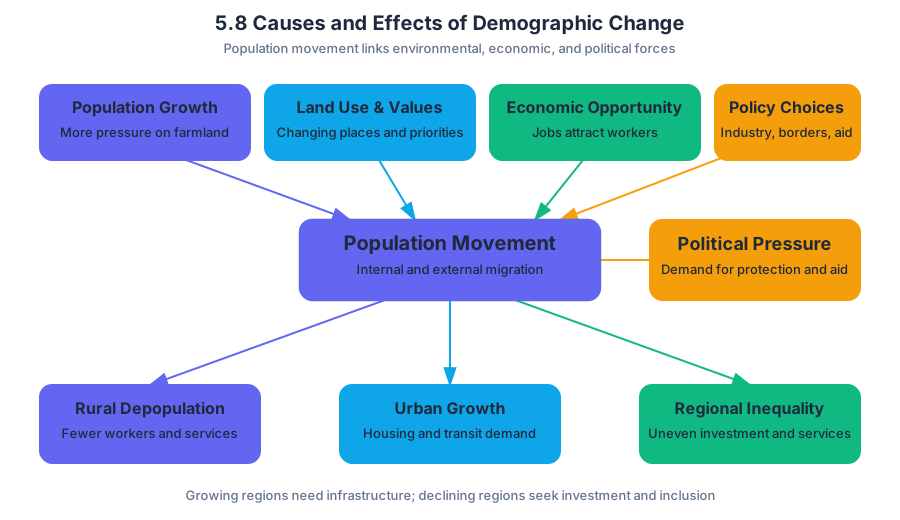
People do not move randomly. LEG-4.A.1 identifies growing populations, changing land use and values, and economic opportunities as causes of internal and external population movement. For example, a growing population may place pressure on farmland, while expanding employment in a city attracts workers from rural areas. The result can be rural depopulation, urban growth, changing migration rates, and greater demands for housing, transportation, schools, health care, and employment.
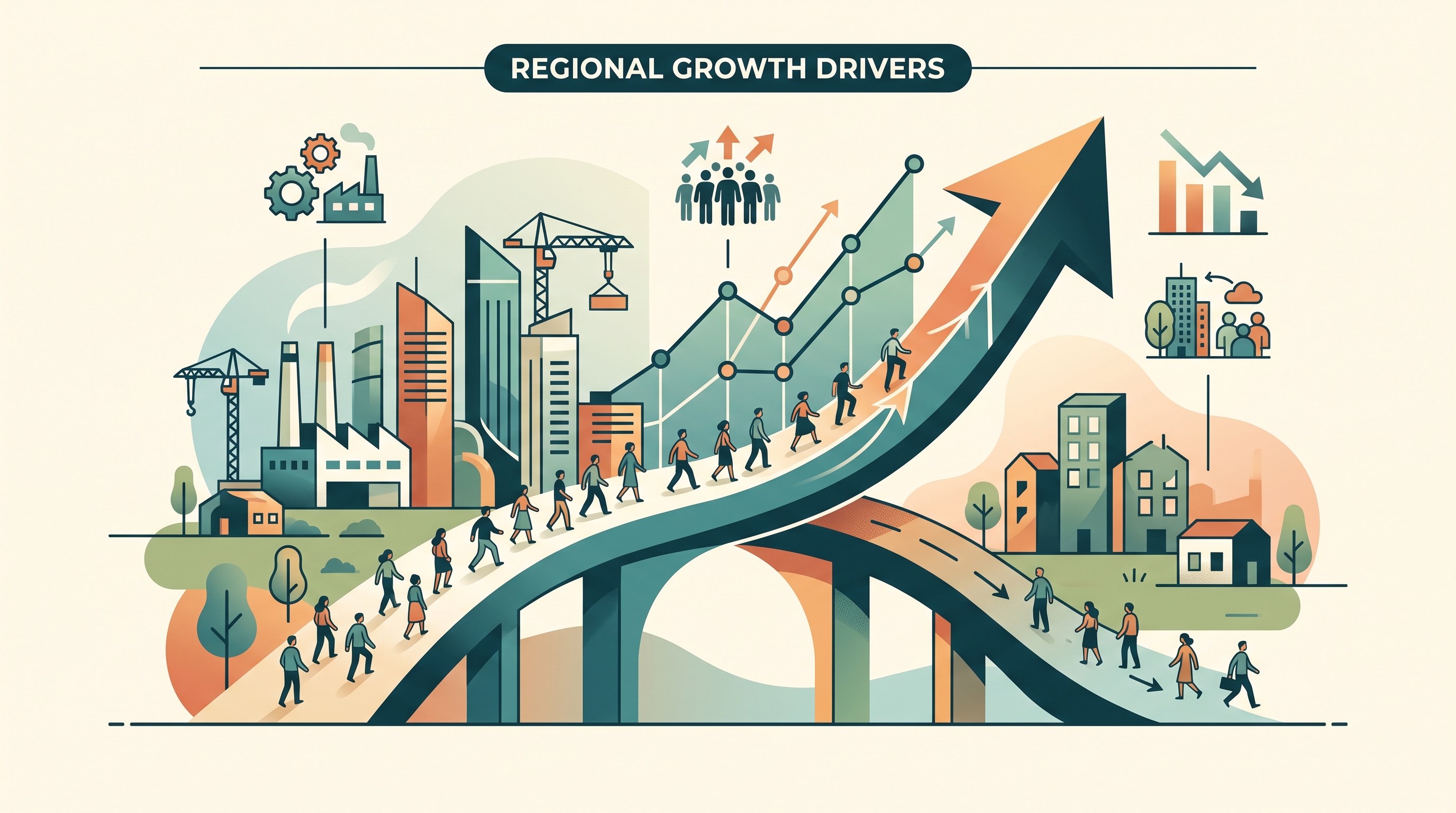
Uneven economic development can attract population to growing regions while depopulating others, producing regional inequalities, migration, and political demands. A government may therefore face two simultaneous problems: rapidly expanding regions need new infrastructure, while declining regions demand investment, services, and protection from economic marginalization.
LEG-4.A.2 adds an explicitly political cause: government policies and employment opportunities can draw workers toward particular geographic regions or influence positive or negative migration rates. A government might locate industries, build transportation networks, subsidize a region, or restrict entry at a border. These choices can deepen preexisting class and regional differences while taxing government resources.
The demographic-change feedback loop
The political process is often circular rather than one-directional:
- A pressure or opportunity emerges: population growth, land degradation, new jobs, or changing land values.
- People move: migration occurs within the country or across borders; rural residents may move to cities.
- Government resources are strained: schools, housing, roads, health systems, and public safety must expand or adapt.
- Inequalities become more visible: migrants and host communities may compete for jobs, land, or services.
- Political demands intensify: citizens may demand redistribution, regional autonomy, immigration controls, or stronger government action.
- Legitimacy is tested: successful adaptation can strengthen confidence in government, while perceived failure can produce protest, distrust, or conflict.
A key analytical distinction is between a cause and a consequence. A government employment program may cause migration toward a region; overcrowded schools and demands for additional public spending may be consequences of that migration.
Nigeria: climate change, migration, and conflict
Environmental consequences of climate change can force demographic change in Nigeria. When environmental conditions damage agricultural production or make land less usable, people may leave vulnerable areas. Movement can increase pressure on receiving communities, especially where employment, land, water, and public services are already limited.
The political consequence is not automatic conflict, but demographic change may increase conflict. New arrivals and established residents can compete over land, livelihoods, and government assistance. Political actors may intensify these tensions by presenting migration as a threat or by distributing resources unevenly. A strong explanation must connect the chain: climate-related environmental pressure causes movement; movement changes local population patterns; altered population patterns increase competition; competition may contribute to conflict and challenge governmental legitimacy.
Worked argument: A defensible claim would be: Climate-related environmental changes in Nigeria may increase conflict when forced migration brings population groups into competition over scarce land, agricultural opportunities, and public resources. The reasoning is stronger when it acknowledges an alternative perspective: migration does not inevitably produce conflict. Effective government planning, fair resource distribution, and cooperation between communities could reduce tensions. The best conclusion is therefore conditional, not absolute.
Data-analysis lens: limitations matter
The suggested skill is Data Analysis (3.E): Explain possible limitations of the data provided. A migration graph may show that a region’s population increased, but it may not reveal why people moved, whether movement was voluntary or forced, or whether the change resulted from births, deaths, internal migration, or international migration. Likewise, a correlation between migration and conflict does not by itself prove that migration caused conflict.
When interpreting data, identify what the evidence demonstrates and what it cannot establish. Ask: Does the measure capture the whole population? Is the time period long enough? Are informal migrants counted? Could another factor—such as unemployment, political exclusion, or weak public services—explain the same pattern?
Misconception check
Misconception: Demographic change is simply a natural population process and therefore has little to do with politics.
Correction: Government policies, employment opportunities, land decisions, and resource distribution can cause population movement. Demographic change then creates political consequences by changing who needs services, who competes for resources, and who believes the government is responding fairly.
Retrieval check
A government builds a major industrial corridor in one region, attracting workers while another region loses population. Name one political cause, one demographic change, and one political consequence. Then state one limitation a population dataset might have when measuring this process.
Source Materials
- AP Comparative Government and Politics Course and Exam Description
- AP Comparative Government and Politics Course and Exam Description Clarifications and Corrections
- AP Comparative Government and Politics Course Overview
- AP Comparative Government and Politics Course at a Glance
- AP Comparative Government and Politics Course at a Glance Poster
- AP Comparative Government and Politics
- AP Comparative Government and Politics
- AP Comparative Government and Politics Sample Syllabus 1