From the free course AP Comparative Government and Politics on Lykke
Course Framework, Skills and Reasoning Processes
Key concepts: Purpose and structure of the AP Program · Course framework and alignment with higher education expectations · Disciplinary practices and related skills · Instructional model: exploring, teaching, and assessing learning · Formative assessment and actionable feedback · AP Classroom Progress Checks · AP Question Bank and its organization by topics and skills · Teacher responsibility for curriculum design and pacing · The six AP Comparative Government and Politics countries · Interdisciplinary analysis using economics, sociology, history, and geography
Political science asks more than who governs: it asks how power is organized, why institutions are obeyed, how citizens participate, and why similar political problems produce different outcomes in different countries.
Course Framework, Skills and Reasoning Processes
Political science asks more than who governs: it asks how power is organized, why institutions are obeyed, how citizens participate, and why similar political problems produce different outcomes in different countries. AP Comparative Government and Politics studies those questions comparatively across China, Iran, Mexico, Nigeria, Russia, and the United Kingdom, drawing evidence from political science as well as economics, sociology, history, and geography.
AP courses provide challenging college-level coursework. Many U.S. four-year colleges and universities grant credit, advanced placement, or both for successful AP Exam performance, although each institution sets its own policy.
What the course framework does
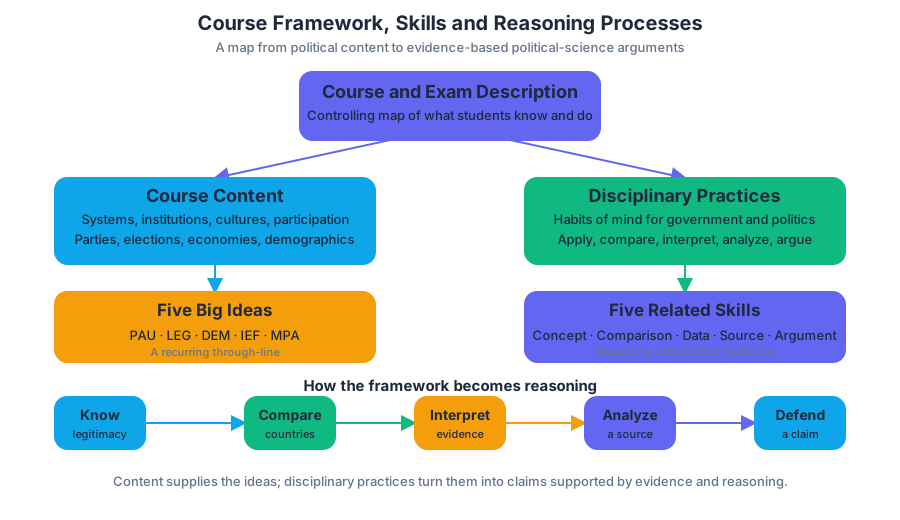
The Course and Exam Description is the controlling map of what students should know and be able to do. It connects required political content to the skills used to construct political-science arguments: applying concepts, comparing countries, analyzing data, interpreting sources, and defending claims with evidence and reasoning.
The framework has two essential components:
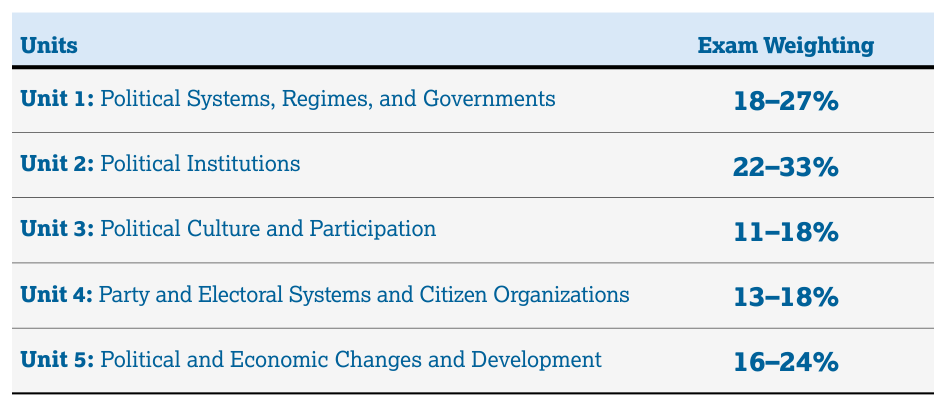
- Course content: the political systems, institutions, cultures, participation patterns, parties, elections, economic changes, demographic pressures, and resource challenges studied across the five units.
- Disciplinary practices: the habits of mind central to the study and practice of government and politics.
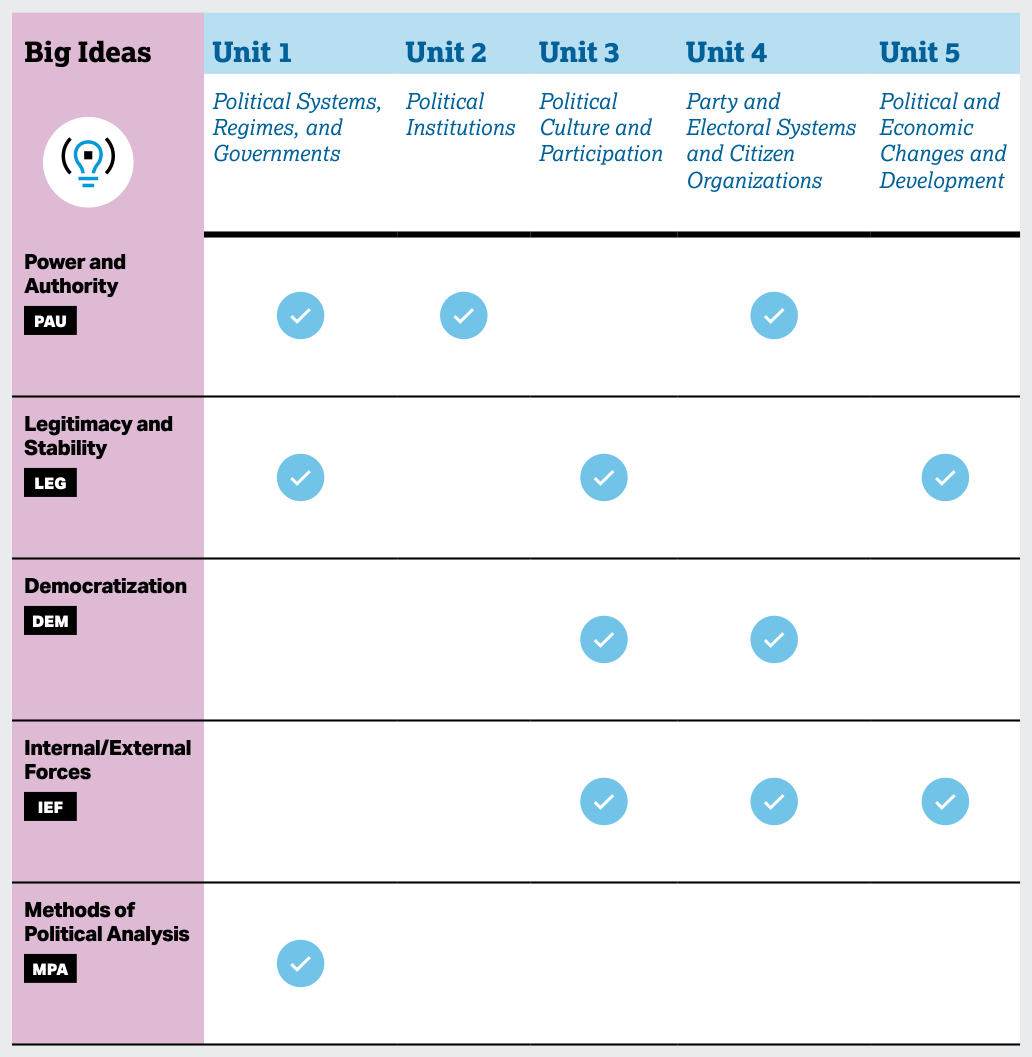
The five recurring Big Ideas give the content a through-line:
- PAU: Power and Authority
- LEG: Legitimacy and Stability
- DEM: Democratization
- IEF: Internal and External Forces
- MPA: Methods of Political Analysis
The five disciplinary practices appear together with related skills. A student may therefore need to know what legitimacy means, compare legitimacy across two countries, interpret evidence about it, analyze a source discussing it, and use the evidence in an argument.
The five disciplinary practices and official skills
| Disciplinary practice | Related skills | What strong work does |
|---|---|---|
| Practice 1: Concept Application | Skill 1.A: Define and explain concepts and theories; Skill 1.B: Describe political systems, institutions, regimes, or processes; Skill 1.C: Explain how political systems, institutions, regimes, or processes relate to one another | Uses a precise concept, not a vague synonym, and connects it to a political mechanism. |
| Practice 2: Country Comparison | Skill 2.A: Describe similarities and/or differences; Skill 2.B: Explain similarities and/or differences | Moves from “Country A has more” to why the difference exists and what it produces. |
| Practice 3: Data Analysis | Skill 3.A: Identify and describe data; Skill 3.B: Describe patterns and trends; Skill 3.C: Draw conclusions from data; Skill 3.D: Explain patterns and trends in data | Reads values accurately, identifies a pattern, draws a defensible conclusion, and explains its political meaning. |
| Practice 4: Source Analysis | Skill 4.A: Identify the claims or arguments in a source; Skill 4.B: Describe the claims or arguments in a source; Skill 4.C: Explain the perspective, purpose, or reasoning of a source | Separates what a source says from why its author says it. |
| Practice 5: Argumentation | Skill 5.A: Make a claim; Skill 5.B: Support a claim with evidence; Skill 5.C: Use reasoning to explain why the evidence supports the claim; Skill 5.D: Use refutation, concession, or rebuttal | Builds a logical chain: claim → evidence → reasoning, while addressing an alternative interpretation. |
A frequent error is confusing description with explanation. For example, “Nigeria has ethnic diversity” describes a condition; “ethnic diversity can encourage coalition-building or intensify competition for state resources, depending on institutions” explains a political relationship. The second statement uses Skill 1.C, and it becomes stronger when supported through Skills 2.B, 3.D, or 5.C.
Plan → Teach → Assess
Teachers design their own AP curriculum and select appropriate instructional resources. The framework focuses that design on assessed content and skills, but the published unit sequence is optional: pacing may be adjusted to students’ needs.
A repeatable instructional cycle connects planning, classroom learning, and feedback:
- Plan: Use unit guides, topic pages, required skills, instructional strategies, and varied resources to decide what students will investigate and what evidence of learning will count.
- Teach: Provide necessary scaffolding, then let students apply concepts, compare countries, analyze data and sources, and construct arguments.
- Assess: Measure understanding, identify the exact point of failure, and provide feedback that tells students what to change.
Formative assessment is most useful when feedback is actionable. “Review political institutions” is too broad; “You identified the trend but did not explain how executive term limits affect accountability” points to a specific conceptual and reasoning repair.
AP Classroom and Progress Checks
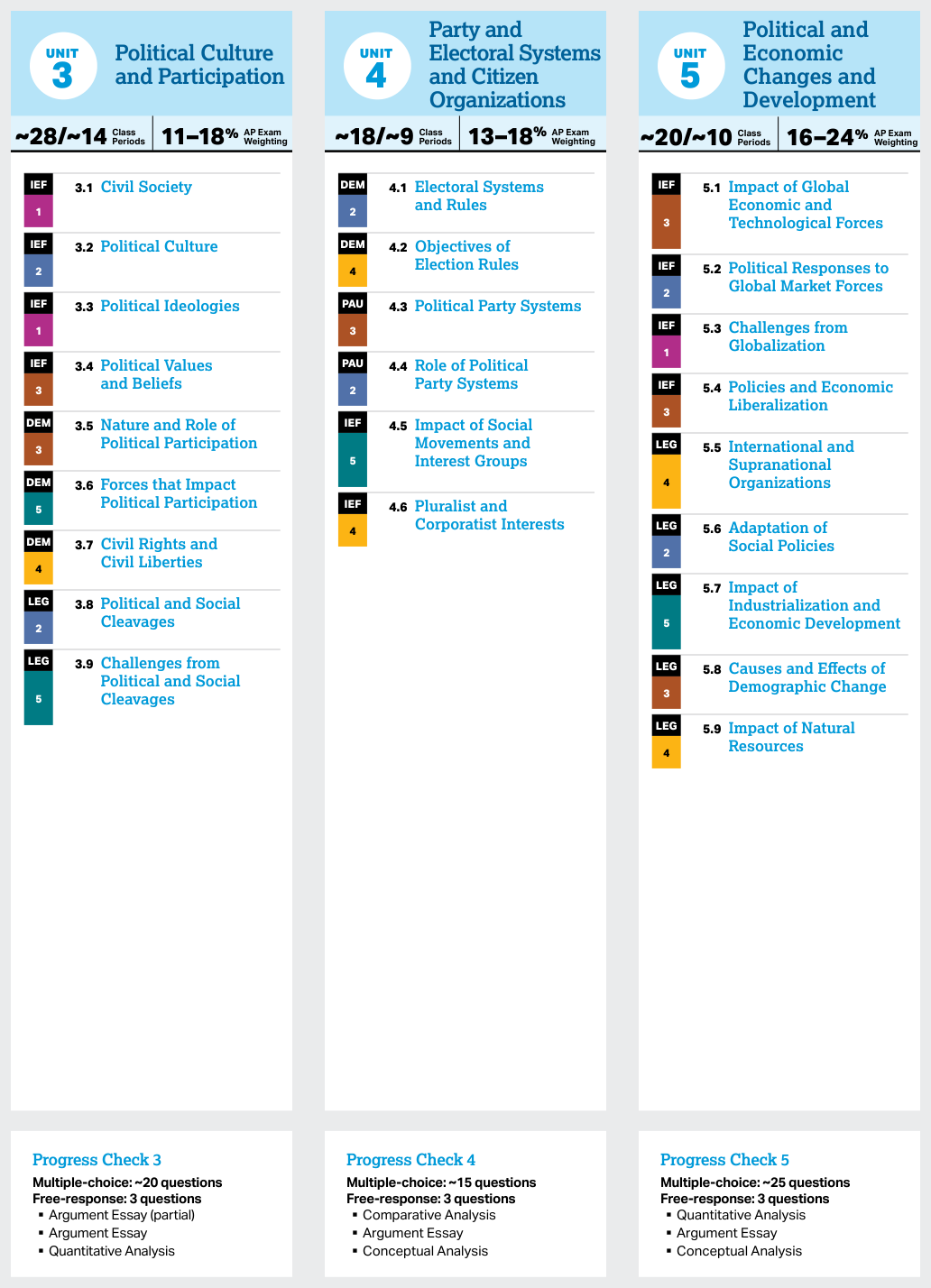
At the end of each unit, teachers can assign an online Progress Check through AP Classroom. Whether completed in class or as homework, it provides immediate feedback connected to that unit’s topics and skills.
Progress Checks combine approximately twenty to thirty multiple-choice questions with three free-response tasks. Across the units, the free-response tasks sample Conceptual Analysis, Quantitative Analysis, Comparative Analysis, and Argument Essay formats, sometimes in partial combinations. The purpose is not merely to produce a score; the dashboard and question-level feedback help locate whether the problem was content knowledge, data interpretation, comparison, source reasoning, or argument construction.
The AP Question Bank supplies secure, real AP Exam questions indexed by course topics and skills for classroom use. It can extend practice after a Progress Check while allowing teachers to target a precise weakness—for example, Skill 3.C: Draw conclusions from data rather than assigning undifferentiated review.
How the skills appear on the exam
The fully digital AP Exam uses multiple-choice and free-response sections, each contributing 50% of the score. Questions may require political concept application, quantitative analysis, qualitative or source analysis, country comparison, and argumentation across the six course countries.
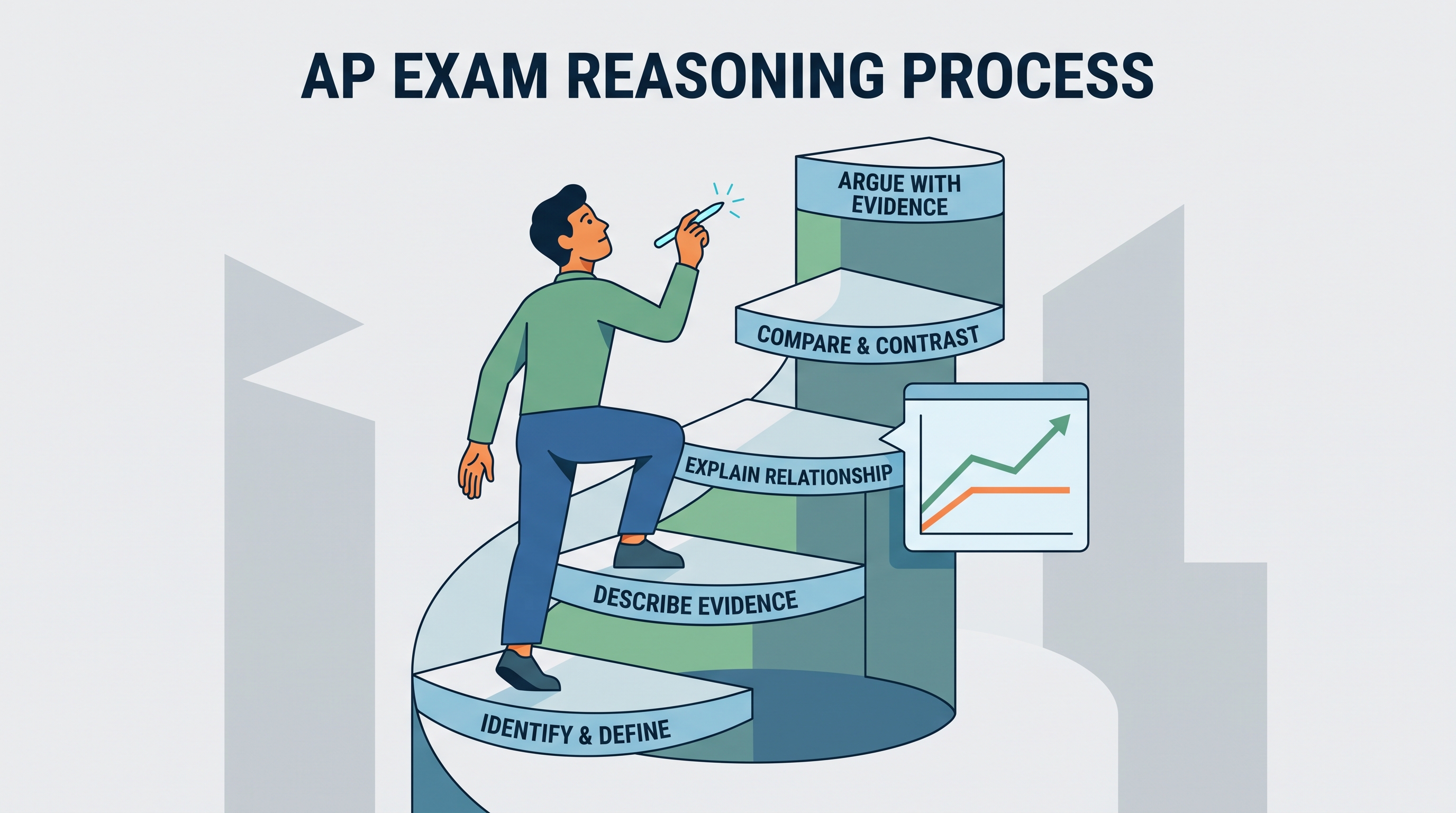
The most reliable response pattern is analytical rather than encyclopedic:
- Name or identify the relevant political concept, pattern, claim, or institution.
- Describe the evidence accurately.
- Explain the relationship or mechanism.
- Compare or qualify when the prompt requires it.
- Support the argument with specific evidence and reasoning.
In-flow check: A graph shows that trust in government rises in Country A after a major expansion of social services but remains flat in Country B. Identifying the rise uses Skill 3.A; describing the trend uses Skill 3.B; concluding that the cases differ uses Skill 3.C; explaining how service delivery may strengthen legitimacy uses Skill 3.D and potentially Skill 5.C.

Source Materials
- AP Comparative Government and Politics Course and Exam Description
- AP Comparative Government and Politics Course and Exam Description Clarifications and Corrections
- AP Comparative Government and Politics Course Overview
- AP Comparative Government and Politics Course at a Glance
- AP Comparative Government and Politics Course at a Glance Poster
- AP Comparative Government and Politics
- AP Comparative Government and Politics
- AP Comparative Government and Politics Sample Syllabus 1
- Figure — AP Comparative Government and Politics Course and Exam Description (p. 1)
- Figure — AP Comparative Government and Politics Course and Exam Description (p. 1)
- Figure — AP Comparative Government and Politics Course and Exam Description (p. 19)
- Figure — AP Comparative Government and Politics Course and Exam Description (p. 27)