From the free course AP Comparative Government and Politics on Lykke
1.6 Change in Power and Authority
Key concepts: Change in power and authority · Centralization and decentralization of power · Unitary systems of government · Federal systems of government · Distribution of power between national and regional governments · Peaceful versus violent political change · Sovereignty · Social cleavages · Policy-making efficiency · Sources of power and authority
Power rarely stays in one place forever. A government may pull authority toward the national capital, transfer responsibilities to provinces or states, or lose control through rebellion, revolution, or external pressure.
1.6 Change in Power and Authority
Power rarely stays in one place forever. A government may pull authority toward the national capital, transfer responsibilities to provinces or states, or lose control through rebellion, revolution, or external pressure. Change in power and authority refers to shifts in who can make, enforce, and sustain binding political decisions.
Investigative question: When authority moves between national and regional governments—or changes hands entirely—does the state become more stable, more responsive, or more vulnerable?
The centralization–decentralization spectrum
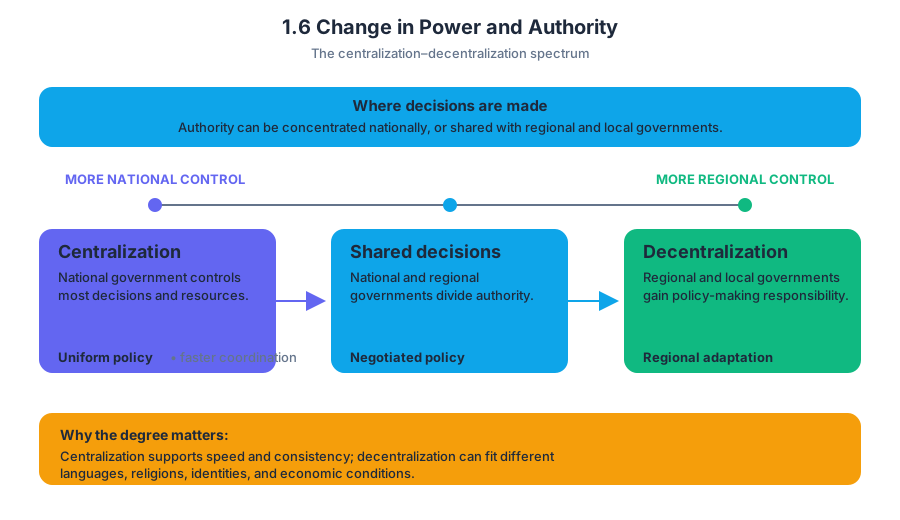
Centralization means that political authority is concentrated primarily in the national government. National officials set broad policies and may control the resources, laws, and institutions that regional governments need in order to act. Decentralization means that authority is distributed downward to regional or local governments, which gain greater responsibility for policy making.
The degree of centralization affects both government authority and policy making. A centralized government may implement a nationwide policy quickly, while a decentralized government may allow different regions to respond to distinct languages, religions, ethnic identities, or economic conditions.
A useful way to visualize the relationship is:
national government controls most decisions → centralization → uniform policy and faster coordination
national and regional governments share decisions → decentralization → regional adaptation and divided authority
Unitary and federal systems
A unitary system is one in which power rests primarily at the national level. Regional governments may exist, but they do not possess constitutionally guaranteed power; the national government can create, reorganize, or limit their authority.
The United Kingdom illustrates a centralized unitary system. The central government retains the greatest authority, while regional institutions receive powers from it. Those powers may be politically important, but they are granted rather than constitutionally guaranteed in the same way that regional powers are protected in a federal system.
A federal system divides power between national and regional governments. The constitution guarantees at least some regional authority, so the national government cannot simply abolish or reclaim every regional responsibility through ordinary political action.
Nigeria uses federalism partly to address challenges created by social cleavages. Its division of authority allows regional governments to respond more directly to local communities, including communities shaped by important religious differences. Federal arrangements therefore can provide recognition and political space for groups that might resist complete control from the national government.
| Question | Unitary system | Federal system |
|---|---|---|
| Where is authority concentrated? | Primarily at the national level | Divided between national and regional levels |
| Are regional powers constitutionally guaranteed? | No | Yes |
| Example emphasized here | United Kingdom | Nigeria |
| Possible advantage | Coordinated, uniform policy | Regional adaptation and representation |
| Possible challenge | Regional groups may feel overcontrolled | Conflicting national and regional policies |
Worked comparison: why the distinction matters
Imagine that two countries contain sharp religious and regional differences. Country A uses a unitary system: the national government designs one education policy and gives regional offices authority to administer it. Country B uses a federal system: regional governments possess constitutionally protected responsibility for education and can adapt policy to local conditions.
The comparison does not prove that Country B will be more democratic or stable. It shows how the distribution of power can address a social cleavage differently. Nigeria’s federal structure can give distinct communities meaningful regional authority; by contrast, describing the United Kingdom’s unitary system as eliminating social cleavages would confuse centralized coordination with automatic social unity.
Exam-ready distinction: Explain the governmental structure first, then connect it to the specific challenge. “Federalism helps Nigeria address religious differences because regional governments have codified authority to respond to different communities” is stronger than merely saying that federalism “creates representation.”
Peaceful and violent political change
Changes in power and authority may occur peacefully or violently. Peaceful change can result from elections, constitutional amendments, negotiated settlements, devolution, or legislation that transfers responsibilities to regional governments. Violent change can result from coups, revolutions, civil wars, separatist movements, or the use of force by a regime to preserve sovereignty.
Sovereignty is the state’s supreme authority to govern within its territory and maintain independence from outside interference. Political regimes use different methods to maintain sovereignty, including legal institutions, security forces, ideological appeals, control of territory, and negotiation with internal groups. A regime may therefore preserve the state through accommodation—or through coercion.
Misconception check
Misconception: “Federal means weak national government, and unitary means no regional government.” Neither statement is correct. Federalism concerns constitutionally divided authority, not the total strength of the national government; unitary states can have powerful regional institutions, but their authority ultimately depends on the national government.
CED traceability and skill application
Learning Objective PAU-2.A: Explain how power and authority are distributed and how they are affected by internal and external factors. Essential Knowledge PAU-2.A.1 and PAU-2.A.2 support analysis of how the distribution of power affects regime stability and how centralization or decentralization can change over time in response to internal and external actors, including ethnic cleavages.
This topic is assessed through Practice 1: Concept Application, when you define or apply unitary, federal, centralization, decentralization, or sovereignty; Practice 2: Country Comparison, when you connect a structural difference to the United Kingdom and Nigeria; and Practice 5: Argumentation, when you defend a claim about whether a distribution of power reduces conflict or improves policy making. In a source-based task, Practice 4: Source Analysis may require you to explain how an author’s perspective on regional authority reflects a political system.
Retrieval check
A country permits provinces to make education policy, but the national legislature can abolish those powers whenever it chooses. Is the system federal or unitary? Unitary: regional authority exists, but it is not constitutionally guaranteed. Now add the reason Nigeria’s federal structure can matter politically: it can give groups divided by social cleavages protected regional space to govern themselves.

Source Materials
- AP Comparative Government and Politics Course and Exam Description
- AP Comparative Government and Politics Course and Exam Description Clarifications and Corrections
- AP Comparative Government and Politics Course Overview
- AP Comparative Government and Politics Course at a Glance
- AP Comparative Government and Politics Course at a Glance Poster
- AP Comparative Government and Politics
- AP Comparative Government and Politics
- AP Comparative Government and Politics Sample Syllabus 1