From the free course AP Comparative Government and Politics on Lykke
2.6 Legislative Systems
Key concepts: Legislative systems · Legislative selection processes · Restrictions on legislative power · Formal constraints on the legislative branch · Effectiveness of formal constraints · Indirect elections · Direct elections with ideological vetting · Single-member district plurality systems · Mixed electoral systems · Proportional representation
A legislature does more than vote on bills: it converts political demands into laws, represents citizens or organized interests, approves public spending, and may supervise the executive branch.
2.6 Legislative Systems
A legislature does more than vote on bills: it converts political demands into laws, represents citizens or organized interests, approves public spending, and may supervise the executive branch. The central comparative question is not simply whether a country has a legislature, but who selects legislators, what powers the legislature formally possesses, and whether those powers operate in practice.
Topic 2.6 — Legislative Systems: Legislative systems vary according to their selection processes and the formal restrictions placed on legislative power.
How legislators are selected
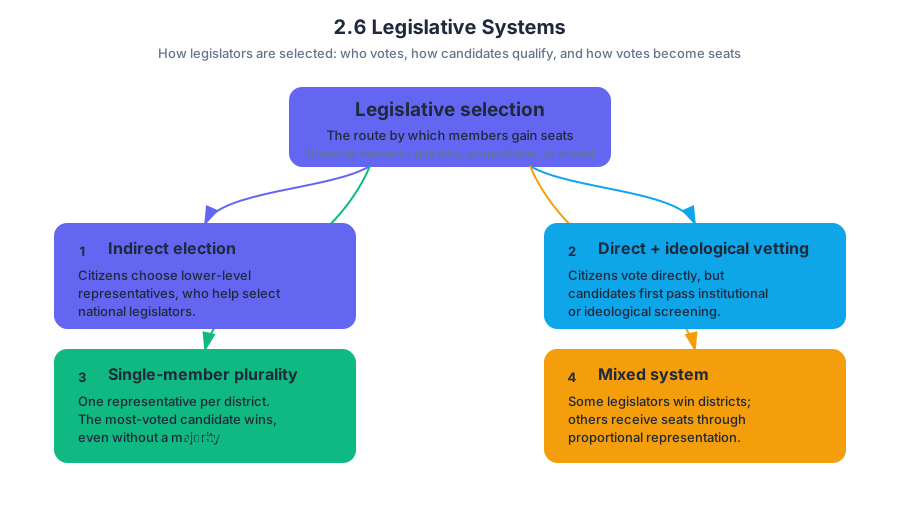
A legislative selection process is the method by which members of a legislature gain their seats. The most important distinctions are whether elections are direct or indirect and whether votes are translated into seats through plurality, proportional representation, or a mixed formula.
| Selection process | How it works | Course-country example |
|---|---|---|
| Indirect election | Citizens may choose lower-level representatives, who then help select national legislators. | China |
| Direct election with ideological vetting | Citizens vote directly, but candidates must first satisfy ideological or institutional screening rules. | Iran |
| Single-member district plurality | Each district elects one representative; the candidate with the most votes wins, even without a majority. | Nigeria and the United Kingdom |
| Mixed system | Some legislators are elected in districts while others receive seats through proportional representation. | Mexico and Russia |
China illustrates an indirect legislative election system. The National People’s Congress, China’s national legislature, is not selected through a single nationwide direct election in which voters choose every national legislator. Instead, representation moves upward through layers of lower-level congresses. This process gives the Chinese Communist Party substantial influence over who reaches the national legislature.
Iran combines direct elections with ideological vetting. Voters directly elect members of the Islamic Consultative Assembly, or Majlis, but candidates must be approved through a vetting process associated with the Guardian Council. Direct voting therefore does not mean unrestricted electoral competition: the electorate chooses among candidates who have already passed institutional and ideological screening.
Nigeria and the United Kingdom use single-member district plurality systems for their lower legislative chambers. Each geographic district selects one representative, and the candidate receiving the largest number of votes wins. A candidate can therefore win with $40%$ of the vote if three or more candidates divide the remaining $60%$.
Mexico and Russia use mixed systems. District representatives provide geographic accountability, while proportional-representation seats allow parties to gain legislative representation based on their overall vote share. The result is a legislature that combines two principles: local representation and broader party representation.
Restrictions on legislative power
A formal constraint is an explicit legal or institutional limit on what a legislature can do. Examples include constitutional review, executive vetoes, judicial review, upper chambers, party rules, candidate restrictions, limited legislative sessions, and requirements that legislation conform to constitutional or ideological principles.
The same formal institution can have different effects in different political systems. A constitution may grant a legislature authority to make laws, but that authority is weaker when another institution controls candidate selection, controls the policy agenda, or can block legislation.
China demonstrates the difference between formal authority and effective power. The National People’s Congress formally passes laws, but the Chinese Communist Party is the actual center of political power. The NPC’s short session—approximately two weeks—also limits extended independent debate and encourages it to approve policies already shaped by the CCP. The legislature therefore possesses formal lawmaking authority but is strongly constrained in exercising independent power.
In Iran, legislative power is constrained by ideological vetting and review by institutions such as the Guardian Council. The Majlis may debate and pass legislation, but laws can be rejected if they conflict with constitutional or Islamic principles as interpreted by the reviewing institution. The constraint is effective when it prevents the legislature from acting outside those boundaries.
In more electorally competitive systems, formal constraints may operate through institutional checks rather than ideological screening. A legislature may face executive vetoes, judicial review, constitutional rules, federal arrangements, or pressure from governing-party leaders. In the United Kingdom, for example, the executive is drawn from Parliament, so party control can limit legislative independence even when Parliament has substantial lawmaking authority.
Worked comparison: from description to explanation
Imagine comparing China and the United Kingdom. A description identifies that China uses indirect legislative elections while the United Kingdom uses single-member district plurality elections. An explanation goes further: China’s selection process reinforces party control over national representation, while the United Kingdom’s district elections create a direct electoral connection between voters and individual members of Parliament.
The comparison must then evaluate constraints. China’s NPC is formally a lawmaking body, but CCP dominance and the short legislative session restrict independent action. The United Kingdom’s Parliament can legislate and scrutinize government, yet the governing party and cabinet often control the parliamentary agenda. Thus, both legislatures face constraints, but the source and degree of constraint differ.
Misconception check
Misconception: “Direct elections automatically make a legislature powerful.”
Direct elections describe how legislators are chosen, not how much authority they exercise after taking office. Iran has direct elections, but ideological vetting limits the range of candidates and legislative outcomes. Conversely, an indirectly selected legislature may possess formal authority in some circumstances. Always separate selection process from legislative power.
Skill connection and retrieval check
This topic develops Concept Application by applying legislative-system concepts to country cases and Country Comparison by explaining meaningful similarities and differences. It also requires the descriptive and explanatory reasoning assessed in legislative-system comparisons: identify the institution, describe its operation, and explain how that operation affects legislative power.
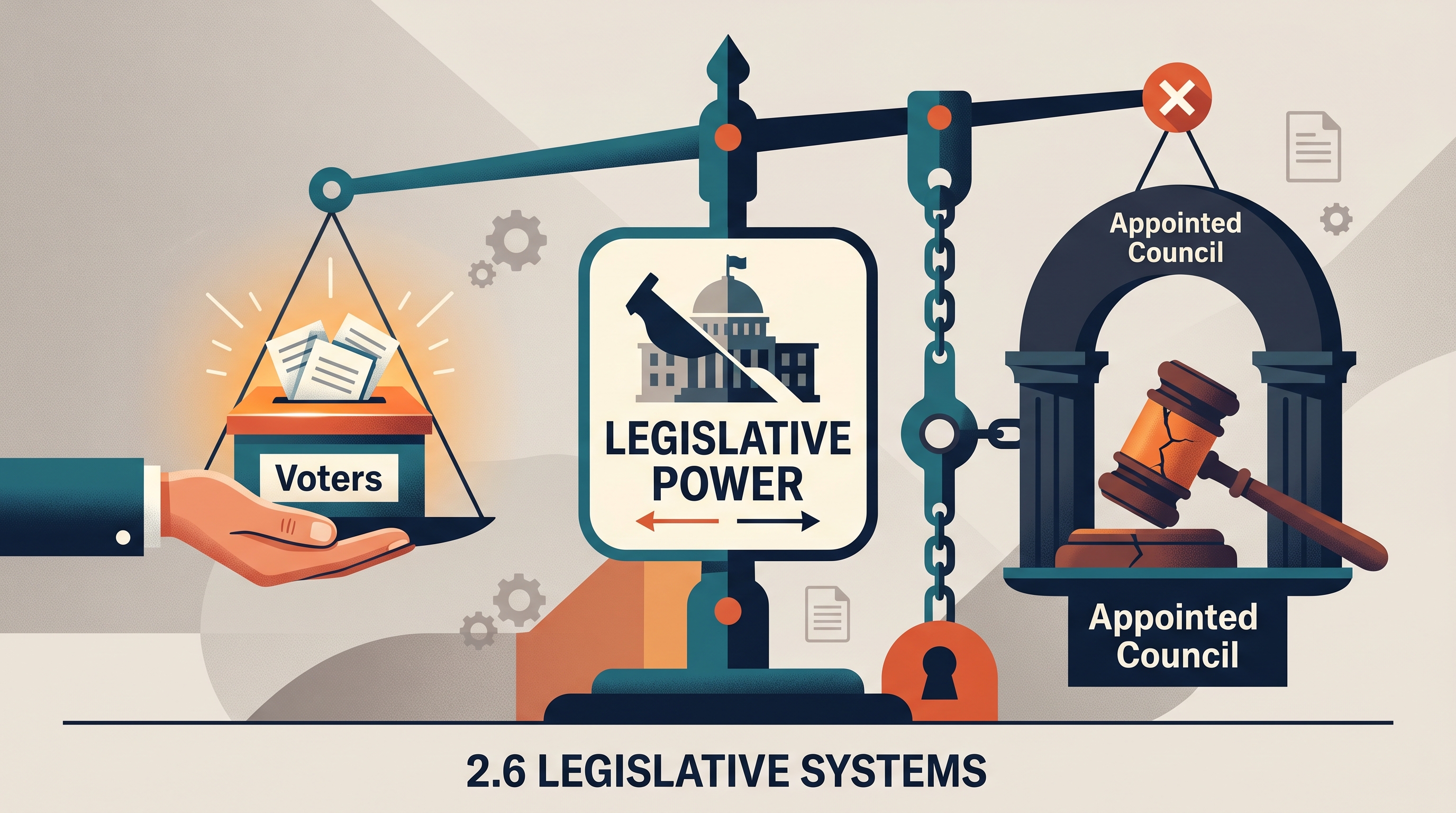
Retrieval check: A country allows voters to choose legislators directly, but an appointed council can reject candidates before the election and invalidate legislation afterward. What are the two separate concepts you should analyze? The answer is the legislative selection process and the formal constraints on legislative power—and neither concept alone proves how independent the legislature is.
Source Materials
- AP Comparative Government and Politics Course and Exam Description
- AP Comparative Government and Politics Course and Exam Description Clarifications and Corrections
- AP Comparative Government and Politics Course Overview
- AP Comparative Government and Politics Course at a Glance
- AP Comparative Government and Politics Course at a Glance Poster
- AP Comparative Government and Politics
- AP Comparative Government and Politics
- AP Comparative Government and Politics Sample Syllabus 1
- Based on your experience at the AP® Reading with student responses, what advice would you offer teachers to help them improve student performance on the exam? Teachers could help students regularly de