From the free course AP Comparative Government and Politics on Lykke
2.8 Judicial Systems
Key concepts: Judicial power · Checks and balances · Separation of powers · Rule of law · Rule by law · Limits on judicial power · Executive or political control of law · United Kingdom · Mexico · Preventing branch overreach
A judicial system does more than punish lawbreakers: it interprets laws, resolves disputes, reviews government action, and helps prevent any one branch from becoming politically dominant.
2.8 Judicial Systems
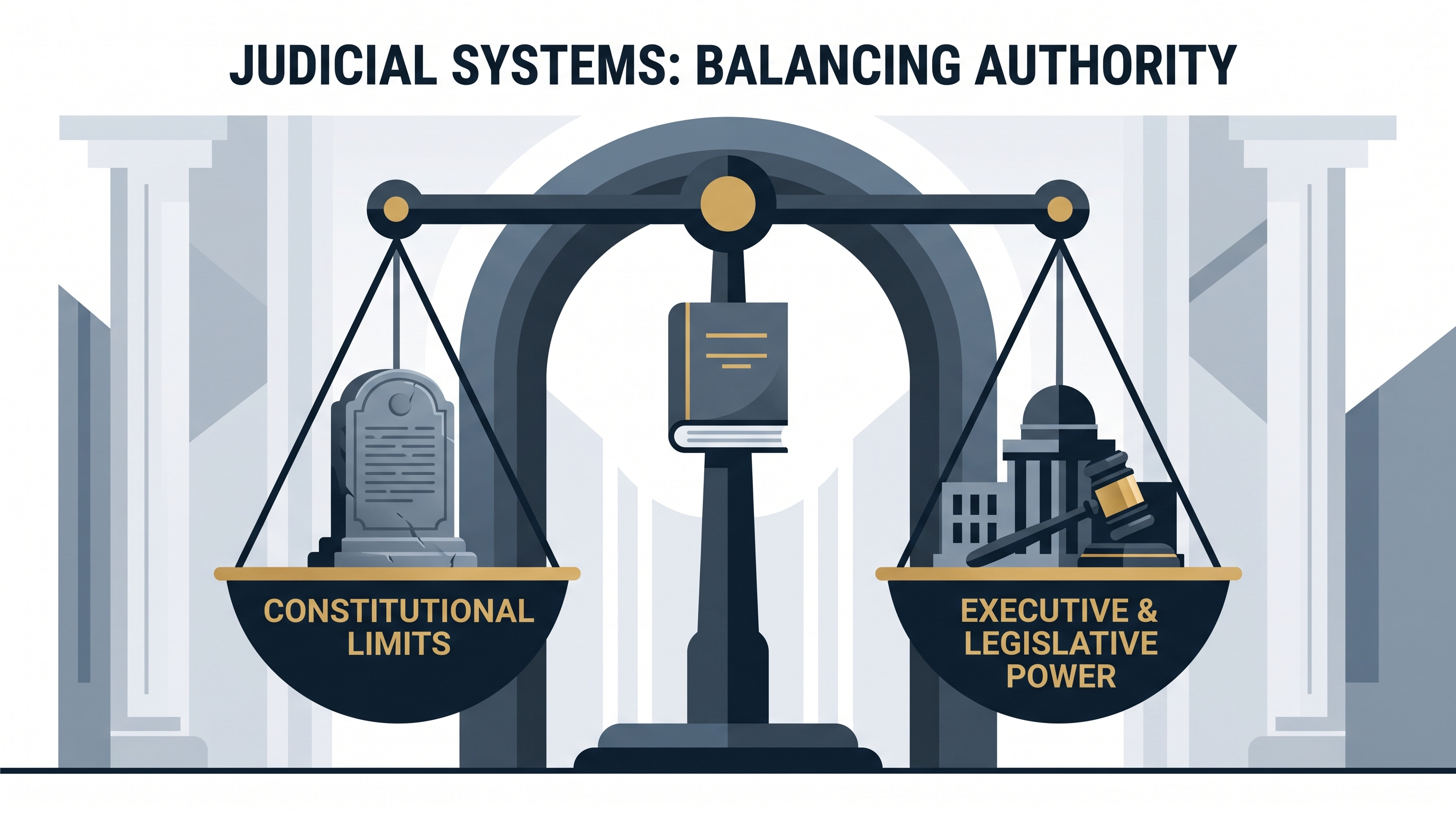
A judicial system does more than punish lawbreakers: it interprets laws, resolves disputes, reviews government action, and helps prevent any one branch from becoming politically dominant. Its power must therefore be strong enough to enforce legal limits—but limited enough to remain part of a broader system of checks and balances.
Judicial power is the authority of courts to interpret and apply law, resolve disputes, assess whether government actions comply with constitutional rules, and protect legal rights.
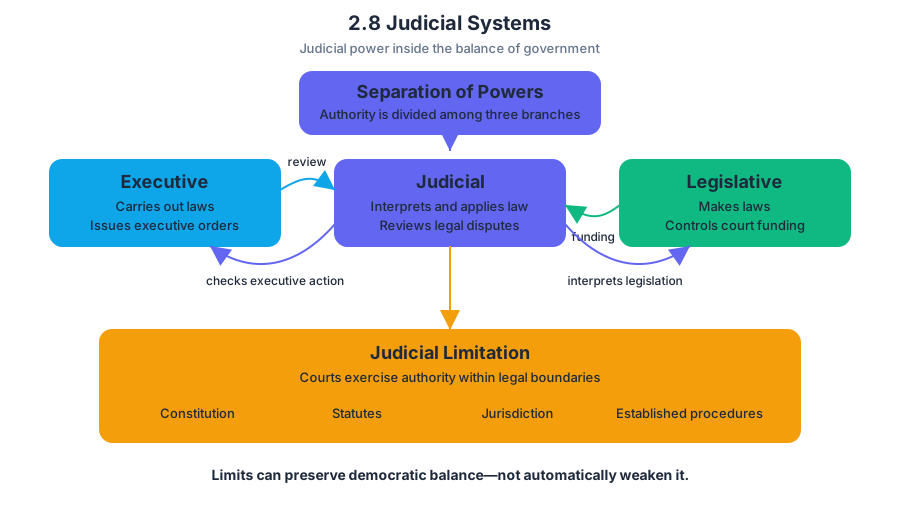
Judicial power inside the balance of government
Separation of powers divides governmental authority among executive, legislative, and judicial branches. Checks and balances then give each branch tools to restrain the others. A court may review an executive order, a legislature may control funding for courts, and constitutional rules may limit what judges themselves can decide.
The key point is that judicial limitation is not automatically anti-democratic. If judges could overrule every elected institution without legal boundaries, the judiciary could become an overbearing branch. Limiting judicial power can preserve balance by ensuring that courts exercise authority within a constitution, statutes, jurisdictional rules, and established procedures.
Mexico: limitation as a balancing mechanism
Mexico illustrates the comparative logic. Constitutional and institutional limits on judicial power can prevent the judiciary from displacing the elected branches and becoming more powerful than the executive or legislature. The purpose of such a limit, in this interpretation, is not to eliminate courts but to keep judicial authority within a system where no branch possesses unlimited power.
A strong AP explanation must identify both parts of the relationship: what limits judicial power and why the limit exists. “Mexico limits the judiciary” is incomplete; “Mexico limits judicial power to help prevent one branch from becoming overbearing and thereby maintain checks and balances” explains the political function.
Important distinction: Limiting judicial power can support checks and balances when it restrains judicial overreach. The same idea can undermine checks and balances when an executive controls courts to prevent them from reviewing executive conduct.
Rule of law and rule by law
The rule of law means that government officials and ordinary citizens are subject to publicly established, consistently applied legal rules. Law is intended to constrain political power rather than serve merely as the government’s weapon.
The United Kingdom provides a concrete example. British courts interpret legislation and review executive action, helping ensure that ministers and public authorities act within legal limits. At the same time, the principle of parliamentary sovereignty limits the courts’ ability to invalidate an Act of Parliament. This arrangement combines judicial oversight of executive action with a legal boundary on judicial power, linking the judiciary to both the rule of law and checks and balances.
Rule by law is different: the government uses law as an instrument of political control. Under rule by law, legal rules may exist and courts may operate, but the law primarily helps authorities discipline opponents, restrict dissent, or legitimize decisions already made by political leaders. Russia illustrates this danger when the executive constrains the judiciary and prevents meaningful judicial review so that courts can help control opposition rather than independently check government power.
| Concept | Central question | Political effect |
|---|---|---|
| Rule of law | Does law constrain those who govern? | Limits arbitrary power |
| Rule by law | Is law being used by those who govern to control others? | Can legitimize repression |
| Checks and balances | Can branches restrain one another? | Prevents branch dominance |
Applying the concept
Use Disciplinary Practice 1: Concept Application by connecting a country fact to a precise concept. Use Disciplinary Practice 2: Country Comparison by comparing not merely whether courts are “powerful,” but how their authority is limited and whether those limits constrain or empower political actors. Use Disciplinary Practice 5: Argumentation by explaining the consequence: a limitation may preserve institutional balance, or it may weaken accountability.
Misconception check — “A limited judiciary is always independent.” Independence concerns whether courts can decide without improper political pressure. A judiciary may have formally limited jurisdiction yet still be independent; conversely, it may possess broad legal authority but be controlled by the executive.
Retrieval check: A country restricts courts from invalidating legislative acts but allows them to review executive decisions. Explain how this arrangement could support both the rule of law and checks and balances. A strong answer should identify the legal limit on judges, the court’s continuing oversight of executive action, and the way the arrangement prevents any single branch from becoming dominant.
Source Materials
- AP Comparative Government and Politics Course and Exam Description
- AP Comparative Government and Politics Course and Exam Description Clarifications and Corrections
- AP Comparative Government and Politics Course Overview
- AP Comparative Government and Politics Course at a Glance
- AP Comparative Government and Politics Course at a Glance Poster
- AP Comparative Government and Politics
- AP Comparative Government and Politics
- AP Comparative Government and Politics Sample Syllabus 1