From the free course AP Comparative Government and Politics on Lykke
AP Practice 4
An argument essay asks you to do more than state an opinion: you must make a defensible claim, support it with comparative evidence, explain the political mechanism connecting evidence to the claim, and address an alternative perspective.
AP Practice 4
An argument essay asks you to do more than state an opinion: you must make a defensible claim, support it with comparative evidence, explain the political mechanism connecting evidence to the claim, and address an alternative perspective. The strongest response behaves like a carefully built bridge—claim → evidence → reasoning → qualification or rebuttal—rather than a pile of country facts.
Task type: Argument Essay
Timing target: 25 minutes. Spend approximately 3 minutes planning, 18 minutes writing, and 4 minutes checking. Use the final check to confirm that every country example is specific, every paragraph returns to the claim, and every task verb has been answered.
Original practice prompt
Develop an argument about the extent to which civil society organizations strengthen political legitimacy in the six AP Comparative Government and Politics countries. In your response, make a claim, support it with evidence from at least two countries, explain the political reasoning behind your argument, and address an alternative perspective.
What the prompt is really asking
The key concept is civil society: voluntary organizations outside the government, such as professional associations, religious groups, labor unions, advocacy organizations, and community organizations. Political legitimacy means the belief that a government has the right to rule. The prompt does not ask whether civil society is always helpful; it asks you to judge its extent of impact.
Plan before writing
A high-value plan might look like this:
| Essay function | Country evidence | Political reasoning |
|---|---|---|
| Main claim | United Kingdom: independent organizations and media can pressure officials and represent citizens | Participation and accountability can increase consent |
| Comparison | China: state-controlled or restricted organizations may provide services without creating independent accountability | Service delivery can support legitimacy, but limited autonomy weakens representation |
| Qualification | Nigeria: civil society can expose corruption and mobilize citizens, but unequal access and instability can limit its effect | Civil society strengthens legitimacy most when organizations are independent and governments respond |
This plan creates an argument rather than a catalog. It identifies a condition: civil society has the greatest legitimizing effect when organizations can operate independently and when institutions respond to their demands.
Worked response
Civil society organizations generally strengthen political legitimacy when they operate independently and can connect citizens to government decision-making. In the United Kingdom, organizations such as advocacy groups, trade unions, and professional associations provide channels for citizens to organize and pressure elected officials. Their activity can make government more responsive because officials must consider organized public demands, which can increase citizens’ belief that the political system represents them.
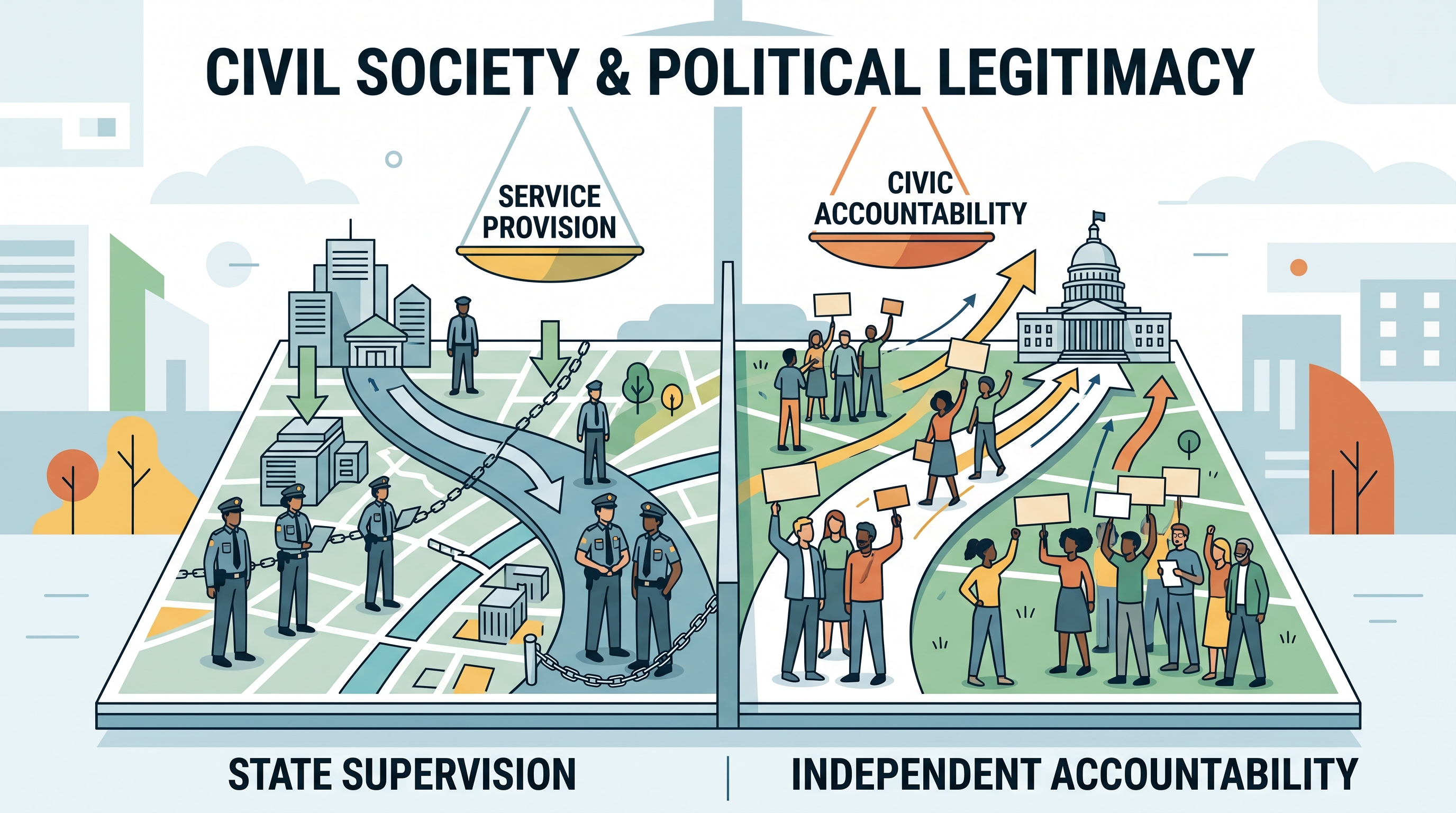
The effect is different in China. The government permits some social organizations to provide services and communicate local concerns, but the state restricts organizations that could independently challenge the Communist Party. These organizations may strengthen legitimacy by helping the government deliver services or respond to limited grievances. However, because independent political opposition is constrained, civil society does not create the same level of accountability as it can in the United Kingdom. This comparison shows that the existence of organizations alone is insufficient; their autonomy matters.
Nigeria provides a further example. Civil society organizations and news organizations can expose corruption, advocate for marginalized communities, and encourage citizens to participate in politics. These activities can strengthen legitimacy by making abuses visible and giving citizens tools to demand reform. At the same time, unequal resources, insecurity, and distrust in institutions may prevent civil society from producing consistent political responsiveness. Therefore, civil society strengthens legitimacy to a substantial but conditional extent: it is most effective when organizations are independent, broadly accessible, and connected to institutions capable of responding.
Why this earns credit
Thesis or claim: The opening establishes a defensible position—civil society strengthens legitimacy “when” organizations are independent and connected to decision-making. This is stronger than saying merely that civil society is “important.”
Evidence: The response uses specific evidence from the United Kingdom, China, and Nigeria. Each country is tied to the prompt rather than mentioned as a name-drop. The United Kingdom illustrates representation and accountability; China illustrates state restriction; Nigeria illustrates oversight alongside institutional limitations.
Reasoning: The response explains why each example matters. For instance, organized demands can increase responsiveness, while restrictions on independent opposition limit accountability. These cause-and-effect links demonstrate political reasoning rather than description.
Alternative perspective: The China paragraph recognizes that even restricted organizations can support legitimacy through service delivery and limited grievance communication. The response then qualifies that point by explaining why service provision is not equivalent to independent accountability.
Common failure modes
Misconception: “Argument” means personal opinion. An AP argument must be defensible through political concepts and evidence. Replace “I believe civil society is good” with a conditional claim about autonomy, representation, accountability, or responsiveness.
Misconception: country lists count as evidence. Writing “the United Kingdom, China, and Nigeria all have civil society” proves almost nothing. Evidence must identify what organizations do and connect that action to legitimacy.
Misconception: qualification cancels the thesis. A qualification does not weaken an argument if it clarifies its limits. “Civil society strengthens legitimacy, but mainly when organizations are independent” is more precise than an absolute claim.
Final retrieval check
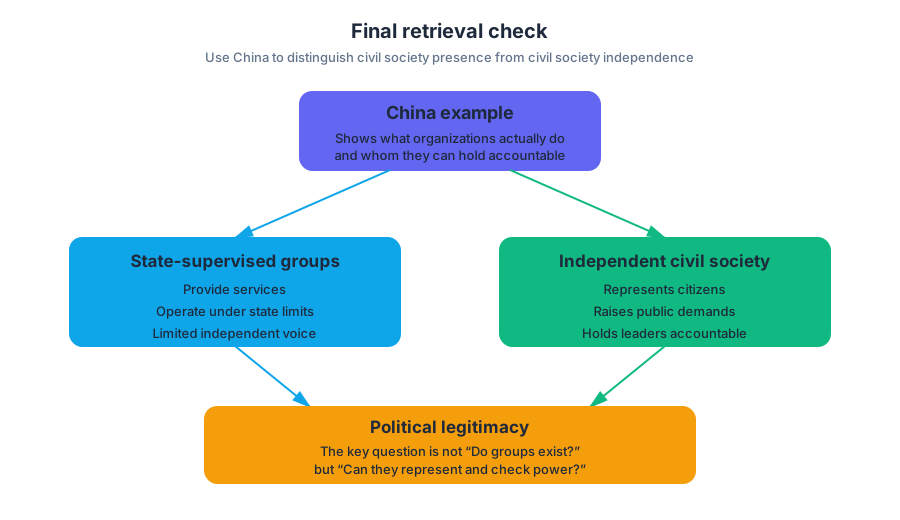
In one sentence, explain why the China example is more useful than simply stating that China has civil society organizations.
A strong answer would say that China demonstrates the difference between organizations that provide services under state supervision and organizations that independently represent citizens and hold leaders accountable; that distinction directly explains when civil society strengthens political legitimacy.
Source Materials
- AP Comparative Government and Politics Course and Exam Description
- AP Comparative Government and Politics Course and Exam Description Clarifications and Corrections
- AP Comparative Government and Politics Course Overview
- AP Comparative Government and Politics Course at a Glance
- AP Comparative Government and Politics Course at a Glance Poster
- AP Comparative Government and Politics
- AP Comparative Government and Politics
- AP Comparative Government and Politics Sample Syllabus 1
- AP Comparative Government and Politics-AP Students-College Board
- AP Comparative Government and Politics-Wikipedia
- AP Comparative Government and Politics Cheat <http://sheets-albert.io>Sheets-Albert.io
- AP Comparative Government and Politics-GOA