From the free course AP Comparative Government and Politics on Lykke
2.3 Executive Systems
Key concepts: Mexico’s mixed system · Limits on judicial power · United Kingdom judiciary · Common law · Rule of law · Judicial removal for misconduct · Judicial age limits
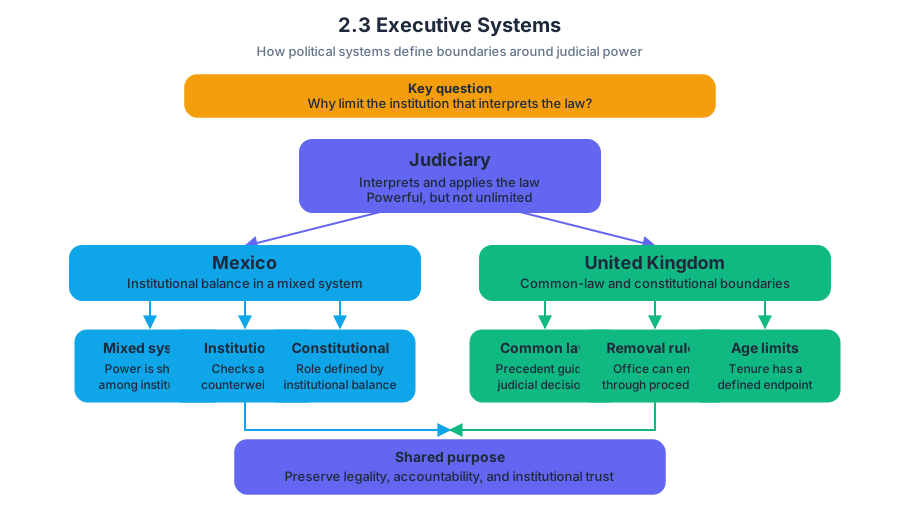
A judiciary can be powerful without being unlimited. Mexico and the United Kingdom illustrate two different ways a political system places boundaries around courts: Mexico uses institutional balance in a mixed political system, while the United Kingdom relies on common law, removal procedures, and age limits to…
2.3 Executive Systems
A judiciary can be powerful without being unlimited. Mexico and the United Kingdom illustrate two different ways a political system places boundaries around courts: Mexico uses institutional balance in a mixed political system, while the United Kingdom relies on common law, removal procedures, and age limits to keep judges within defined legal and constitutional roles.
Key question: Why would a government limit the power of the institution responsible for interpreting and applying the law?
Mexico: judicial power within a mixed system
Mexico’s mixed system combines institutions associated with both presidential and representative government. Its executive and legislative branches possess substantial authority, while the judiciary operates within a constitutional structure designed to prevent any single branch from becoming dominant.
The central idea is checks and balances: each branch has some ability to limit the others. Judicial power is therefore not unlimited. Courts may interpret laws, resolve disputes, and review government actions, but their authority remains bounded by the constitution, legislation, institutional procedures, and the powers of the elected branches.
This limitation does not necessarily mean that Mexico’s judiciary is powerless or merely controlled by the executive. Rather, its power is constrained so that one branch does not become more powerful than the others. Limiting judicial authority can preserve a balance among the branches and reduce the risk that judges, rather than elected institutions, determine all major public policies.
Worked comparison
Imagine that Mexico’s highest court invalidates a government policy. Judicial review gives the court a meaningful check on executive or legislative action. However, the court cannot automatically govern, write the national budget, or replace elected officials. Its authority is significant but specialized: it applies constitutional and legal standards rather than exercising unlimited political power.
| Country | How judicial power is limited | Why the limit exists |
|---|---|---|
| Mexico | Constitutional and institutional checks restrict the judiciary’s reach | To prevent one branch from becoming more powerful than the others |
| United Kingdom | Common law, defined removal procedures, and judicial age limits constrain judges; the Supreme Court lacks broad judicial review | To preserve the rule of law and keep judicial authority within established legal boundaries |
United Kingdom: common law and the rule of law
The United Kingdom’s judiciary must abide by common law, a legal tradition in which judicial decisions and precedents help shape the law over time. A precedent is an earlier judicial decision that guides later cases with similar facts. Common law gives judges interpretive influence, but it also binds them to accumulated legal principles rather than allowing each judge to decide entirely from personal preference.
This supports the rule of law, the principle that government officials and ordinary citizens are subject to publicly known laws applied through established procedures. The rule of law differs from rule by law: under rule by law, authorities may use legal rules as instruments of state power, even when courts lack genuine independence. In the United Kingdom, adherence to common law helps make judicial decisions more predictable and limits arbitrary judicial action.
The United Kingdom also limits judicial power through institutional boundaries. Its Supreme Court does not possess the same broad power of judicial review found in some constitutional systems. Judges therefore interpret and apply law, but they do not possess unlimited authority to strike down every act of Parliament.
Accountability without ordinary political control
Judges in the United Kingdom can be removed for misconduct, meaning serious behavior that violates the standards expected of judicial office. This process creates accountability while distinguishing misconduct from an unpopular ruling: a judge should not be removed simply because a government dislikes a legally defensible decision.
Judges also face age limits. Mandatory retirement rules prevent judicial office from becoming indefinite and create a regular point at which new judges can enter the system. Together, misconduct procedures and age limits limit tenure-based power without making judges directly dependent on changing political majorities.
The comparative logic
The two countries limit judicial power for related but distinct reasons. Mexico emphasizes interbranch balance: judicial authority must not allow the judiciary to dominate the political system. The United Kingdom emphasizes legal constraint and institutional accountability: judges must follow common law, operate within defined powers, and remain answerable for misconduct.
Misconception check: “Limiting judicial power means the courts are not independent.”
Not necessarily. A judiciary can be independent in deciding cases while still being limited by constitutional jurisdiction, legal precedent, removal standards, retirement rules, or the absence of broad judicial review.
AP skill connection and retrieval check
This topic most directly uses Practice 1: Concept Application, especially 1.A Define and/or describe a concept or political process and 1.B Explain how a political concept or process relates to a political scenario. It also uses Practice 2: Country Comparison, especially 2.A Describe similarities and differences between countries and 2.B Explain similarities and differences between countries.
Retrieval check: A response states that Mexico limits judicial power to prevent one branch from becoming dominant, while the United Kingdom limits it through common law, misconduct procedures, age limits, and restricted judicial review. Which country’s explanation primarily reflects checks and balances, and which primarily reflects legal and procedural constraint?
Answer: Mexico primarily reflects checks and balances; the United Kingdom primarily reflects legal and procedural constraint.
Source Materials
- AP Comparative Government and Politics Course and Exam Description
- AP Comparative Government and Politics Course and Exam Description Clarifications and Corrections
- AP Comparative Government and Politics Course Overview
- AP Comparative Government and Politics Course at a Glance
- AP Comparative Government and Politics Course at a Glance Poster
- AP Comparative Government and Politics
- AP Comparative Government and Politics
- AP Comparative Government and Politics Sample Syllabus 1