From the free course AP Comparative Government and Politics on Lykke
5.3 Challenges from Globalization
Key concepts: Globalization and economic liberalization · Challenges to state sovereignty · Multinational corporations (MNCs) · Economic dependence and loss of autonomy · Government incentives to encourage globalization · Political and economic effects of globalization · Environmental consequences of globalization · Resource extraction and foreign-owned economic interests · Nationalism as a response to globalization · Social conflict and protest movements
Globalization connects economies across political borders, but the same connections that bring investment and jobs can reduce a government’s freedom to regulate its own economy.
5.3 Challenges from Globalization
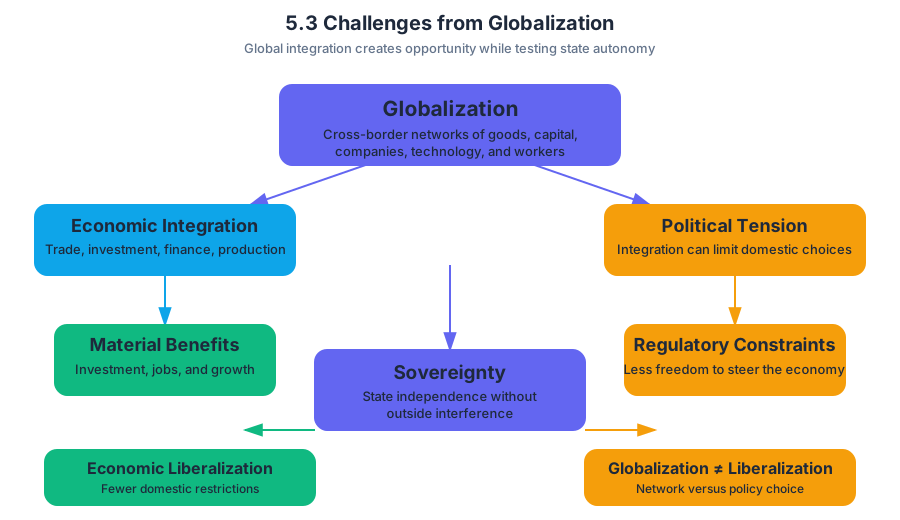
Globalization connects economies across political borders, but the same connections that bring investment and jobs can reduce a government’s freedom to regulate its own economy. The central tension is simple: How can states gain the material benefits of global integration without surrendering political and economic autonomy?
Sovereignty is a state’s ability to remain independent without outside interference.
Economic globalization links countries through trade, investment, finance, production, technology, and multinational corporations. Economic liberalization is the reduction of government restrictions on economic activity, while globalization describes the wider international network in which goods, capital, companies, and sometimes workers cross borders. The two can reinforce each other, but they are not identical.
The sovereignty trade-off
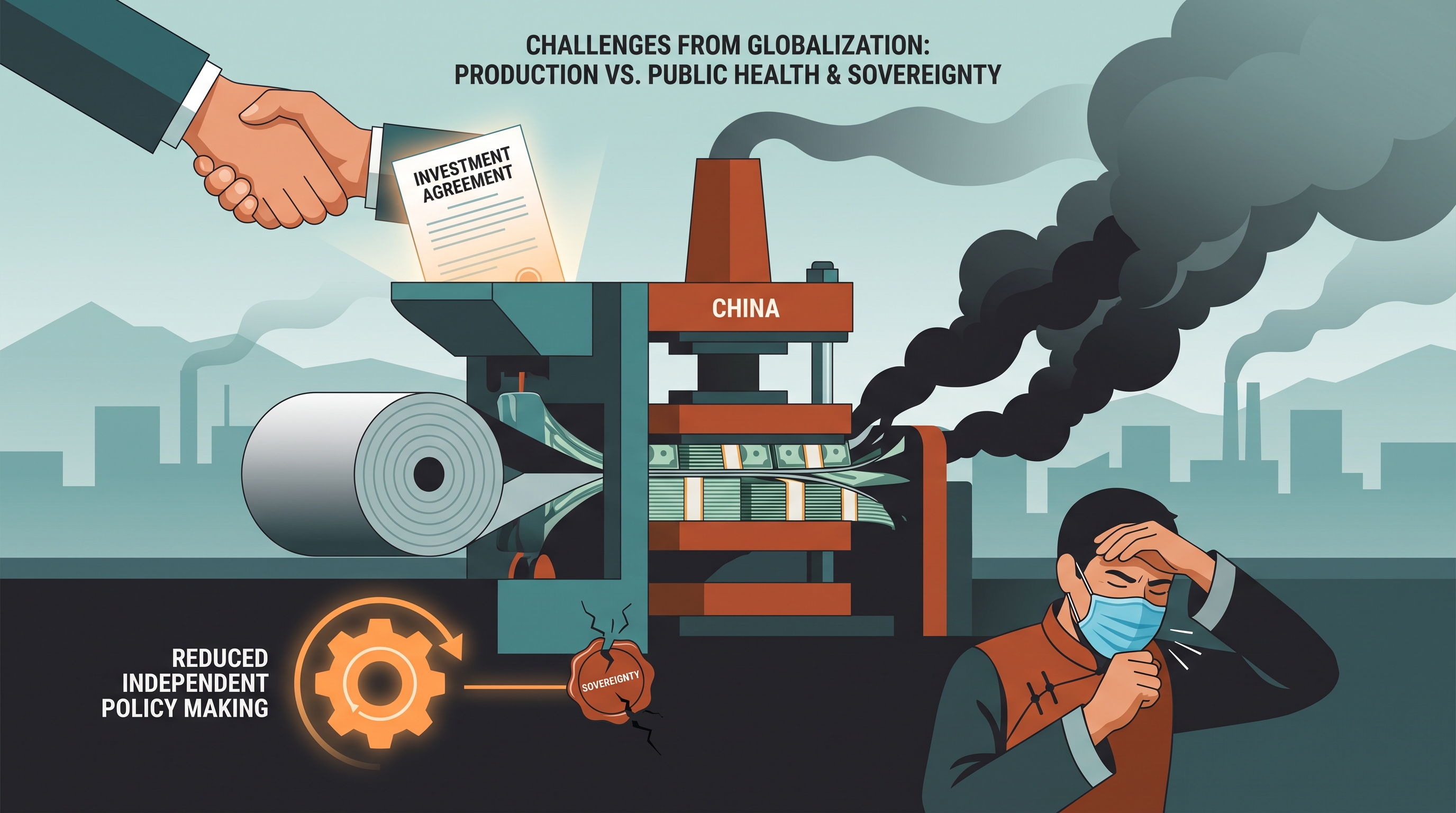
A government may invite a foreign company to build a factory, extract oil, or provide infrastructure. In return, the company may demand favorable taxes, access to land, relaxed regulations, or protection from future policy changes. The state still possesses formal legal authority, but its practical choices become narrower because reversing the agreement could cost investment, employment, or economic growth.
Multinational corporations (MNCs) are companies that operate in more than one country. MNCs can challenge sovereignty by requiring states to follow corporate rules and regulations in exchange for investment or economic benefits. Their financial resources may allow them to pressure governments, while their goals may conflict with domestic labor protections, environmental rules, land rights, taxation, or public spending priorities.
The challenge is therefore causal, not merely descriptive:
- A state seeks foreign investment.
- An MNC offers capital, production, or employment.
- The MNC negotiates conditions that protect its profits.
- The government accepts limits on regulation or taxation.
- Domestic policy becomes more responsive to corporate demands and less fully controlled by the state.
Worked example: If a government grants an MNC exclusive control over a transportation network, the immediate benefit may be improved infrastructure and jobs. However, if the contract prevents the government from raising safety standards or changing prices, the MNC has influenced domestic policy. That influence demonstrates a challenge to sovereignty.
Who gains—and who loses?
Globalization can limit domestic businesses’ access to markets when foreign firms with greater capital, technology, or economies of scale enter the country. It can also contribute to the privatization of certain industries, shifting services or resources from public control to private ownership. Consumers may receive cheaper goods, but domestic producers and workers may face stronger competition.
Governments may nevertheless encourage economic globalization because it can provide foreign direct investment, economic growth, jobs, infrastructure, and other material benefits. A government may calculate that these gains will raise living standards, increase tax revenue, or strengthen its political legitimacy even when globalization creates risks to sovereignty.
Misconception check — “Privatization equals globalization.” Privatization transfers ownership or management from the public sector to private actors. Globalization increases cross-border economic interdependence. A privatized company may be domestically owned, while a foreign MNC may operate through a publicly owned project; the concepts can overlap, but they are not interchangeable.
Nigeria: globalization, resources, and resistance
Nigeria illustrates how global economic activity can produce political opposition. Economic liberalization and unjust oil-extraction practices contributed to protests and to environmental movements such as the Movement for the Emancipation of the Niger Delta (MEND) and the Movement for the Survival of the Ogoni People (MOSOP). Foreign-owned economic interests motivated groups seeking to preserve Nigerian cultural and economic interests to resist outside control.
The effects extend beyond ownership. Environmental changes connected partly to globalization have contributed to agricultural-production losses and land degradation in Nigeria. Climate-change-related demographic change may also increase conflict as people compete over land, water, and livelihoods. Global economic integration can thus create political effects through environmental damage, displacement, public-health concerns, and nationalist reactions.
China and the human costs of production
In major manufacturing regions of China, severe air pollution has created public-health consequences, including the need for people to wear masks. This example shows why globalization should not be measured only by exports or economic growth: production can generate employment and state revenue while imposing environmental costs on communities.
Skill focus — IEF-3.C, “Explain how globalization creates challenges to regime sovereignty.” The relevant AP disciplinary practice is Concept Application, especially 1.A Define and/or describe concepts or processes, 1.B Explain how political concepts or processes relate to a scenario, and 1.C Explain the causes and effects of political concepts or processes. A strong response defines sovereignty, identifies a specific globalization mechanism, and explains the link between that mechanism and reduced state autonomy.
Retrieval check: A government creates a special economic zone and exempts an MNC from several environmental regulations. What is the strongest explanation of the sovereignty challenge? The answer must connect the investment agreement to the government’s reduced ability to independently make and enforce domestic policy—not merely state that globalization is “bad” or that the company is foreign.
Source Materials
- AP Comparative Government and Politics Course and Exam Description
- AP Comparative Government and Politics Course and Exam Description Clarifications and Corrections
- AP Comparative Government and Politics Course Overview
- AP Comparative Government and Politics Course at a Glance
- AP Comparative Government and Politics Course at a Glance Poster
- AP Comparative Government and Politics
- AP Comparative Government and Politics
- AP Comparative Government and Politics Sample Syllabus 1