From the free course AP Comparative Government and Politics on Lykke
3.3 Political Ideologies
Key concepts: Political platforms · Political ideologies · Social movements · Political parties · Political tactics · Protests · Legislative processes · Political change
Political ideologies turn broad beliefs about society and government into political action: they help parties decide what policies to support, while social movements pressure institutions from outside them.
3.3 Political Ideologies
Political ideologies turn broad beliefs about society and government into political action: they help parties decide what policies to support, while social movements pressure institutions from outside them.
Political ideology is an organized set of ideas about how political, economic, and social life should be arranged.
An ideology is more than a personal opinion. It connects goals to explanations and strategies: What is wrong? What should government do? Who should make the decision? How quickly should change occur? A political platform is the specific set of policies a political party presents to voters; an ideology supplies the wider principles that make those policies seem coherent.
How ideology becomes a party platform
Under Essential Knowledge 3.3.A.1, political parties are associated with platforms or ideologies. For example, a market-oriented party might emphasize private enterprise, lower taxes, and limited economic regulation. A socialist-oriented party might support stronger labor protections, expanded public services, and greater redistribution of wealth. The contrast is not merely a difference in policy preferences: each platform reflects a different answer to the question of how resources and responsibilities should be distributed.
The same ideology can shape both a party’s policy position and its political tactic. A market-oriented party may seek tax reductions through legislation and argue that economic freedom encourages investment; a socialist-oriented party may seek higher taxes on wealth and expanded public programs through legislation and argue that public authority should reduce inequality. Neither example predicts every policy a real party will adopt, because parties also respond to voters, institutions, crises, and coalition pressures.
Parties and social movements: two routes to change
A political party is a formal organization that seeks to win elections and exercise government power. A social movement is a more informal organization of people pursuing social or political change around a particular cause or issue. A movement may endorse a candidate, but a party is the organization that formally selects candidates and builds a broad governing platform.
The central difference is tactical. Social movements may use unconventional tactics, such as protests, rallies, boycotts, civil disobedience, or—sometimes—violence. Political parties rely more heavily on conventional methods, especially elections, coalition-building, legislative bargaining, and executive policymaking.
| Organization | Main objective | Typical policy scope | Common methods |
|---|---|---|---|
| Social movement | Promote change around a cause or issue | Often narrower or more focused | Protests, demonstrations, lobbying, endorsements |
| Political party | Win elections and govern | Broad platform or ideology | Campaigns, candidate selection, legislation, voting |
The distinction is not absolute. A movement can lobby officials or support candidates, and a party can organize demonstrations. The useful comparison is which method is more central: movements generally apply pressure from outside formal institutions, whereas parties generally seek control of those institutions.
Legislative processes: how demands become policy
A legislative process is the institutional route through which a policy proposal becomes law. A bill is introduced, referred for consideration, debated, amended, and voted on; if approved by the required legislative chambers and executive authority, it is enacted and implemented.
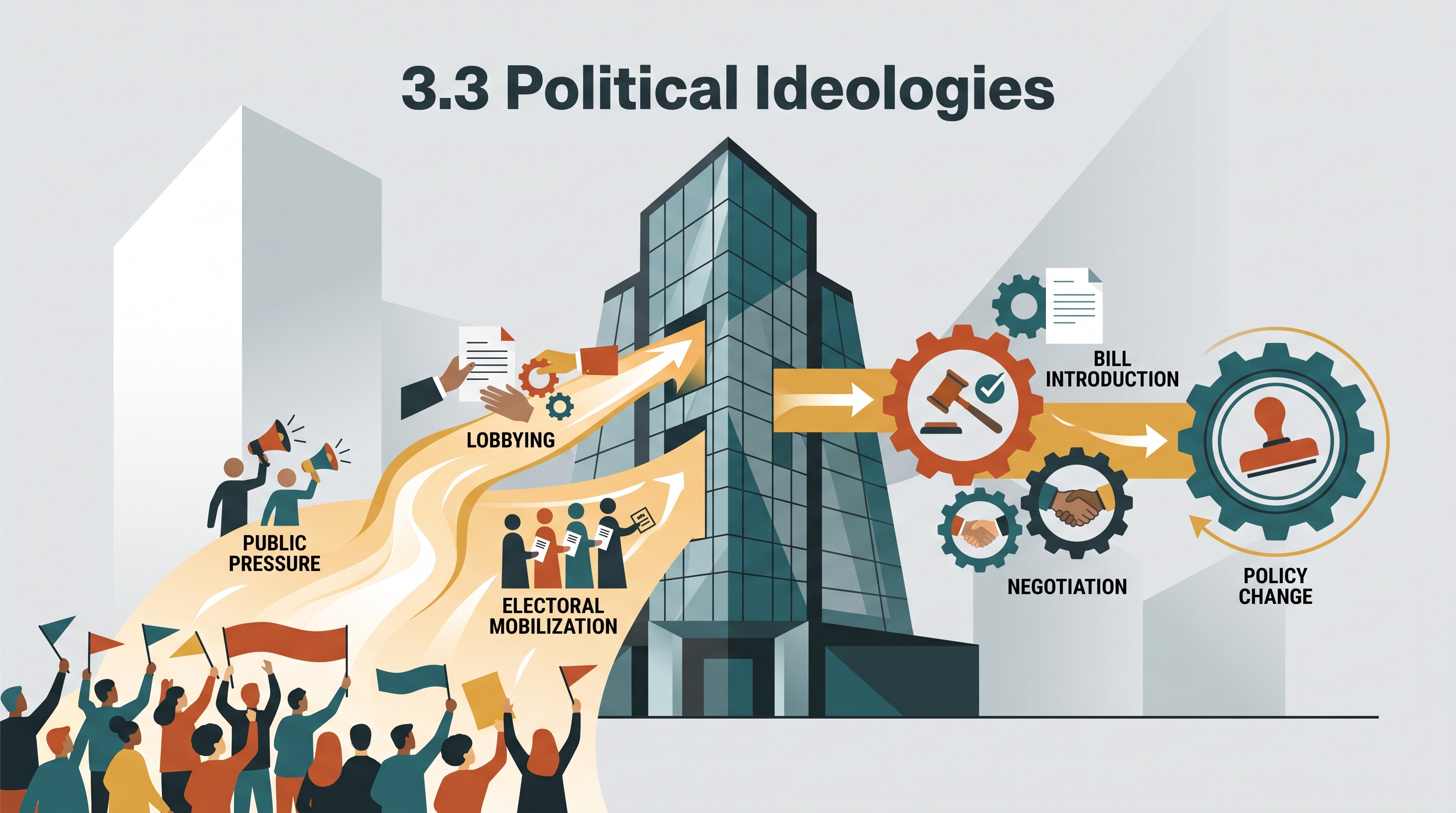
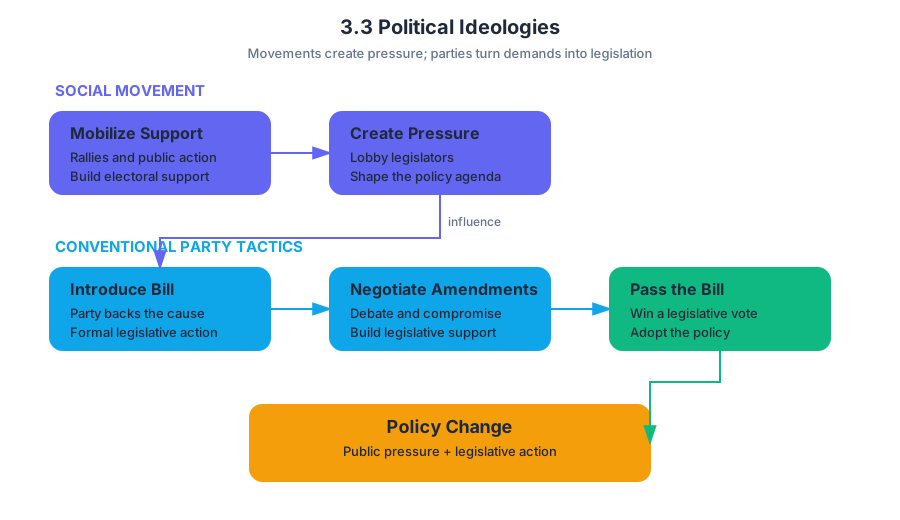
This process explains why parties use conventional tactics. A party converts an ideological goal into bill language, persuades legislators or coalition partners, negotiates amendments, wins votes, and secures enactment. A social movement can affect every stage indirectly: protests may place an issue on the agenda, public demonstrations may increase electoral pressure, and lobbying may persuade officials to introduce or revise a bill.
Worked example: Suppose a movement demands stronger protections against workplace discrimination. It might organize demonstrations to attract public attention, contact legislators, and endorse candidates who support the cause. A political party may then include the demand in its platform, sponsor a bill, debate its provisions, compromise over enforcement, and seek enough votes for passage. The movement supplies pressure and visibility; the party uses institutional access to pursue lawmaking.
Misconception check
Misconception: “Social movements and political parties are interchangeable.” They are not. Both can influence political change, but their organizational form, goals, and usual tactics differ. A movement does not need to win elections to influence policy, while a party normally must build electoral support and govern through formal institutions.
AP skill connection
This topic most directly develops Practice 1: Concept Application, especially defining a social movement, distinguishing it from a political party, and explaining how each affects political change. It also supports Practice 5: Argumentation, because a strong argument can connect ideology, organizational strategy, legislative action, and political outcomes. When comparing countries, Practice 2: Country Comparison requires identifying a meaningful similarity or difference rather than merely naming two examples; Practice 4: Source Analysis may require inferring an ideology or tactic from a speech, platform, or description of protest activity.
Retrieval check
A movement stages rallies, contacts legislators, and endorses a candidate who supports its cause. The candidate’s party introduces a bill, accepts amendments during debate, and wins a legislative vote. Which action is most clearly a conventional party tactic, and how did the movement contribute to the policy change? The party’s introduction, negotiation, and passage of the bill are conventional legislative tactics; the movement contributed by creating public pressure, lobbying, and mobilizing electoral support.
Source Materials
- AP Comparative Government and Politics Course and Exam Description
- AP Comparative Government and Politics Course and Exam Description Clarifications and Corrections
- AP Comparative Government and Politics Course Overview
- AP Comparative Government and Politics Course at a Glance
- AP Comparative Government and Politics Course at a Glance Poster
- AP Comparative Government and Politics
- AP Comparative Government and Politics
- AP Comparative Government and Politics Sample Syllabus 1