From the free course AP Comparative Government and Politics on Lykke
3.4 Political Values and Beliefs
Key concepts: Political culture · Political values and beliefs · Political ideology · Tension between social order and individual liberty · State–citizen relationships · Citizen control of government policymaking · Political socialization · Rule of law · Civil society and democratization · Polling-data analysis of political attitudes
A government can protect individual freedom, enforce social order, or attempt both—but citizens’ political culture determines what they expect that balance to look like. Building on the ideological commitments examined earlier, political culture develops when those commitments shape citizens’ expectations,…
3.4 Political Values and Beliefs
A government can protect individual freedom, enforce social order, or attempt both—but citizens’ political culture determines what they expect that balance to look like. Building on the ideological commitments examined earlier, political culture develops when those commitments shape citizens’ expectations, behavior, and judgments about legitimate state action.
IEF-1 — Enduring Understanding: Political culture, including core beliefs and values that address the tension between order and liberty, shapes the relationship between a state and its citizens.
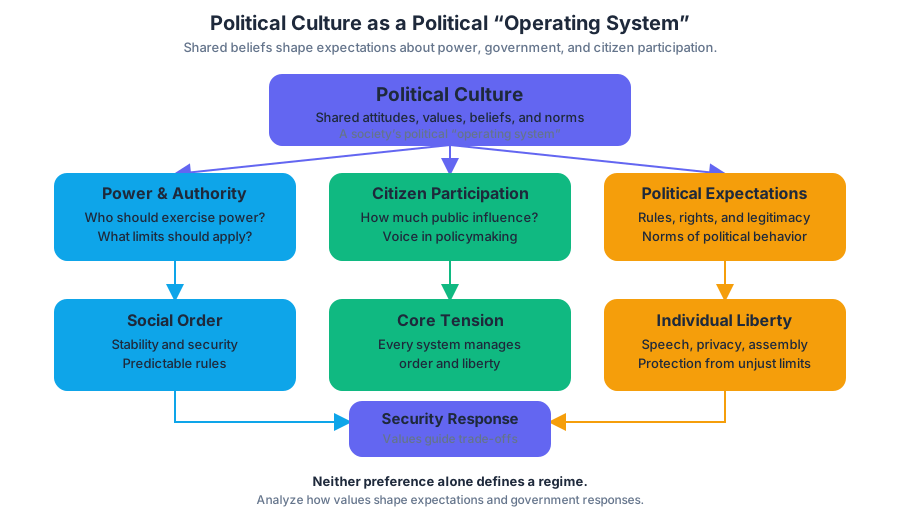
Political culture as a political “operating system”
Political culture is the collective attitudes, values, beliefs, and norms of behavior held by citizens within a political system. It is not simply whether people like or dislike a particular leader. It establishes deeper expectations: Who should exercise power? What limits should apply to government? How much authority should citizens have over policymaking?
IEF-1.C.1 — Essential Knowledge: Political culture includes the core beliefs and values that address the tension between social order and individual liberty. Social order means stability, security, and predictable rules; individual liberty means freedom from unjustified government restrictions. Every political system must manage this tension, even when its citizens disagree about the correct balance.
A useful comparison is to imagine two societies responding to a public-security threat:
- A society that places greater weight on order may accept expanded surveillance, strict public regulations, or limits on protest if these measures appear to prevent disorder.
- A society that places greater weight on liberty may demand stronger protections for speech, privacy, assembly, and opposition—even when those protections make government responses slower or less uniform.
Neither preference automatically identifies a regime as democratic or authoritarian. The analytical question is how political values shape expectations about the legitimate exercise of power and whether institutions actually honor those expectations.
State–citizen relationships
IEF-1.C — Learning Objective: Explain how political culture relates to citizen behavior and the role of the state.
Political culture shapes the relationship between the state and its citizens in two directions. Citizens’ values influence what they demand from government, while government institutions reinforce—or violate—the norms citizens have learned to expect. Political values therefore affect voting behavior, public-policy preferences, trust in institutions, and willingness to accept government authority.
The rule of law illustrates this relationship. It means that laws apply to government officials and ordinary citizens alike; the state is limited by the same legal rules that govern the population. If citizens believe officials are above the law, elections or courts may appear performative rather than legitimate. If citizens expect impartial enforcement, corruption or arbitrary punishment can produce especially sharp losses of trust.
Civil society—nongovernmental organizations, business and professional associations, religious groups, and other voluntary organizations—can mediate this relationship. These groups give citizens ways to organize, communicate demands, monitor officials, and press for reforms, making civil society an important potential agent of democratization.
Transmission and political behavior
Political culture is transmitted through political socialization, the process by which people develop political values, beliefs, attitudes, and behaviors. Families may teach views about authority; schools may model participation or obedience; peers and media may normalize protest or political cynicism; religious institutions may shape ideas about justice, community, and the state.
Worked contextual example: interpreting a policy preference
Suppose polling data show that younger citizens in Country A strongly support freedom of expression but also favor strict penalties for public disorder. A careful conclusion is not that the respondents are “contradictory.” Their answers suggest a political culture attempting to balance liberty with order: expressive freedoms are valued, but citizens also expect the state to preserve security.
To analyze the pattern, compare multiple variables—such as age, education, urban or rural residence, and trust in government. If highly educated urban respondents support free expression at higher rates, that pattern may indicate that social location influences political values. It does not, by itself, prove that education caused the belief. A comparison with another course country can reveal whether the pattern is country-specific or more widespread.
Misconception check
Misconception: political culture is identical to political ideology. Political ideology is a set of values and beliefs about government, policy, or politics; political culture is broader. It includes ideologies, but also shared norms, expectations, historical memories, socialization patterns, and assumptions about citizen–state relations.
Misconception: strong government means no liberty. A state may claim that restrictions protect liberty by producing security, while citizens may judge those restrictions excessive. AP analysis requires identifying the competing values and explaining how they shape behavior or policy—not labeling one side automatically “correct.”
Retrieval and interpretation check
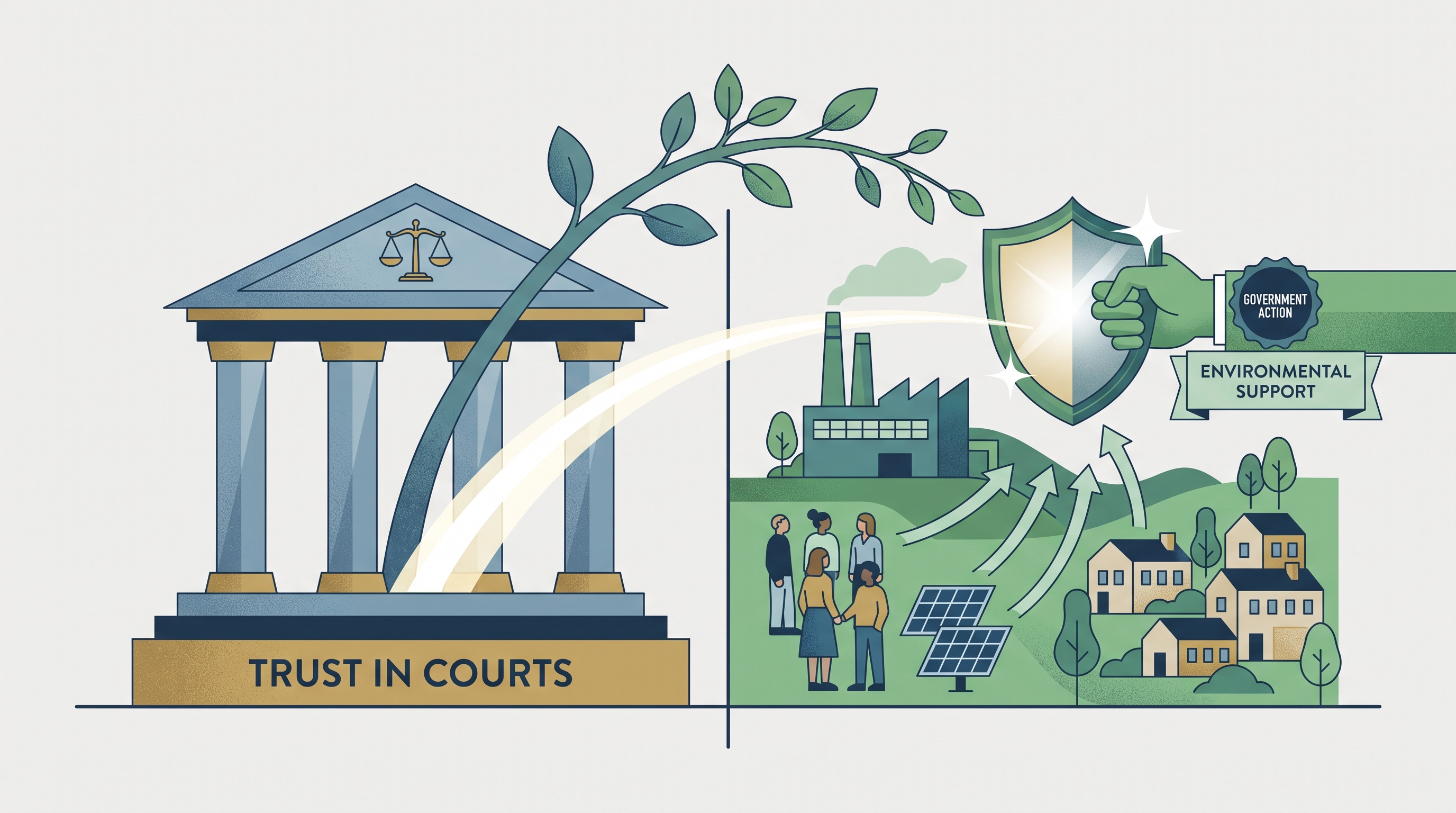
A poll finds that citizens who report high trust in courts are also more likely to support government enforcement of environmental regulations. What should a strong interpretation identify? It should connect the pattern to political culture: confidence in lawful, impartial institutions may increase citizens’ willingness to accept state action. The data show an association, however—not definite proof that trust in courts caused support for regulation. This applies Concept Application and Data Analysis, especially identifying patterns, comparing variables, and drawing evidence-based conclusions.
Source Materials
- AP Comparative Government and Politics Course and Exam Description
- AP Comparative Government and Politics Course and Exam Description Clarifications and Corrections
- AP Comparative Government and Politics Course Overview
- AP Comparative Government and Politics Course at a Glance
- AP Comparative Government and Politics Course at a Glance Poster
- AP Comparative Government and Politics
- AP Comparative Government and Politics
- AP Comparative Government and Politics Sample Syllabus 1