From the free course AP Comparative Government and Politics on Lykke
3.6 Forces that Impact Political Participation
Key concepts: Political participation by individuals and groups · State–society interactions · Population characteristics and demands shaping political patterns · Social cleavages such as ethnicity, religion, and class · Perceived legitimacy of government · Political opposition and electoral competition in authoritarian regimes · Globalization and neoliberalism as influences on political participation · Cultural influences, including Western influences, on domestic politics · Devolution and delegation of power to regional governments · Political participation as an effect of decentralization
Political participation changes when citizens decide whether the government is responsive, legitimate, and worth engaging—or when social divisions, economic pressures, and regime rules make participation easier or riskier.
3.6 Forces that Impact Political Participation
Political participation changes when citizens decide whether the government is responsive, legitimate, and worth engaging—or when social divisions, economic pressures, and regime rules make participation easier or riskier. The same population may vote, protest, organize, or remain silent depending on how the state structures political opportunity.
Learning Objective 3.6.A: Explain the factors that impact political participation. The essential knowledge for this topic is organized under DEM-3.F, with connections to LEG-1.B.5 and IEF-4.A: participation is shaped by population characteristics, state–society relations, perceived legitimacy, globalization, political opposition, and the distribution of authority within a country.
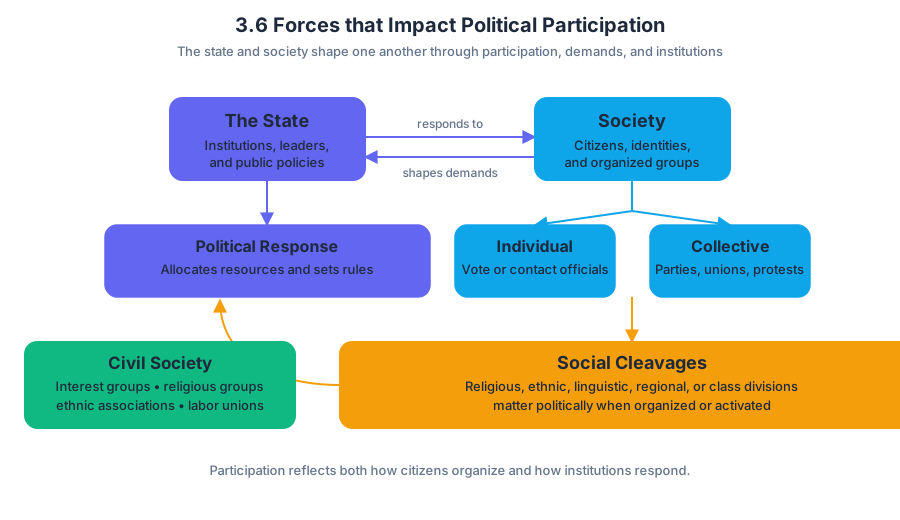
The state and society shape one another
State–society interactions are the ways governments and populations respond to one another. Citizens participate both individually—for example, by voting, contacting officials, or joining a protest—and collectively through political parties, interest groups, labor unions, religious organizations, ethnic associations, and other civil-society groups.
A government does not face a politically uniform population. Population characteristics and demands influence political patterns: a country with large religious, ethnic, linguistic, regional, or class divisions may experience different forms of participation from a more socially homogeneous country. These divisions are called social cleavages—important lines of difference within a population.
The political importance of a cleavage depends on whether institutions, leaders, or policies activate it. Ethnicity, religion, or class may remain mostly private identities, but a cleavage becomes politically significant when citizens organize around it, parties campaign through it, or governments distribute resources in ways that favor one group.
Worked example: when a cleavage becomes political
Imagine a country with two major religious communities. If both communities receive equal access to schools, public employment, and political representation, religious identity may not dominate elections. If the government consistently favors one community, the other may respond through protests, opposition organizations, demands for regional autonomy, or support for a different party.
The causal chain is:
- Population characteristic: religious difference exists.
- Government action: public benefits are distributed unevenly.
- Group response: the disadvantaged community organizes.
- Political pattern: participation becomes more religiously polarized.
- State–society consequence: legitimacy may decline if the government appears unfair.
Legitimacy changes the willingness to participate
Perceived legitimacy is the belief that a government has the rightful authority to rule. Legitimacy affects participation in two directions: citizens may participate because they trust institutions to respond, or they may participate against the government because they believe it has lost its right to rule.
High perceived legitimacy can encourage voting, civic association, and cooperation with public policies. Low perceived legitimacy can produce apathy, protest, civil disobedience, or support for opposition movements. However, low participation does not automatically prove legitimacy: people may be satisfied, politically powerless, afraid of repression, or excluded from elections.
Key distinction: Participation answers what citizens do. Legitimacy answers whether citizens regard authority as rightful. A protest can indicate active participation and declining legitimacy at the same time.
Authoritarian regimes and controlled competition
Regime type strongly influences the available forms of participation. In authoritarian regimes, few or no opposition candidates may be allowed to run for office. When opposition candidates are permitted, they advocate views that differ from those of the controlling party or elite, but censorship, surveillance, registration requirements, or electoral restrictions may limit their effectiveness.
An election therefore does not automatically demonstrate democratic participation. A ruling party may use elections to measure public opinion, distribute patronage, create an appearance of legitimacy, or identify dissatisfied regions while preventing genuine competition. Citizens may participate strategically—supporting an opposition candidate, boycotting an election, or using the campaign period to publicize grievances.
Globalization, neoliberalism, and participation
Globalization increases the movement of goods, investment, ideas, technology, and people across borders. It can expand political demands by exposing citizens to new cultural influences—often Western—and by connecting domestic activists to international organizations and information networks.
Neoliberalism, an approach emphasizing market competition, privatization, reduced regulation, and limited government economic intervention, can also provoke conflict. Economic reforms may attract investment and increase efficiency, but they can place new demands on governments when workers lose protections, prices rise, or regional inequalities widen. Citizens may then organize against the policies or demand compensation from the state.
Devolution: participation closer to home
Devolution is the transfer of authority from a central government to regional or local governments. It can increase participation because decisions occur closer to citizens, make policies more responsive to local needs, encourage policy innovation, improve representation for religious, ethnic, or minority groups, and check central power.
Devolution is not automatically stabilizing. Regional governments may create contradictory policies, implement programs unevenly, compete for resources, or intensify ethnic and local tensions. If citizens blame fragmented authority for poor outcomes, devolution can weaken legitimacy and make social, political, and economic problems harder to resolve.
Misconception check: Devolution is not the same as independence. A devolved region receives authority within the state; it does not necessarily possess sovereignty or the legal right to leave the country.
AP skill application
This topic is especially suited to Practice 1: Concept Application—1.A Define and describe political concepts and processes and 1.B Explain how political concepts and processes relate to one another—because a strong response must connect legitimacy, cleavages, globalization, devolution, and participation rather than merely define them.
It also develops Practice 2: Country Comparison, especially 2.A Describe similarities and differences in political systems and 2.B Explain how political processes relate to political systems. Practice 5: Argumentation—5.A Make a claim with evidence, 5.B Support a claim with evidence, and 5.C Use reasoning to organize and analyze evidence—is required when judging whether a policy such as devolution increases or decreases participation.
Retrieval check
A government permits opposition candidates but restricts campaign media and arrests organizers after demonstrations. Identify one way regime type affects participation and explain how the restrictions could affect perceived legitimacy. A complete answer should connect controlled electoral competition to limited participation and then to a possible decline in the government’s perceived right to rule.

Source Materials
- AP Comparative Government and Politics Course and Exam Description
- AP Comparative Government and Politics Course and Exam Description Clarifications and Corrections
- AP Comparative Government and Politics Course Overview
- AP Comparative Government and Politics Course at a Glance
- AP Comparative Government and Politics Course at a Glance Poster
- AP Comparative Government and Politics
- AP Comparative Government and Politics
- AP Comparative Government and Politics Sample Syllabus 1