From the free course AP Comparative Government and Politics on Lykke
5.1 Impact of Global Economic and Technological Forces
Key concepts: Economic globalization · Technological forces · Sovereignty · Global interconnectedness · Worldwide markets · Economic liberalization · Reduction of state control over economies · International trade institutions · Foreign direct investment · Domestic political backlash
A product assembled in several countries, financed by foreign capital, and sold through a digital platform illustrates a central political reality: economic activity increasingly crosses borders that governments once controlled more directly.
5.1 Impact of Global Economic and Technological Forces
A product assembled in several countries, financed by foreign capital, and sold through a digital platform illustrates a central political reality: economic activity increasingly crosses borders that governments once controlled more directly. Economic globalization is the growth of interconnected economic networks and a worldwide market in which workers, goods, capital, and corporations operate across political borders.
Learning Objective IEF-3.A: Explain how global economic and technological forces influence political policies, behaviors, and culture.
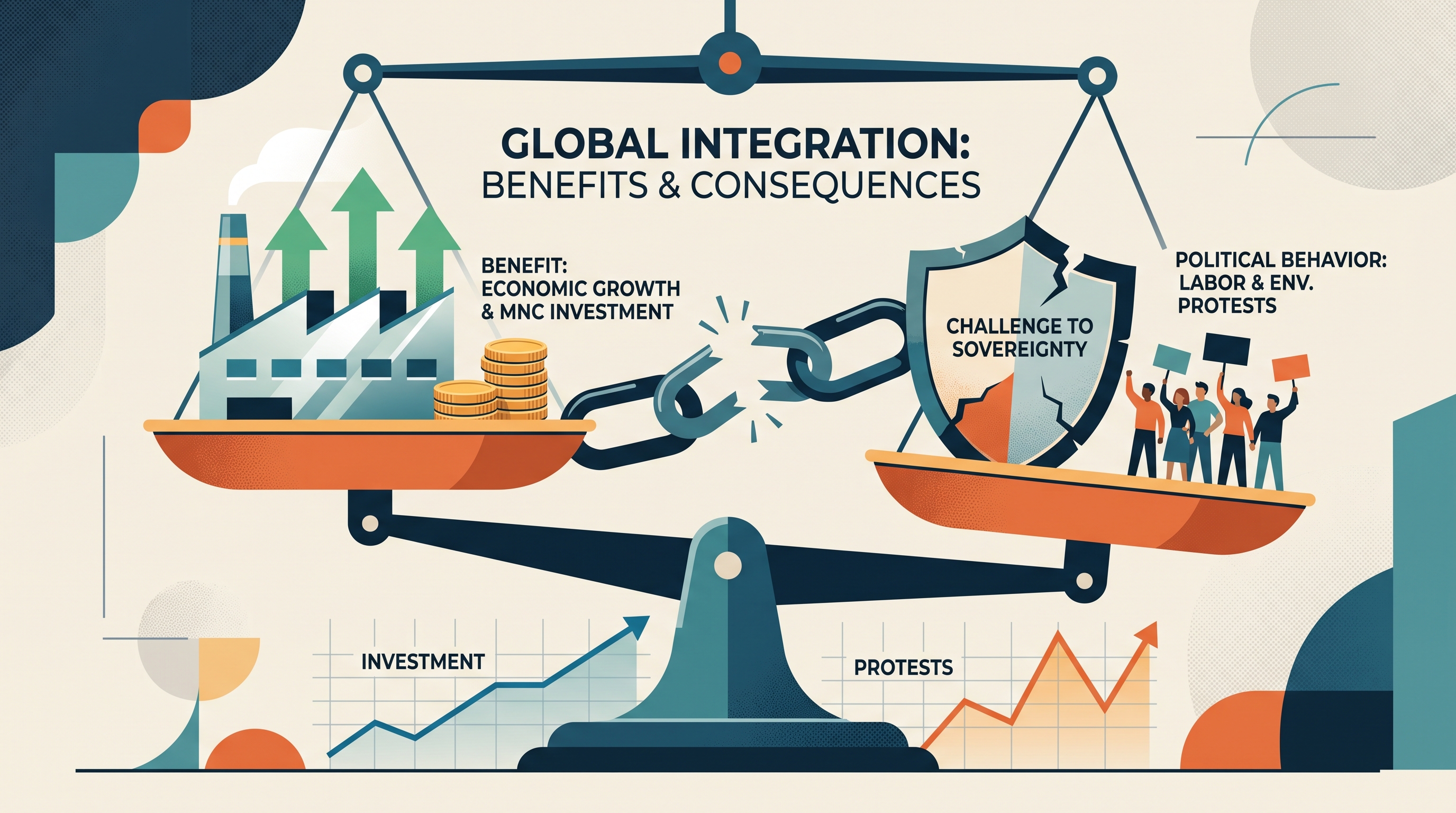
The enduring idea is that economic globalization and economic liberalization have positively and negatively affected political policies and behaviors. Global connections can create growth, investment, and cooperation, but they can also reduce state control, intensify inequality, challenge cultural stability, and provoke resistance.
Economic globalization: connection and reduced control
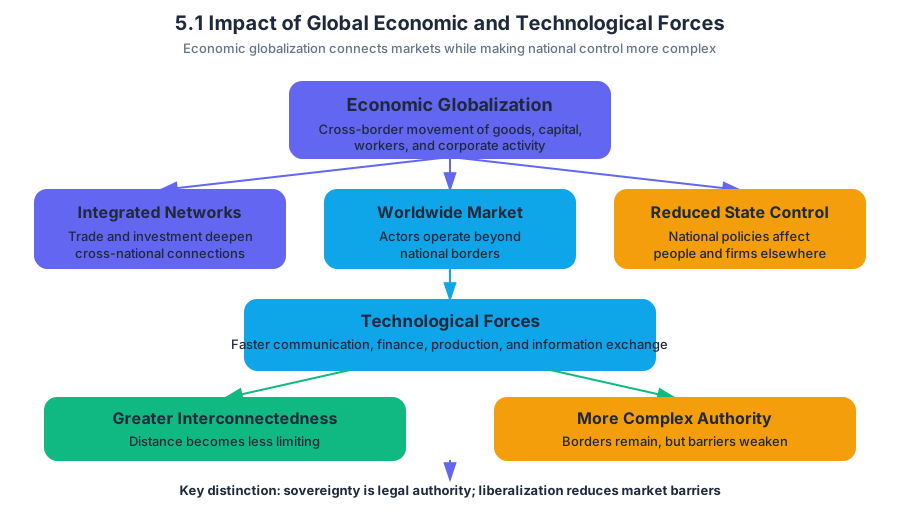
Under IEF-3.A.1, economic globalization has three connected features: increasingly integrated networks, a worldwide market with actors less constrained by national borders, and a reduction in state control over national economies. Trade and investment deepen cross-national connections, so a policy made in one country can affect workers, consumers, businesses, and governments elsewhere.
Technological forces accelerate this process by making communication, financial transfers, production, and information exchange faster across distance. Technology does not eliminate political borders, but it makes those borders less effective as barriers to economic activity. The result is greater global interconnectedness—and a more complicated relationship between national authority and international markets.
A useful distinction is:
| Concept | Political meaning |
|---|---|
| Sovereignty | A state’s supreme legal authority to govern its population and territory without outside interference |
| Economic globalization | Increasing cross-border movement of workers, goods, capital, and corporate activity |
| Economic liberalization | Reducing state ownership, tariffs, regulations, or other barriers so markets and private actors have greater freedom |
| Worldwide market | An economic arena in which actors operate across national political borders |
Economic liberalization can include privatizing state-owned enterprises, reducing tariffs and subsidies, lowering regulations, joining trade agreements, or creating special economic zones. Membership in the International Monetary Fund (IMF), World Bank, and World Trade Organization (WTO) has promoted liberalization policies, linking domestic economic choices to global economic governance under IEF-3.A.2.
Multinational corporations and state authority
A multinational corporation (MNC) operates in more than one country and may possess resources greater than those available to a local firm or government agency. Under IEF-3.A.3, MNCs can challenge domestic policies concerning labor, environmental protection, land rights, taxation, and public budgets.
The tension is not simply “government versus business.” A government may welcome foreign investment because it creates jobs, expands production, or brings technology. Yet the same government may face pressure to weaken labor rules, reduce taxes, permit land development, or protect corporate profits—choices that can conflict with domestic priorities.
Worked example: tracing the political effect
Imagine that Country A creates a special economic zone to attract an electronics MNC. The government expects factories, employment, and export revenue. Foreign investment arrives, but the company requests lower taxes and fewer environmental restrictions.
The causal chain is:
- Liberalization: Country A reduces barriers to foreign investment.
- Global connection: An MNC enters with capital, technology, and production networks.
- Policy pressure: The company seeks favorable tax, labor, land, or environmental rules.
- Political response: Civil society groups demand stronger regulation.
- Political behavior: Students, workers, or disenfranchised groups protest.
- Authority challenge: If inequality or environmental damage grows, citizens may blame the government for surrendering control.
This example shows why globalization can produce both positive and negative effects. Economic growth may strengthen government legitimacy, while unequal benefits or cultural disruption may weaken it.
Sovereignty, culture, and backlash
Globalization can challenge sovereignty when a government must comply with international trade policies that conflict with national laws. The government formally remains sovereign, but its practical policy choices become more constrained by international commitments, foreign governments, MNCs, and global financial institutions.
Foreign direct investment can also introduce outside values, consumption patterns, and workplace practices that challenge traditions, producing cultural erosion. Economic development may further create inequality or environmental damage, leading to domestic unrest and challenges to government authority.
Under IEF-3.A.4, globalization and neoliberalism can generate internal conflict through increased demands from civil society groups, protests by students and marginalized groups, arrests of protesters, social-media restrictions, and the empowerment of nationalist or populist groups that blame governments for economic and cultural change.
Misconception check: Globalization does not automatically weaken every state or benefit every citizen. Its effects depend on who gains resources, who bears costs, and how governments respond.
In-flow retrieval check
A government joins the WTO, lowers tariffs, attracts an MNC, and later faces protests over pollution and unequal wages. Identify one benefit, one challenge to sovereignty, and one political behavior produced by this sequence. A strong answer connects each effect causally rather than merely listing globalization-related terms.
Suggested skill: Data Analysis — Describe the data presented. When a graph or table shows trade, investment, inequality, or protest trends, first identify the visible pattern accurately; then connect that pattern to IEF-3.A without claiming that the data alone proves a cause.
Source Materials
- AP Comparative Government and Politics Course and Exam Description
- AP Comparative Government and Politics Course and Exam Description Clarifications and Corrections
- AP Comparative Government and Politics Course Overview
- AP Comparative Government and Politics Course at a Glance
- AP Comparative Government and Politics Course at a Glance Poster
- AP Comparative Government and Politics
- AP Comparative Government and Politics
- AP Comparative Government and Politics Sample Syllabus 1
- AP Comparative Government and Politics-AP Students-College Board
- AP Comparative Government and Politics-Wikipedia
- AP Comparative Government and Politics Cheat <http://sheets-albert.io>Sheets-Albert.io
- AP Comparative Government and Politics-GOA