From the free course AP Comparative Government and Politics on Lykke
1.10 Political Stability
Key concepts: Political stability · Fragile States Index · State fragility · Rule of law · Rule by law · Judicial independence · Institutional trust · Economic liberalization · Nationalism and patriotism · Social movements and political change
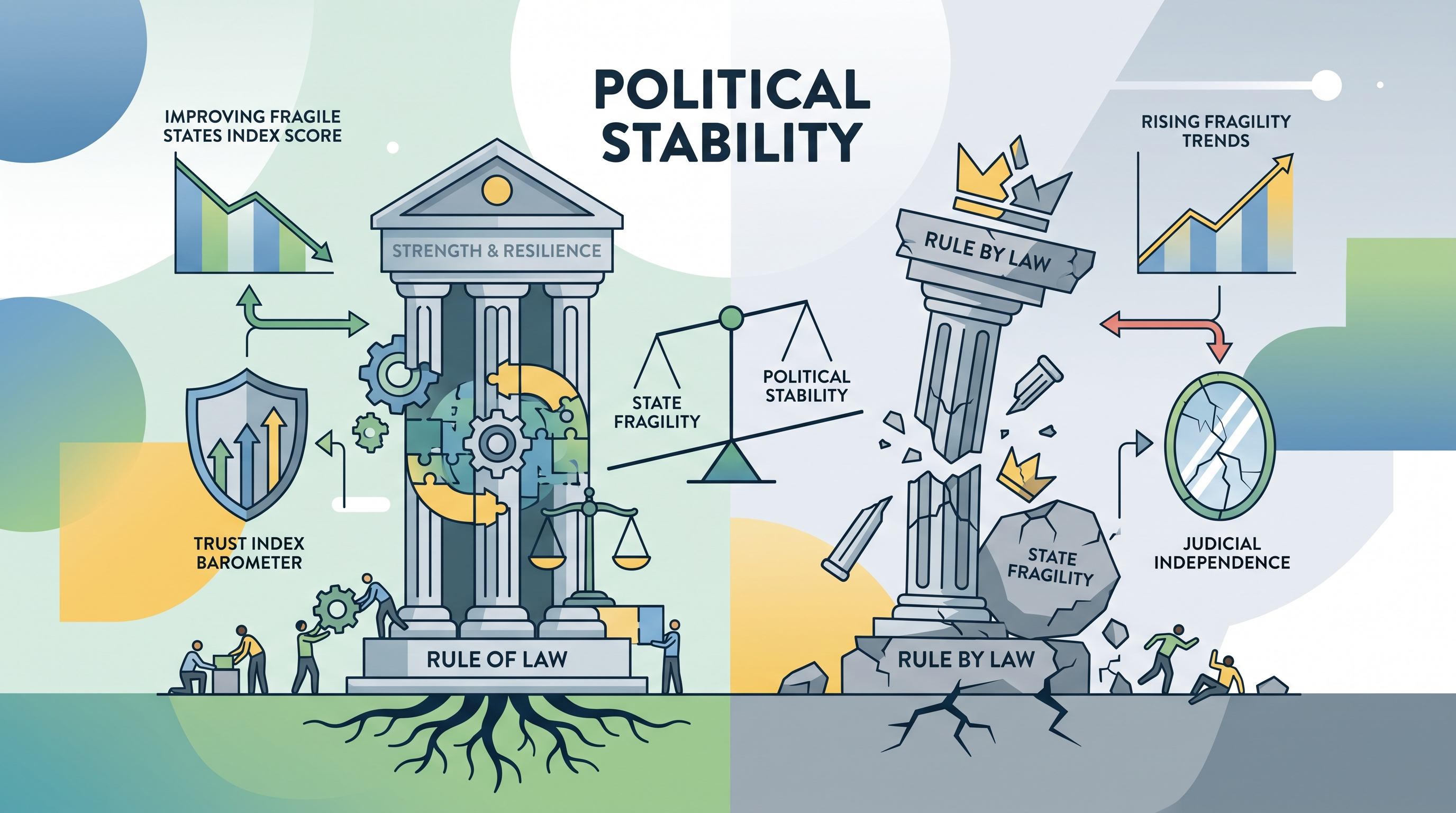
A state is politically stable when its governing institutions maintain order, manage conflict, and continue functioning without frequent crises, coups, violent challenges, or breakdowns in authority.
1.10 Political Stability
A state is politically stable when its governing institutions maintain order, manage conflict, and continue functioning without frequent crises, coups, violent challenges, or breakdowns in authority. Stability is not the same as public happiness or democracy: an authoritarian government may preserve order through censorship and coercion, while a democracy may experience protest yet remain institutionally stable.
LEG-1.C — Explain how internal actors influence and interact with state authority and either enhance or threaten stability.
Stability, fragility, and trust
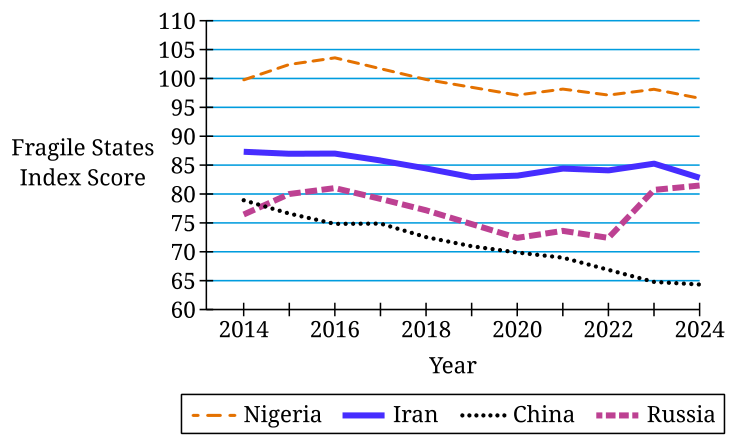
The Fragile States Index measures how vulnerable a state is to political, social, and economic breakdown. Its scale runs from $0$ to $120$: a score of $0$ indicates the least fragility and greatest stability, while $120$ indicates the greatest fragility and least stability.
The index compares Nigeria, Iran, China, and Russia from 2014 to 2024. To interpret a line graph, do not merely identify which country has the highest score in one year. Track both level and trend: a country can remain relatively fragile while becoming more stable if its score falls over time.
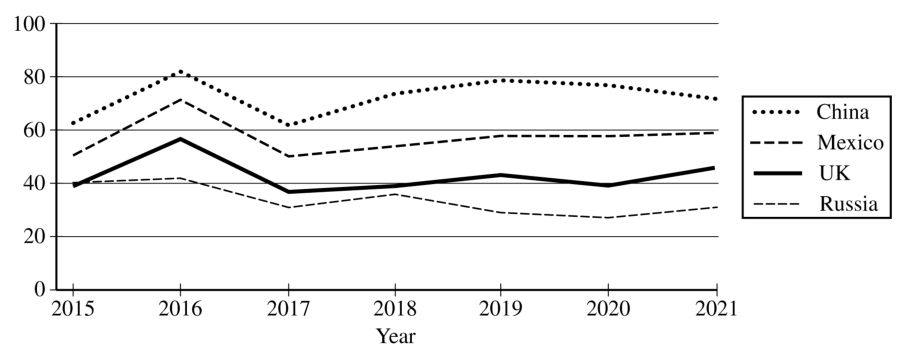
A second measure, the Trust Index Barometer, records mass-population trust in government, business, media, and nongovernmental organizations from $2015$ to $2021$ in China, Mexico, the United Kingdom, and Russia. Here, higher scores indicate greater public trust in institutions. Trust can support stability because people are more likely to obey decisions, use established channels, and accept temporary sacrifices when they believe institutions are credible.
Possible explanations for higher trust or greater political stability include economic growth, effective media censorship, combating corruption, and encouraging patriotism. These explanations do not have identical political meanings. Economic growth may improve living conditions; anti-corruption campaigns may increase confidence; censorship may suppress criticism without creating genuine consent; and patriotism may unify citizens but also marginalize dissenters.
Rule of law versus rule by law
The rule of law means that laws constrain government officials as well as citizens. It requires predictable legal procedures, legal equality, protection of rights and liberties, and courts capable of judging government action. Rule by law, by contrast, occurs when authorities use laws and courts as instruments of government control; laws exist, but they do not meaningfully limit those who rule.
The United Kingdom Supreme Court illustrates an independent judiciary. Using common law, the court can uphold the rule of law and protect rights and liberties by applying legal principles even when doing so limits government action. Judicial independence means that judges can make decisions without improper control by executives, legislatures, political parties, or other powerful actors.
China, Iran, and Russia are presented as lacking independent judiciaries. Judicial rulings may strengthen governmental control rather than restrain it, making these examples of rule by law rather than rule of law. The key comparison is not whether courts exist; it is whether courts can impose meaningful legal limits on state authority.
Misconception check: “A country has rule of law because it has many laws and courts.”
Correction: Rule of law depends on constraint, independence, and legal equality, not simply on the number of statutes or court buildings.
Internal actors and the stability trade-off
Internal actors—including courts, civil society groups, political parties, protest movements, media organizations, and separatist groups—can either reinforce or threaten stability. Social movements can produce political change by organizing citizens, publicizing grievances, pressuring officials, and forcing policy reform; unlike political parties, however, they do not necessarily possess an organized structure for contesting elections or governing.
State responses create a central stability trade-off. Repression, censorship, or restrictions may reduce visible unrest in the short term, but unresolved grievances can weaken long-term stability. Reform, transparency, legal equality, and protection of civil liberties may invite criticism initially while strengthening institutions and public trust over time.
Brexit demonstrates that stability involves more than sovereignty. Brexit may have increased British sovereignty by returning authority from the European Union to the United Kingdom, yet it may also have decreased political stability by encouraging Scottish independence movements. A state can therefore gain authority in one dimension while facing greater internal contestation in another.
Economic policy can produce a similar trade-off. A state may prefer economic liberalization—such as reducing state control over national industry—because private investment and economic growth can support stability. However, liberalization can also create inequality, weaken protected industries, or generate opposition from groups that lose state support.
AP skill application
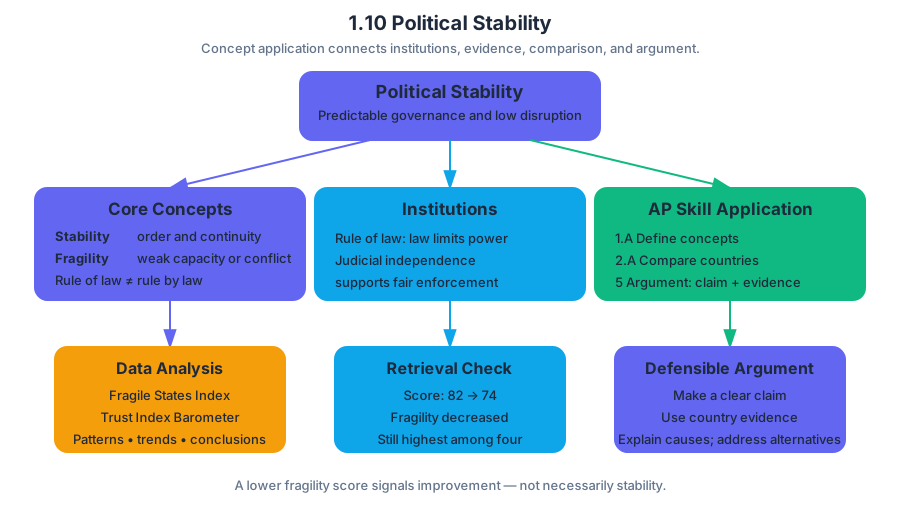
This topic most directly develops Practice 1: Concept Application, especially 1.A Define and explain concepts and processes, by distinguishing political stability, state fragility, rule of law, rule by law, and judicial independence. It also develops Practice 2: Country Comparison, 2.A Describe similarities and differences, and Practice 3: Data Analysis, including identifying patterns, describing trends, and drawing conclusions from the Fragile States Index and Trust Index Barometer. In written responses, Practice 5: Argumentation requires a defensible claim, specific country evidence, causal reasoning, and attention to an alternate perspective.
Retrieval check: A country’s Fragile States Index score falls from $82$ to $74$, but it still has the highest score among four countries. What two conclusions are justified?
Answer: Its fragility decreased over the period, indicating improving stability, but it remained the most fragile of the countries compared. A falling score does not automatically mean the country became stable.
Source Materials
- AP Comparative Government and Politics Course and Exam Description
- AP Comparative Government and Politics Course and Exam Description Clarifications and Corrections
- AP Comparative Government and Politics Course Overview
- AP Comparative Government and Politics Course at a Glance
- AP Comparative Government and Politics Course at a Glance Poster
- AP Comparative Government and Politics
- AP Comparative Government and Politics
- AP Comparative Government and Politics Sample Syllabus 1
- Source: Edelman Global Trust Barometer
- Source: Fragile States Index