From the free course AP Comparative Government and Politics on Lykke
2.7 Independent Legislatures
Key concepts: Independent legislatures · Liberties · Progression of topics within each unit
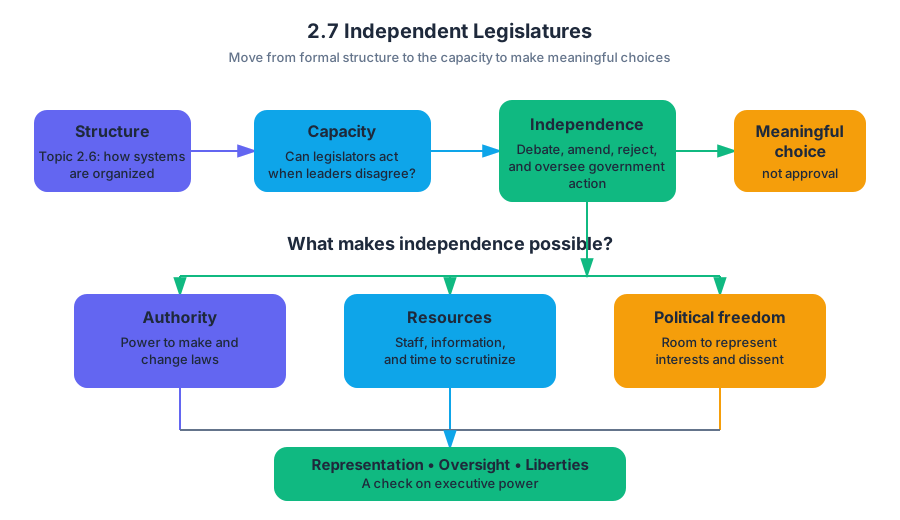
A legislature is independent when it can debate, amend, reject, and oversee government action without being controlled by the executive. The key question is not whether a country has a parliament or congress—it is whether that institution can make meaningful choices when the executive disagrees.
2.7 Independent Legislatures
A legislature is independent when it can debate, amend, reject, and oversee government action without being controlled by the executive. The key question is not whether a country has a parliament or congress—it is whether that institution can make meaningful choices when the executive disagrees.
In the progression of Unit 2, the analysis therefore moves from structure to capacity: after identifying how legislative systems are organized in Topic 2.6, ask whether legislators possess enough institutional power, resources, and political freedom to act independently. That question prepares the analysis of another institutional check without treating the legislature as automatically powerful simply because it exists.
Independent legislature: a legislature that has sufficient authority and autonomy to create laws, represent interests, oversee the executive, and protect liberties rather than merely approve decisions already made by executive leaders.
What makes a legislature independent?
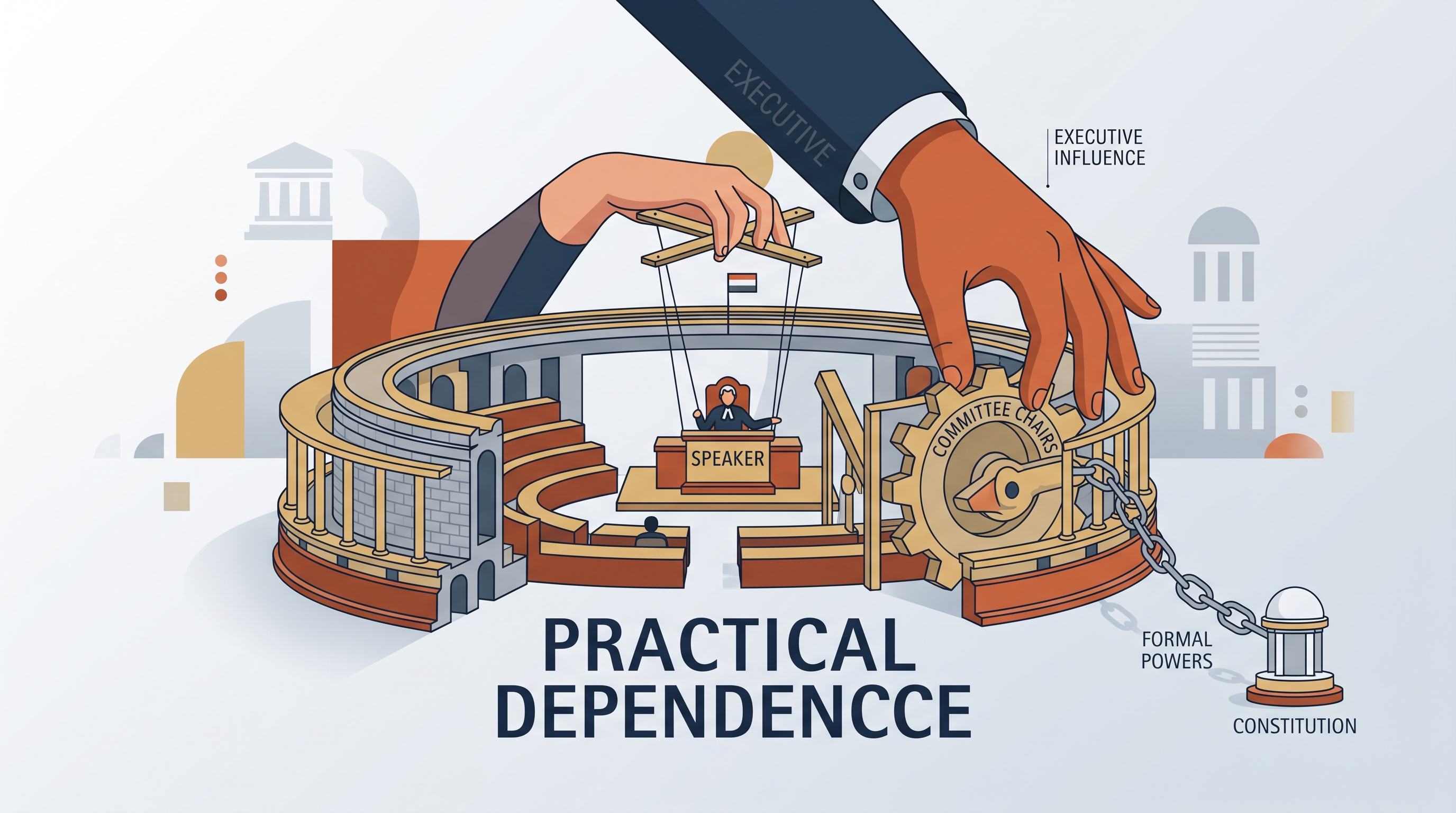
Legislative independence has several dimensions. A legislature may possess formal constitutional authority but lack practical independence if the executive controls the governing party, intimidates opposition members, restricts debate, or controls access to information.
The most useful test is to examine what happens when the legislature and executive disagree. An independent legislature can investigate executive conduct, alter proposed laws, control or scrutinize public spending, represent organized interests, and force public justification of government decisions.
| Dimension of independence | Question to ask | Evidence of stronger independence |
|---|---|---|
| Law-making authority | Can legislators amend or reject executive proposals? | Bills change substantially during legislative debate |
| Oversight | Can the legislature investigate officials? | Committees request documents or summon ministers |
| Budgetary authority | Can legislators influence public spending? | The executive must obtain legislative approval |
| Institutional resources | Do legislators have staff, research, and information? | Committees can evaluate complex policies independently |
| Political autonomy | Can members disagree without retaliation? | Governing-party legislators sometimes vote against the executive |
| Representation | Can competing interests enter debate? | Opposition and minority groups participate meaningfully |
Formal power versus practical power
A constitution may grant a legislature the power to pass laws, approve budgets, or remove officials. Those powers are formal powers: authority written into legal rules. Practical power is the ability to use those authorities effectively under real political conditions.
For example, a legislature may legally reject a presidential proposal, yet remain dependent on the president if the president’s party holds nearly every seat, controls committee leadership, and can punish dissenters by denying renomination. The legislature is formally active but practically subordinate.
Exam distinction: Do not equate “has a legislature” with “has an independent legislature.” Independence is demonstrated through behavior, not merely institutional design.
Worked example: evaluating legislative independence
Imagine Country A. Its constitution allows the National Assembly to amend bills and investigate ministers. However, the president’s party controls $85%$ of the seats, opposition members receive limited media access, and committee chairs are appointed directly by the president. When the president proposes a security law, the Assembly approves it without changes after a single short debate.
A strong analysis would separate the evidence:
- The Assembly has formal law-making and oversight powers.
- The president’s overwhelming party majority reduces the likelihood of legislative resistance.
- Presidential control over committee leadership limits independent investigation.
- The brief, unamended debate suggests that the Assembly is not exercising meaningful policy influence.
- Therefore, Country A has a legislature with constitutional authority but low practical independence.
The conclusion should not be that the legislature is completely powerless. It may still represent local interests or provide administrative approval. The precise claim is that executive dominance prevents it from functioning as an effective independent check.
Independent legislatures and liberties
The connection to Liberties is direct. Civil liberties—basic freedoms such as expression, association, religious practice, and protection from arbitrary government action—are more vulnerable when no institution can challenge executive overreach.
An independent legislature can protect liberties by requiring public debate, revising restrictive laws, exposing abuses through hearings, and representing groups that executive officials overlook. This protection is not guaranteed: a legislature can also pass repressive laws. Independence creates an opportunity for scrutiny and opposition; it does not automatically produce liberal policy.
Named misconception: “An elected legislature is independent”
Correction: Elections may improve representation, but they do not by themselves guarantee institutional independence. A legislature can be elected yet constrained by executive control of parties, unequal electoral rules, censorship, patronage, intimidation, or emergency powers.
A second misconception is that disagreement always proves independence. Occasional criticism may be symbolic. To establish independence, look for repeated evidence: legislators changing proposals, investigating officials, controlling resources, and protecting dissent even when those actions impose political costs.
Skill application
Topic 2.7 is associated with 2.A and the concept of Liberties, and its skill pairing includes 4.C. In practice, 4.C requires explaining how evidence from a political source supports a claim. If a source reports that a legislature rejected an executive bill, do not stop at “the legislature is independent.” Explain the mechanism: rejection demonstrates that legislators could oppose the executive and exercise law-making authority.
A country comparison should also distinguish degree rather than force a binary label. One legislature may control the budget but lack freedom from the governing party; another may represent opposition groups but possess little authority over national security. Independence is multidimensional.
Retrieval check
A constitution grants parliament the power to investigate ministers, but the executive appoints committee chairs, controls legislative information, and punishes governing-party members who vote against executive bills. Is parliament formally independent, practically independent, both, or neither? Explain using one piece of evidence and the mechanism connecting it to legislative independence.
Source Materials
- AP Comparative Government and Politics Course and Exam Description
- AP Comparative Government and Politics Course and Exam Description Clarifications and Corrections
- AP Comparative Government and Politics Course Overview
- AP Comparative Government and Politics Course at a Glance
- AP Comparative Government and Politics Course at a Glance Poster
- AP Comparative Government and Politics
- AP Comparative Government and Politics
- AP Comparative Government and Politics Sample Syllabus 1