From the free course AP Comparative Government and Politics on Lykke
4.2 Objectives of Election Rules
Key concepts: Objectives and functions of election rules · Electoral regulatory organizations · Fairness and efficiency in elections · Enforcement of election rules · Democratic consolidation · Electoral competition · Political representation · Independent election-management bodies · Authoritarian actions and electoral accountability · Effects of election-rule changes
Election rules do more than count votes: they decide who may compete, how votes become representation, and whether citizens can trust the result. A rule that appears administrative—such as requiring an independent election commission—can therefore alter the balance of power between voters, governing elites, and…
4.2 Objectives of Election Rules
Election rules do more than count votes: they decide who may compete, how votes become representation, and whether citizens can trust the result. A rule that appears administrative—such as requiring an independent election commission—can therefore alter the balance of power between voters, governing elites, and opposition groups.
Learning Objective DEM-2.B: Explain how election rules serve different regime objectives regarding ballot access, election wins, and constituency accountability.
Election rules as political instruments
Election rules are the procedures that organize participation and convert political preferences into official outcomes. Their objectives may include expanding ballot access, helping a ruling party win, encouraging accountability to constituents, limiting fraud, or preserving the governing elite’s political agenda.
The same rule can serve different political purposes depending on how it is designed and enforced. For example, an appointment system for some legislative seats may promote a diversity of viewpoints, but appointments can also allow governing elites to select members who advance the regime’s agenda rather than reflect voters’ preferences.
Electoral regulatory organizations
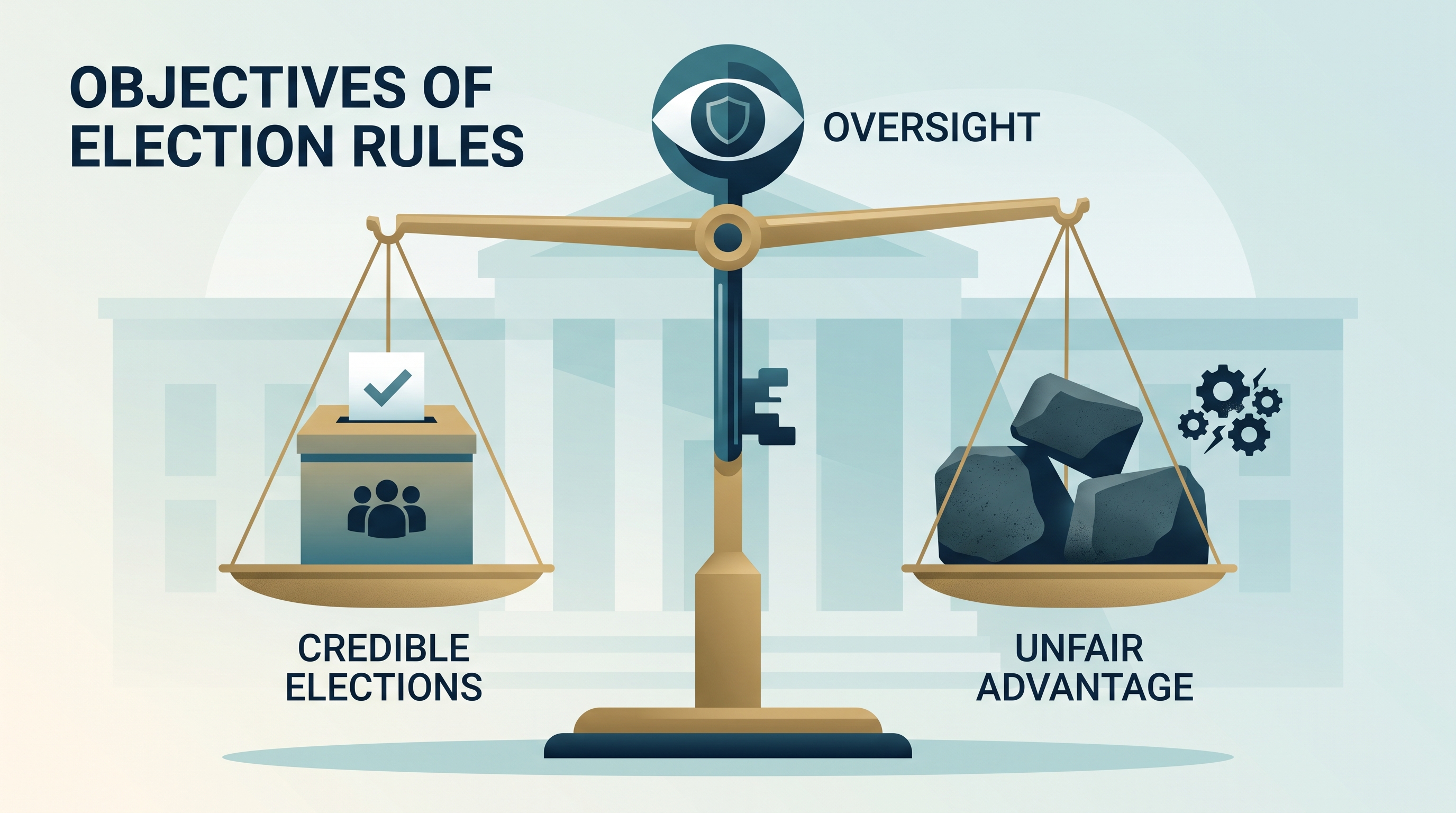
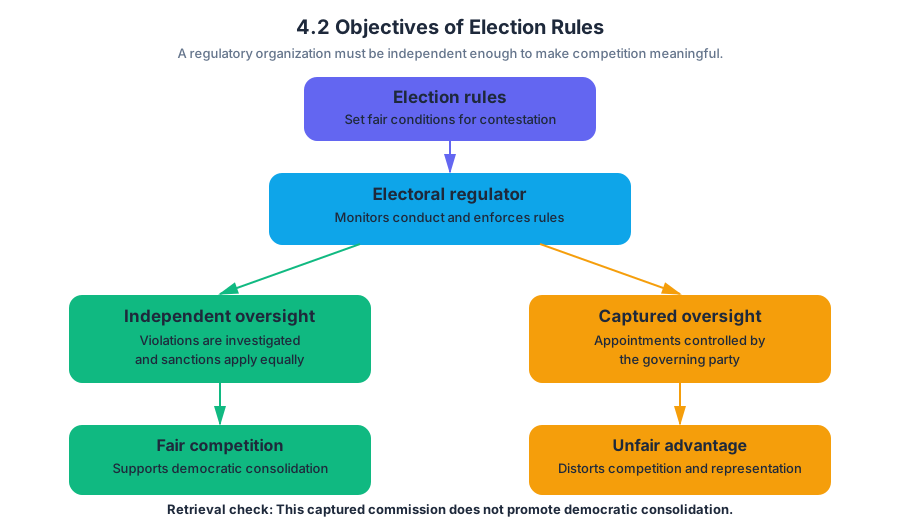
Electoral regulatory organizations are institutions responsible for making sure election rules are followed while an election is taking place. Their work commonly includes administering voting procedures, monitoring compliance, reducing voter fraud and manipulation, and helping elections operate with fairness and efficiency.
Fairness means that candidates and voters operate under rules that are not arbitrarily tilted toward one side. Efficiency means that elections are organized accurately and predictably: eligible citizens can vote, ballots are processed, and results are produced without unnecessary disorder or delay.
Mexico and Nigeria created independent election commissions as part of their democratic transitions. These organizations attempted to reduce fraud and manipulation while enhancing electoral competition. Their significance lies not merely in existing as separate institutions, but in the political function they perform: independent administration can make competition more credible.
Worked example: from institution to democratization
Imagine that an election commission prevents local officials from discarding opposition ballots, publishes consistent voting procedures, and verifies the count. The immediate function is enforcement of election rules. The broader consequence is that citizens have stronger reason to believe that their votes will be counted, opposition candidates have a greater reason to compete, and election results are more likely to reflect citizen preferences.
That chain explains how an electoral regulatory organization can contribute to democratization, the process through which a political system becomes more democratic. It is not enough to write “the commission makes elections fair.” A complete explanation connects the institution to a mechanism and then to a political outcome: independent enforcement limits manipulation, which increases credible competition and makes government more responsive to voters.
Fairness, competition, and representation
Election rules can either widen or narrow representation. Some electoral systems limit the number of candidates on the ballot, reducing electoral competition—the ability of multiple candidates or parties to contest power. Fewer competitors may simplify voting, but it can also reduce the range of viewpoints and weaken voters’ ability to hold leaders accountable.
Changes to election rules therefore affect political representation. A restriction that removes smaller candidates may increase the probability that a major party wins while decreasing the likelihood that minority interests appear in the legislature. This is why election rules must be analyzed by asking whose access, whose victory, and whose accountability the rule promotes.
Enforcement and democratic consolidation
Election rules can prevent executives or legislatures from tolerating ruling-party corruption, reducing civil liberties, or ignoring election results. Enforcement creates institutional limits: leaders cannot simply treat electoral procedures as optional when an independent organization can investigate violations, apply the rules, and protect the credibility of the result.
Democratic consolidation is the process of strengthening and stabilizing democracy so that democratic rules become durable rather than temporary. Election rules and civil liberties can support consolidation when they protect meaningful competition, reliable participation, and acceptance of results; they can impede democratization when they restrict candidates, tolerate manipulation, or make opposition participation ineffective.
Misconception check
Misconception: “An electoral commission automatically makes a country democratic.” An electoral organization matters only if its rules are applied impartially and its decisions have enough independence to constrain manipulation. Naming the institution earns less analytical value than explaining how its enforcement changes competition, representation, or public trust.
AP skill connection: This topic most directly develops Practice 1: Concept Application, by applying electoral regulation, democratization, and democratic consolidation to a political situation; Practice 2: Country Comparison, through comparison of Mexico and Nigeria; and Practice 5: Argumentation, when explaining whether a rule strengthens or weakens democratic competition. A strong response states the function, identifies the mechanism, and links that mechanism to the political consequence.
Retrieval check
A government creates an election commission, but the governing party controls its appointments and the commission ignores violations by ruling-party candidates. Is the organization promoting democratic consolidation? Explain your answer using one function of electoral regulatory organizations and one consequence for electoral competition or representation.
Source Materials
- AP Comparative Government and Politics Course and Exam Description
- AP Comparative Government and Politics Course and Exam Description Clarifications and Corrections
- AP Comparative Government and Politics Course Overview
- AP Comparative Government and Politics Course at a Glance
- AP Comparative Government and Politics Course at a Glance Poster
- AP Comparative Government and Politics
- AP Comparative Government and Politics
- AP Comparative Government and Politics Sample Syllabus 1