From the free course AP Comparative Government and Politics on Lykke
1.5 Sources of Power and Authority
Key concepts: sources of power and authority · political systems and regimes · dynamic balance of power between government and citizens · legitimacy · elections · governmental transparency · constitutional provisions · checks and balances · unitary systems · federal systems
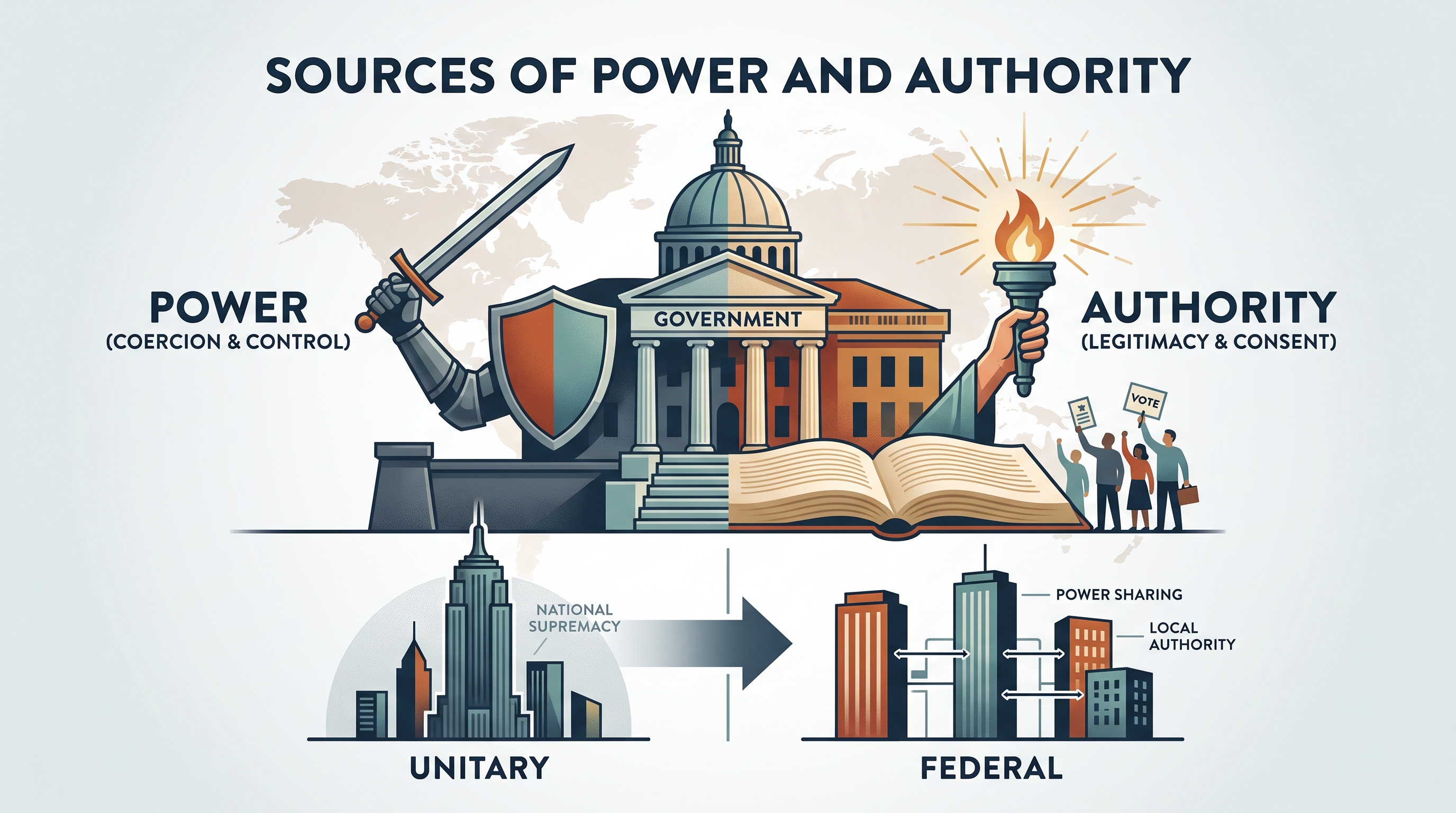
A government may possess laws, offices, and police forces yet still struggle to make citizens obey. Power is the ability to influence behavior or produce an outcome; authority is power regarded as rightful or accepted.
1.5 Sources of Power and Authority
A government may possess laws, offices, and police forces yet still struggle to make citizens obey. Power is the ability to influence behavior or produce an outcome; authority is power regarded as rightful or accepted. The central question is therefore not simply Who controls the state? but Why do people, institutions, or organizations accept that control?
PAU-1.D — Explain sources of power and authority in political systems.
The dynamic balance between government and citizens
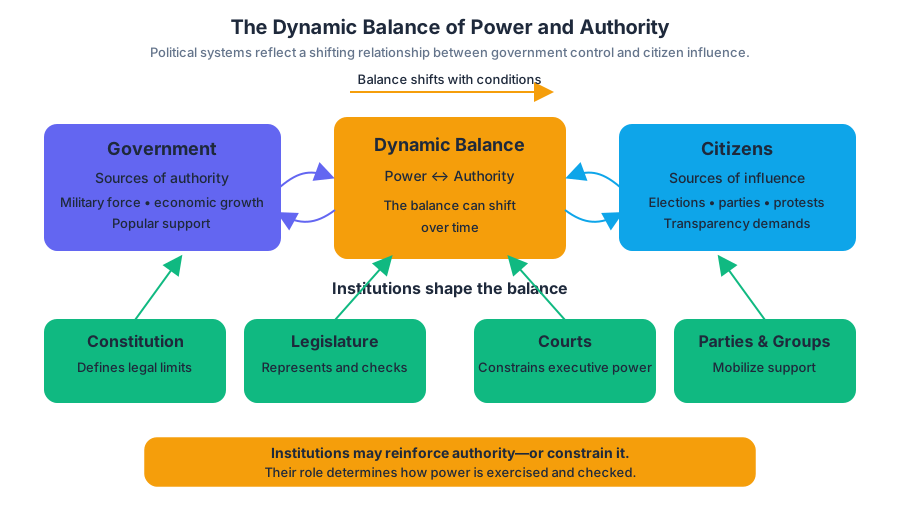
Political systems and regimes reflect a dynamic balance of power between the government and its citizens. “Dynamic” means that the balance can shift: a government may strengthen its control through military force, economic growth, or popular support, while citizens may gain influence through elections, political parties, legislatures, protests, or demands for greater transparency.
The balance is not a simple government-versus-citizens contest. Political parties, legislatures, courts, constitutions, religious organizations, and military forces can either reinforce government authority or constrain it. In China, for example, the Communist Party’s control over the military supplies the regime with power and authority that can help maintain stability; in another system, an independent legislature or judiciary may limit executive power.
Sources of authority
Legitimacy refers to the people’s belief that a government has the right to rule. Legitimacy is different from raw coercion: a government can force compliance without being widely viewed as rightful, but legitimate authority makes obedience more durable because citizens recognize the government’s rule as acceptable.
Common sources of legitimacy include:
| Source | How it can support authority |
|---|---|
| Elections | Leaders gain authority through a process citizens recognize as representative. |
| Governmental transparency | Public access to information can make decisions appear accountable rather than hidden. |
| Constitutional provisions | A government can claim authority by following established legal rules. |
| Economic growth | Improved living conditions may strengthen popular support. |
| Tradition | Long-established institutions may be accepted because they are familiar and historically rooted. |
| Charisma | A leader’s personal appeal can generate loyalty. |
| Religious heritage or organization | Religious traditions or institutions can provide moral justification for political rule. |
These sources can overlap, but they are not interchangeable. A government may hold elections without being viewed as fully legitimate if citizens believe the elections are unfair. Likewise, economic growth may increase support without creating constitutional authority. A source of legitimacy explains why rule is accepted; it does not automatically prove that rule is democratic.
Formal structures: unitary and federal power
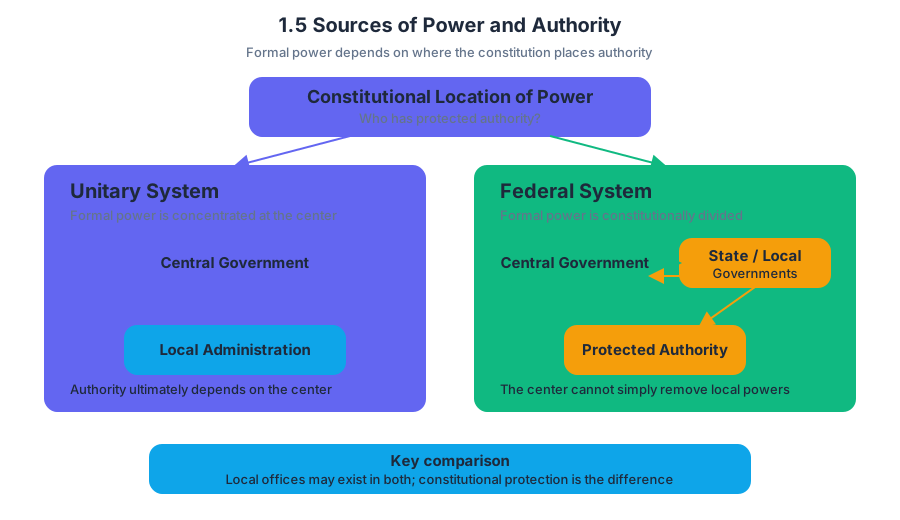
A unitary system places all formal power in the central government, with no constitutional authority given to state or local governments. Local officials may administer policies, but their authority ultimately depends on the center.
A federal system distributes formal power between a central government and state or local governments. The subnational governments possess constitutionally recognized authority, so the central government cannot simply eliminate their powers through an ordinary administrative decision.
The distinction concerns the constitutional location of formal power, not whether a country has local offices. A unitary country can decentralize administration, and a federal country can have a powerful central government. The key comparison is whether state or local authority is constitutionally protected.
Accountability and checks
Judicial power and the ability to carry out checks and balances among government branches can enhance governmental accountability. Courts may interpret laws, review governmental action, protect rights, and help prevent one branch from exercising unlimited authority. Legislatures can also scrutinize executives, control legislation, and express political disapproval.
The United Kingdom illustrates how authority can be checked even without a fixed election schedule. The prime minister’s power is constrained by Parliament, which can remove the prime minister when there is sufficient disapproval. The example shows why identifying a system’s formal rules is not enough: analysts must also ask which institutions can withdraw support or compel an officeholder to leave power.
Worked comparison: explaining authority
Imagine comparing China and the United Kingdom. China’s regime can draw authority from the Communist Party’s control of the military, constitutional and institutional arrangements, economic performance, and claims of political stability. The United Kingdom’s government can draw authority from elections, parliamentary accountability, constitutional practices, and traditions associated with its political institutions.
A strong comparison does more than list differences:
- Identify the source: military-party control in China; elections and parliamentary accountability in the United Kingdom.
- Explain the mechanism: control of coercive institutions can preserve regime stability, while parliamentary disapproval can remove a prime minister.
- State the significance: both systems seek effective rule, but authority is organized and constrained through different institutional relationships.
Country Comparison — PAU-1.D.1? / Practice 2: Compare countries by explaining a meaningful similarity or difference in their political systems, institutions, processes, policies, or behaviors—not by merely naming two countries.
Misconception check — “Power and legitimacy are the same.” They are not. Power describes the capacity to get an outcome; legitimacy describes the belief that rule is rightful. A government may possess power through coercion while facing weak legitimacy, or it may combine coercive capacity with broad acceptance.
Retrieval check
A country’s constitution grants local governments protected authority, but the national government controls the military and citizens distrust national elections. Is the country more likely unitary or federal, and which two sources of power or authority are present? Explain in two sentences, naming the constitutional structure and distinguishing power from legitimacy.
Source Materials
- AP Comparative Government and Politics Course and Exam Description
- AP Comparative Government and Politics Course and Exam Description Clarifications and Corrections
- AP Comparative Government and Politics Course Overview
- AP Comparative Government and Politics Course at a Glance
- AP Comparative Government and Politics Course at a Glance Poster
- AP Comparative Government and Politics
- AP Comparative Government and Politics
- AP Comparative Government and Politics Sample Syllabus 1