From the free course AP Comparative Government and Politics on Lykke
5.5 International and Supranational Organizations
Key concepts: International organizations · Supranational organizations · International Monetary Fund (IMF) · World Bank · Domestic policymakers · National sovereignty · Globalization · Political legitimacy · International agreements and rules · Regime stability
International organizations can influence a government without directly ruling its territory: money, trade rules, and regional agreements can turn international decisions into domestic political choices.
5.5 International and Supranational Organizations
International organizations can influence a government without directly ruling its territory: money, trade rules, and regional agreements can turn international decisions into domestic political choices.
Learning Objective LEG-3.A: Explain how international and supranational organizations influence domestic policymakers and national sovereignty.
Enduring Understanding LEG-3: A government bolsters regime stability by adapting its policies to environmental, political, economic, and cultural conditions.
Three kinds of international influence
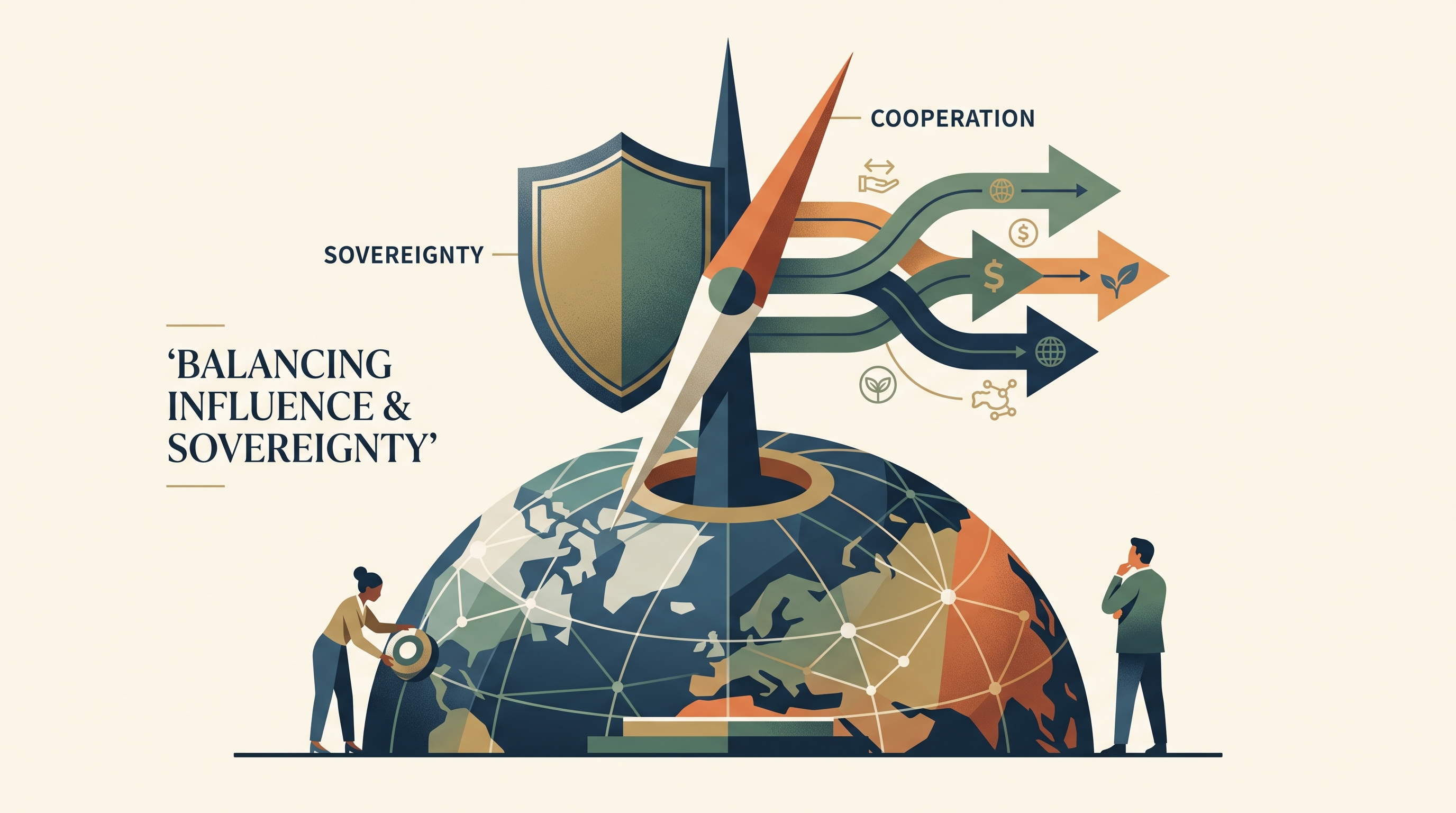
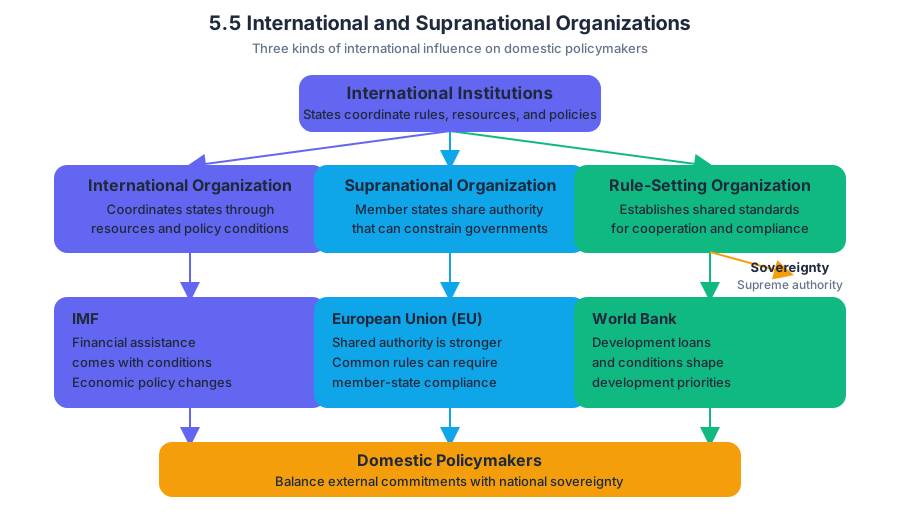
An international organization is an institution created by states to coordinate policies, provide resources, or establish shared rules. A supranational organization goes further: member states give the organization some authority that can constrain national governments. National sovereignty is a state’s supreme legal authority to govern its population and territory without outside interference.
| Organization | Best classification | How it influences domestic policymakers |
|---|---|---|
| International Monetary Fund (IMF) | International organization | Attaches conditions to financial assistance, encouraging governments to change economic policies. |
| World Bank | International organization | Uses development loans and their conditions to influence domestic economic and development priorities. |
| European Union (EU) | Supranational organization | Exercises stronger shared authority over member states and can require compliance with common rules. |
| World Trade Organization (WTO) | International rule-setting organization | Establishes trade rules and pressures governments to reduce barriers such as tariffs. |
| Economic Community of West African States (ECOWAS) | Regional organization with limited supranational features | Coordinates regional policies and can pressure members, but its authority is less extensive than the EU’s. |
Financial assistance and domestic sovereignty
The IMF and World Bank influence countries through preconditions attached to financial assistance. A government seeking loans may have to accept policy changes before receiving money or continuing to receive it. IMF assistance, for example, can require a structural adjustment program involving privatization of state-owned companies, reduced tariffs, and reduced government subsidies for domestic industries.
The key political issue is not simply whether the policy is economically useful. It is who gets to choose it. A government may formally retain sovereignty while facing severe financial pressure to adopt policies designed partly by an international organization. Domestic policymakers therefore balance immediate access to capital against reduced freedom to set economic policy independently.
Worked example: Suppose a government cannot pay its debts and requests IMF assistance. The IMF requires privatization and lower tariffs. The government accepts because the loan may prevent a deeper financial crisis. Domestically, however, affected workers and protected industries may accuse leaders of surrendering national sovereignty. The causal chain is:
- Financial crisis creates dependence on outside assistance.
- The IMF attaches policy preconditions to that assistance.
- Domestic policymakers alter economic rules to qualify for support.
- The government gains financial relief but loses some policy autonomy.
Trade rules and national policy choices
The WTO is best understood here as an international rule-setting organization, not as equivalent to the EU. Its trade rules and dispute processes can pressure governments to reduce tariffs and otherwise liberalize trade. The EU possesses stronger supranational authority because member states accept shared rules that can directly constrain national policymaking. ECOWAS promotes regional integration and can exert pressure on members, but its supranational authority is more limited and uneven.
These pressures can conflict with domestic strategies already established in the study of economic policy. Governments that want to protect developing industries may raise tariffs and encourage local production of industrialized products to reduce foreign dependency. International lenders or trade organizations may push in the opposite direction, creating a sovereignty tradeoff: greater access to loans and markets in exchange for narrower policy choices.
Legitimacy, environment, and health
International rules can also strengthen sovereignty indirectly by helping governments solve problems they cannot manage alone. Abiding by international agreements or rules established by supranational organizations may improve citizens’ environment and health. Cleaner air, safer products, or coordinated responses to cross-border pollution can make government authority appear more effective and legitimate.
The reverse is equally important. Environmental crises, including uncontrolled air pollution linked partly to globalization, can decrease political legitimacy—the belief that a government has the right to rule—when citizens see that leaders cannot respond effectively. A government may lose support not because an international organization directly removed its authority, but because domestic failures expose the limits of its capacity.
Globalization as a political force
Globalization increases economic connections among countries through trade, investment, finance, production, and technology. Its political effects differ across countries such as China and Mexico because governments respond according to their institutions, economic goals, and vulnerabilities. International organizations may bring investment and market access, while also increasing exposure to foreign firms, external rules, and environmental pressures.
Misconception check — “International influence always ends sovereignty.” It does not. Sovereignty is challenged when outside conditions constrain domestic choices, but governments often enter agreements voluntarily because the benefits—financial assistance, trade access, regional coordination, or environmental improvement—can strengthen regime stability and legitimacy.
Retrieval check: A government accepts a World Bank loan requiring changes to domestic subsidies. Identify the organization’s category, the mechanism of influence, and one sovereignty tradeoff. A strong answer identifies the World Bank as an international organization, explains that loan preconditions shape domestic policy, and notes that financial assistance is gained while independent policymaking is reduced.
Source Materials
- AP Comparative Government and Politics Course and Exam Description
- AP Comparative Government and Politics Course and Exam Description Clarifications and Corrections
- AP Comparative Government and Politics Course Overview
- AP Comparative Government and Politics Course at a Glance
- AP Comparative Government and Politics Course at a Glance Poster
- AP Comparative Government and Politics
- AP Comparative Government and Politics
- AP Comparative Government and Politics Sample Syllabus 1
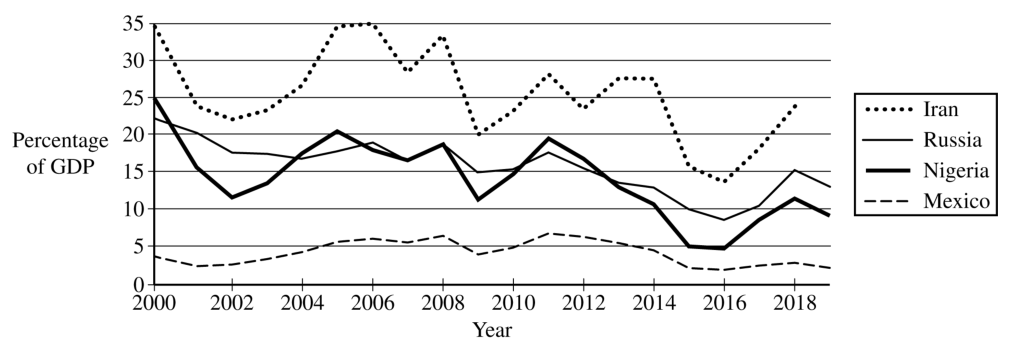
- Source: World Bank, 2018