From the free course AP Comparative Government and Politics on Lykke
5.7 Impact of Industrialization and Economic Development
Key concepts: Impact of industrialization and economic development · Rapid industrialization · Economic development · Changes in governmental policies · Regime stability · Policy adaptation to environmental, political, economic, and cultural conditions · Argumentation · Refutation, concession, and rebuttal · Political and economic changes and development
Rapid industrialization can force a government to rewrite its policies because factories, cities, energy systems, and social identities change faster than existing institutions can manage.
5.7 Impact of Industrialization and Economic Development
Rapid industrialization can force a government to rewrite its policies because factories, cities, energy systems, and social identities change faster than existing institutions can manage.
LEG-3 — Enduring Understanding: A government bolsters regime stability by adapting its policies to environmental, political, economic, and cultural conditions.
From economic change to policy change
Rapid industrialization is the accelerated growth of factories, mechanized production, urban employment, and infrastructure. Economic development is the broader improvement of productive capacity and living conditions, often involving higher incomes, transportation networks, education, health systems, and technological change. These processes can generate prosperity, but they also create problems that older policies were never designed to solve.
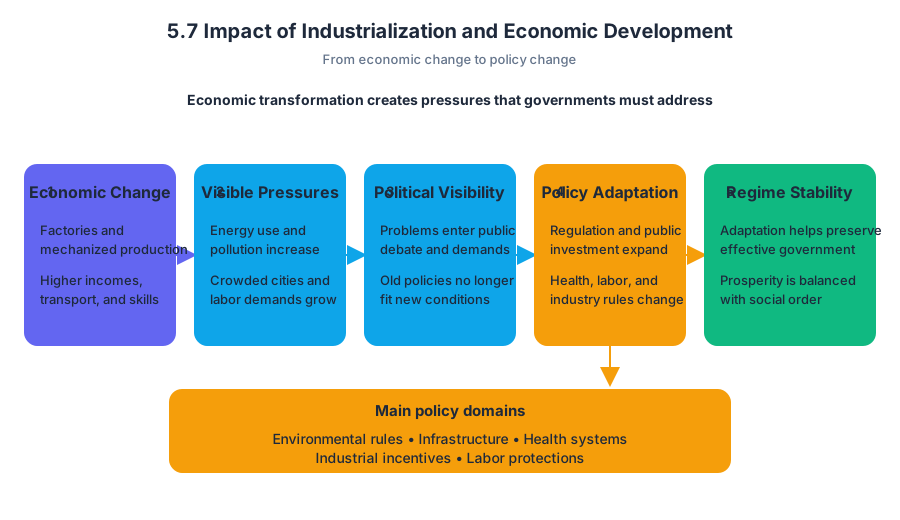
The causal chain is:
Industrial growth increases energy use, pollution, urban crowding, labor demands, and public expectations. As these pressures become politically visible, governments may radically change environmental regulation, infrastructure spending, health policy, industrial incentives, and labor rules. Policy adaptation is therefore not simply an economic choice; it can become a strategy for preserving regime stability, meaning the continued survival and effective operation of a political regime.
LEG-3.C — Learning Objective
LEG-3.C: Explain how rapid industrialization and economic development have produced radical changes in governmental policies.
LEG-3.C.1 — Essential Knowledge: Rapid industrialization and increasing dependence on energy from fossil fuels have created environmental and political problems that governments must address to protect citizens.
Possible government responses include physically moving factories away from densely populated or environmentally vulnerable areas, subsidizing green technologies so industries can comply with new standards, expanding infrastructure, and strengthening environmental regulation. Governments may also require nationwide conversion to hybrid vehicles or develop infrastructure capable of responding to health crises intensified by urbanization and industrial concentration.
Why policy adaptation can stabilize a regime
Industrialization creates winners and losers. Businesses may gain profits, while workers experience dangerous conditions; urban residents may gain jobs but face pollution; citizens may demand cleaner air, safer transportation, and reliable public services. If the government responds effectively, it can demonstrate policy responsiveness—the capacity to address public problems—and strengthen public acceptance of the regime.
If the government refuses to adapt, environmental damage or economic disruption can become evidence that leaders are incompetent, corrupt, or indifferent. Protests, labor unrest, regional resistance, or declining trust may follow. Policy change does not guarantee stability, but failure to address industrial problems can make instability more likely.
Adaptation depends on conditions
Governments do not use one universal response. They adapt policies to four conditions:
- Environmental conditions: A government facing severe industrial pollution may relocate factories, impose emissions rules, or subsidize cleaner technology.
- Political conditions: Leaders may expand infrastructure or regulate industry when citizens, opposition parties, or social movements make environmental protection politically urgent.
- Economic conditions: A government may protect jobs during a transition to cleaner energy, offer subsidies to industries, or invest in transportation to sustain economic growth.
- Cultural conditions: Industrialization can change language use, education, workplace expectations, and group identities. A government might provide public services in multiple languages, revise schools to recognize new cultural identities, or create labor and integration policies that accommodate changing urban populations. Such adaptation can reduce perceptions of exclusion and help different groups regard the regime as legitimate.
Worked example: Suppose rapid industrialization draws rural communities and migrant workers into a city. Pollution rises, factories demand labor, and residents speak several languages. A government that only builds factories may increase production but deepen conflict. A more adaptive government can combine environmental enforcement, public transit, worker protections, multilingual education, and health infrastructure. Each policy addresses a different condition; together, they reduce grievances and connect economic development to regime stability.
Argumentation: refutation, concession, and rebuttal
The suggested skill is Argumentation 5.D: Use refutation, concession, or rebuttal in responding to opposing or alternate perspectives.
- Refutation shows that an opposing claim is incomplete, logically weak, or unsupported.
- Concession acknowledges that an opposing claim contains a limited truth.
- Rebuttal responds to that claim by explaining why the argument being defended is stronger or more convincing.
Modeled response: “Some observers argue that industrialization inevitably destabilizes regimes because it produces pollution, inequality, and labor conflict. This claim is incomplete: industrialization creates pressures, but instability is not automatic. Governments can refute the prediction of inevitable collapse by pointing to adaptive policies such as factory relocation, green-technology subsidies, infrastructure investment, and environmental regulation. It is fair to concede that rapid growth can initially intensify grievances. However, the stronger rebuttal is that governments capable of adapting policies to environmental, political, economic, and cultural conditions can convert those pressures into greater responsiveness and regime stability.”
Misconception check
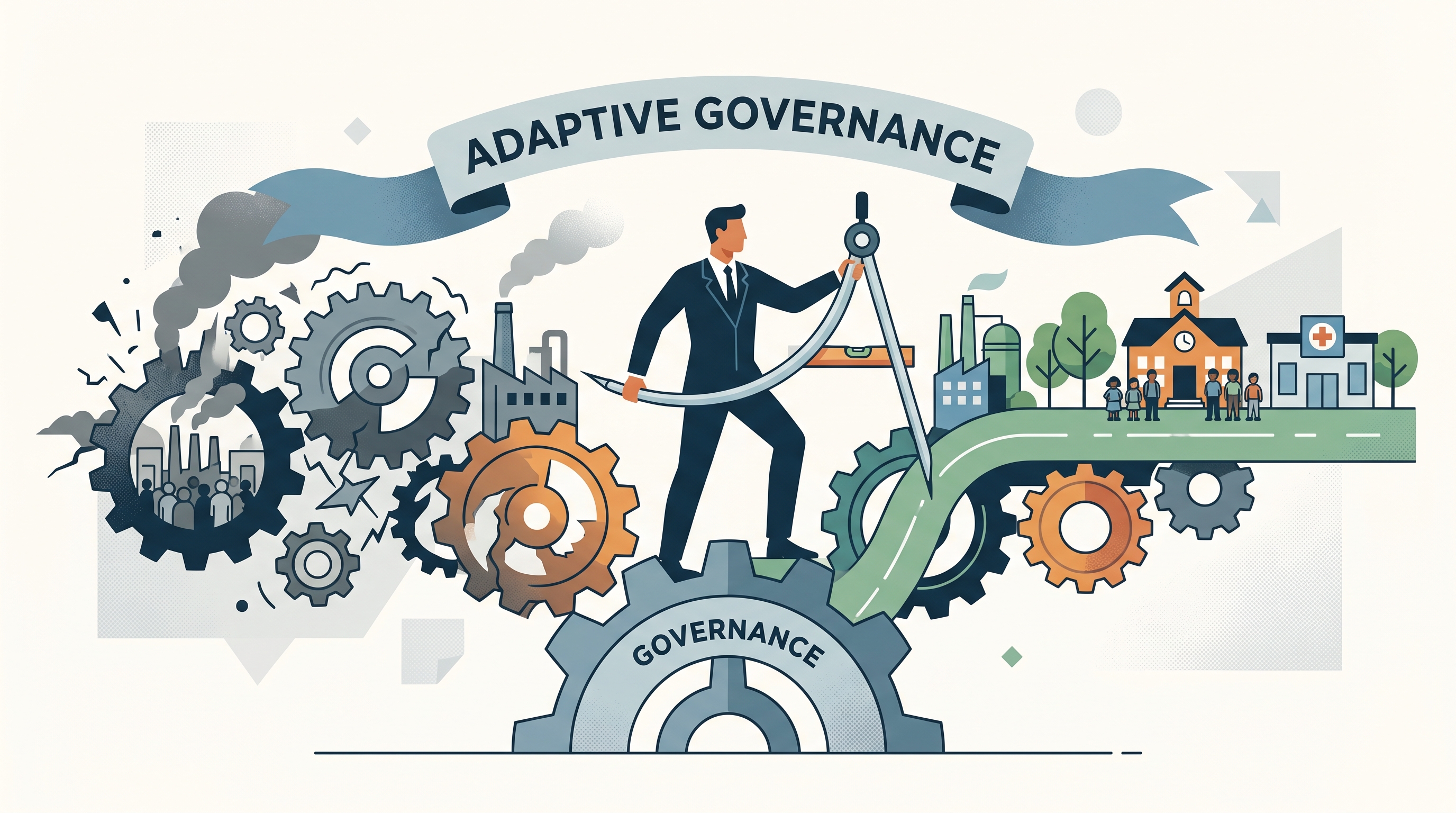
Misconception: “Economic development always produces political instability.” Development can generate conflict, but its political effects depend on government responses. The key comparison is not industrialization versus no industrialization; it is unmanaged change versus adaptive governance.
Retrieval check: A government introduces factory-relocation rules, subsidizes cleaner technology, expands health infrastructure, and offers multilingual education after rapid urban growth. Identify one environmental, one economic, and one cultural condition being addressed, then explain how the combined policies could bolster regime stability.
Source Materials
- AP Comparative Government and Politics Course and Exam Description
- AP Comparative Government and Politics Course and Exam Description Clarifications and Corrections
- AP Comparative Government and Politics Course Overview
- AP Comparative Government and Politics Course at a Glance
- AP Comparative Government and Politics Course at a Glance Poster
- AP Comparative Government and Politics
- AP Comparative Government and Politics
- AP Comparative Government and Politics Sample Syllabus 1