From the free course AP Comparative Government and Politics on Lykke
4.5 Impact of Social Movements and Interest Groups
Key concepts: Social movements · Interest groups · Citizen organizations · Grassroots social movements · Civil society organizations · Political and social change · Peak associations (SPAs) · Pluralist interests · Corporatist interests · State control over citizen organizations
A government may win an election and still face powerful political pressure from outside formal institutions. Workers demanding safer conditions, farmers resisting land policies, businesses seeking lower taxes, or citizens campaigning for civil liberties can organize into social movements and interest groups that…
4.5 Impact of Social Movements and Interest Groups
A government may win an election and still face powerful political pressure from outside formal institutions. Workers demanding safer conditions, farmers resisting land policies, businesses seeking lower taxes, or citizens campaigning for civil liberties can organize into social movements and interest groups that reshape public debate and government action.
Enduring Understanding IEF-2: Strong and varied citizen organizations and movements foster and are reinforced by democratization.
Learning Objective IEF-2.B: Describe pluralist and corporatist interest group systems.
Citizen organizations are organized groups through which people pursue shared interests outside the direct structure of the state. They include social movements, labor organizations, business associations, agricultural organizations, and civil society organizations. Their influence depends not only on how many members they have, but also on whether the political regime permits independent organization, protest, lobbying, and access to policymakers.
Social Movements: Broad Change From the Ground Up
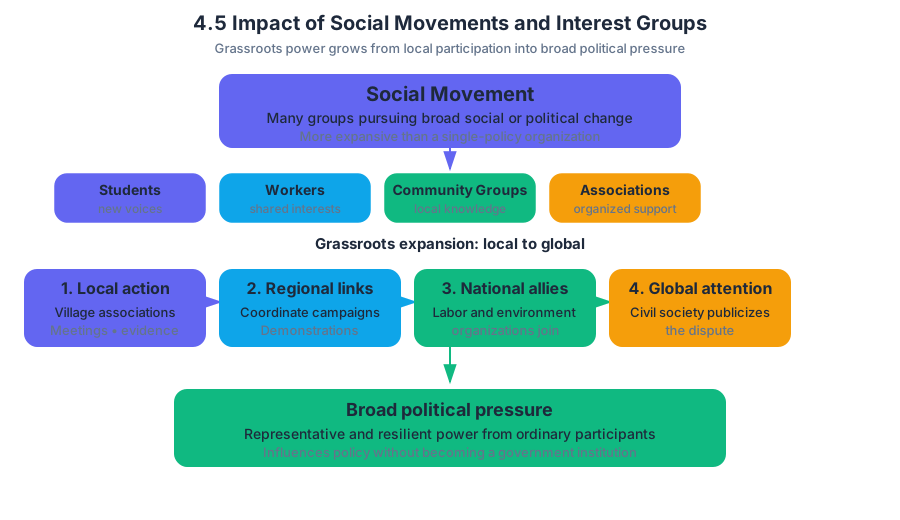
A social movement is a collective effort involving multiple groups and individuals who advocate broad social or political change. Unlike a narrow organization focused on one policy benefit, a movement may unite students, workers, religious groups, professional associations, and community organizations around a larger demand.
Grassroots social movements build power from the local level upward. A local campaign may first organize neighborhood meetings, petitions, or demonstrations; then connect with regional organizations; and eventually attract national or international attention. This bottom-up process can make a movement more representative and resilient because its support is rooted in ordinary participants rather than a single national leader.
Worked example — tracing grassroots power: Suppose agricultural communities oppose a proposed land policy. Local farmers first form village associations, share evidence about the policy’s effects, and coordinate regional demonstrations. National labor and environmental organizations then join the campaign, while international civil society organizations publicize the dispute. The movement has expanded from local participation to broader political pressure without becoming a government institution.
Interest Groups and Civil Society Organizations
An interest group seeks to influence public policy for a particular constituency or sector. Interest groups may represent labor, business, or agriculture. A labor federation might lobby for workplace protections; a business association might seek changes to taxation; and an agricultural organization might press for subsidies or land-policy reform.
Civil society organizations operate independently from the state and may monitor governments, represent members, provide services, lobby officials, or mobilize public opinion. Strong and varied citizen organizations can increase accountability and give citizens channels for political participation beyond elections.
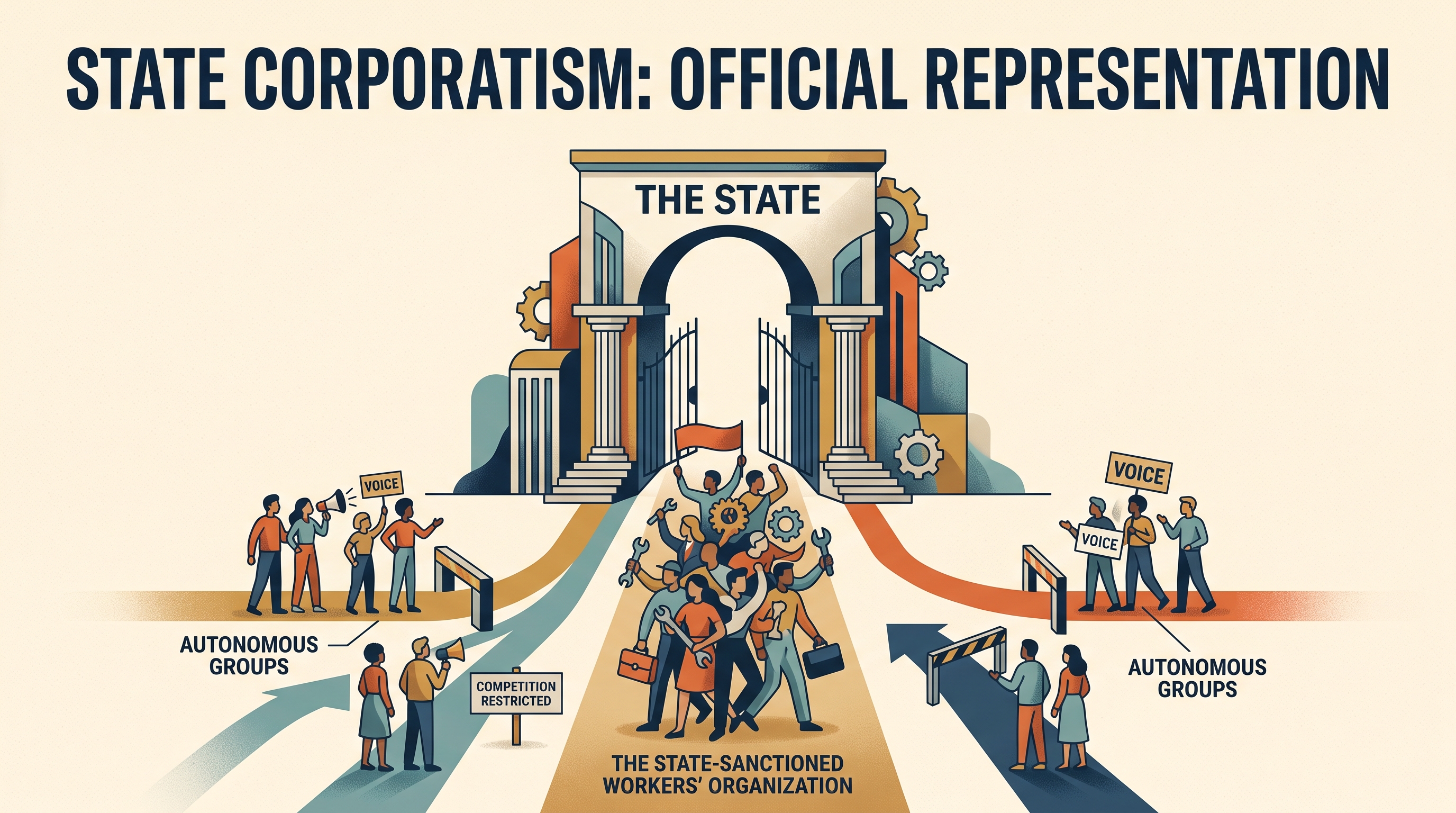
The effect of these organizations varies by political regime. Democratic regimes generally provide more room for independent associations, public criticism, and organized advocacy. Authoritarian regimes may restrict organizations through registration requirements, censorship, surveillance, or repression. The state may permit organizations to exist while retaining substantial control over their leaders, funding, membership, or policy access.
Political Change Across Countries
The relationship between citizen organizations and democratization works in both directions. Independent organizations can encourage democratization by demanding rights, monitoring officials, and teaching citizens how to organize. Democratization can then create additional protections that allow more organizations and movements to form.
Mexico illustrates how interest-group systems can change over time. Mexico moved from a more corporatist arrangement, in which the state relied on officially recognized organizations to represent major sectors, toward a more pluralist system with greater competition among autonomous groups. The change did not eliminate organized interests; it altered who could organize and how independently they could influence policy.
| Political environment | Likely organization pattern | Political consequence |
|---|---|---|
| More open democratic system | Many autonomous groups compete and lobby | Broader participation, but possible conflict among groups |
| More controlled authoritarian system | Organizations face state monitoring or approval | Fewer independent channels for opposition |
| Transitioning system | Official groups coexist with newer autonomous movements | Competition over representation and policy access |
Misconception Check
Misconception: “More organizations always mean more democracy.” Variety matters, but organizations must also possess meaningful independence. A state-controlled organization may look participatory while limiting genuine citizen input. Conversely, a large number of competing groups can produce unequal influence if wealthy or well-connected organizations dominate access to policymakers.
AP Skills and Argumentation
This topic is assessed through Practice 4: Source Analysis, especially Skill 4.C: Explain how the implications of the author’s argument or perspective may affect political systems, principles, and institutions. When reading a source about a protest or organization, identify the author’s position, then explain what would follow if that perspective shaped policy—for example, stronger protections for independent associations or tighter state control over them.
It also develops Practice 5: Argumentation. A strong argument makes a defensible claim, uses specific evidence, and explains the connection between evidence and the claim. Advanced responses add a concession, acknowledging a reasonable opposing point, followed by a refutation or rebuttal showing why the original claim remains stronger.
Argument model: “Independent citizen organizations are more likely to produce political change in an open regime because they can organize without state approval.” Evidence might include grassroots mobilization and Mexico’s movement toward a more competitive interest-group system. A concession could recognize that authoritarian governments can sometimes respond to organized pressure; the rebuttal is that state control still limits independent participation and sustained opposition.
Retrieval Check
A government officially recognizes one organization to represent all workers and approves its leaders. Is this closer to a pluralist or corporatist system, and why? Answer: It is closer to corporatism because the state controls access to policymaking through a state-sanctioned organization rather than allowing autonomous groups to compete.


Source Materials
- AP Comparative Government and Politics Course and Exam Description
- AP Comparative Government and Politics Course and Exam Description Clarifications and Corrections
- AP Comparative Government and Politics Course Overview
- AP Comparative Government and Politics Course at a Glance
- AP Comparative Government and Politics Course at a Glance Poster
- AP Comparative Government and Politics
- AP Comparative Government and Politics
- AP Comparative Government and Politics Sample Syllabus 1
- Figure — Sample Responses Q1 - Set 2 (p. 3)
- Figure — Sample Responses Q1 - Set 2 (p. 4)
- Figure — Sample Responses Q1 - Set 2 (p. 5)