From the free course AP Comparative Government and Politics on Lykke
2.1 Parliamentary, Presidential, and Semi-Presidential Systems
Key concepts: Parliamentary systems · Presidential systems · Semi-presidential systems · Head of state · Head of government · Executive-legislative relations · Cabinet accountability · Fixed-term elections · Impeachment · Allocation of political power
A political system answers a deceptively practical question: who gets to choose, supervise, and remove the executive? The answer reveals how power is allocated among the legislature, the executive, and—in many systems—the voters.
2.1 Parliamentary, Presidential, and Semi-Presidential Systems
A political system answers a deceptively practical question: who gets to choose, supervise, and remove the executive? The answer reveals how power is allocated among the legislature, the executive, and—in many systems—the voters.
PAU-3: The structure and function of political institutions reflect the allocation of power within a political system.
PAU-3.A: Describe parliamentary, presidential, and semi-presidential systems.
The executive has two possible jobs
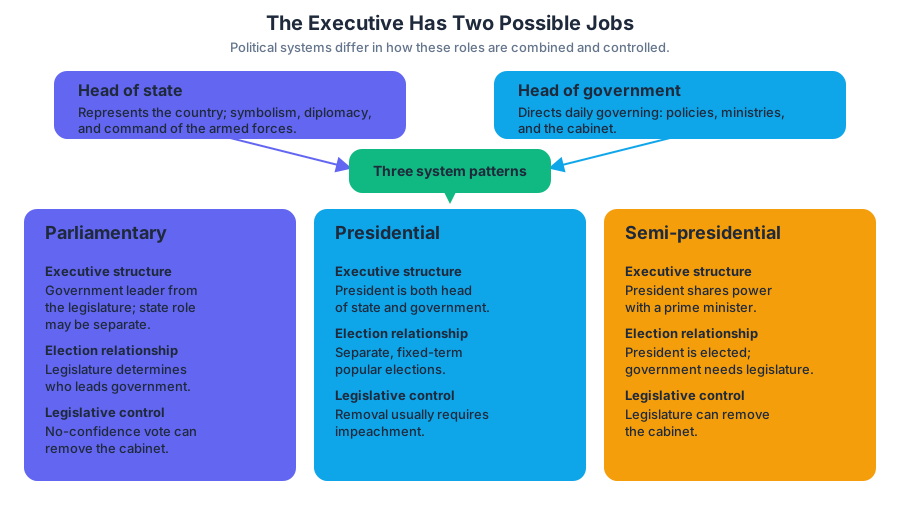
Head of state is the official representative of the country. This role may involve national symbolism, diplomacy, and command of the armed forces.
Head of government directs the daily work of governing: proposing policies, coordinating ministries, and leading the cabinet. In some systems, one person performs both jobs; in others, the roles are divided.
| System | Executive structure | Election relationship | Legislative control | Example |
|---|---|---|---|---|
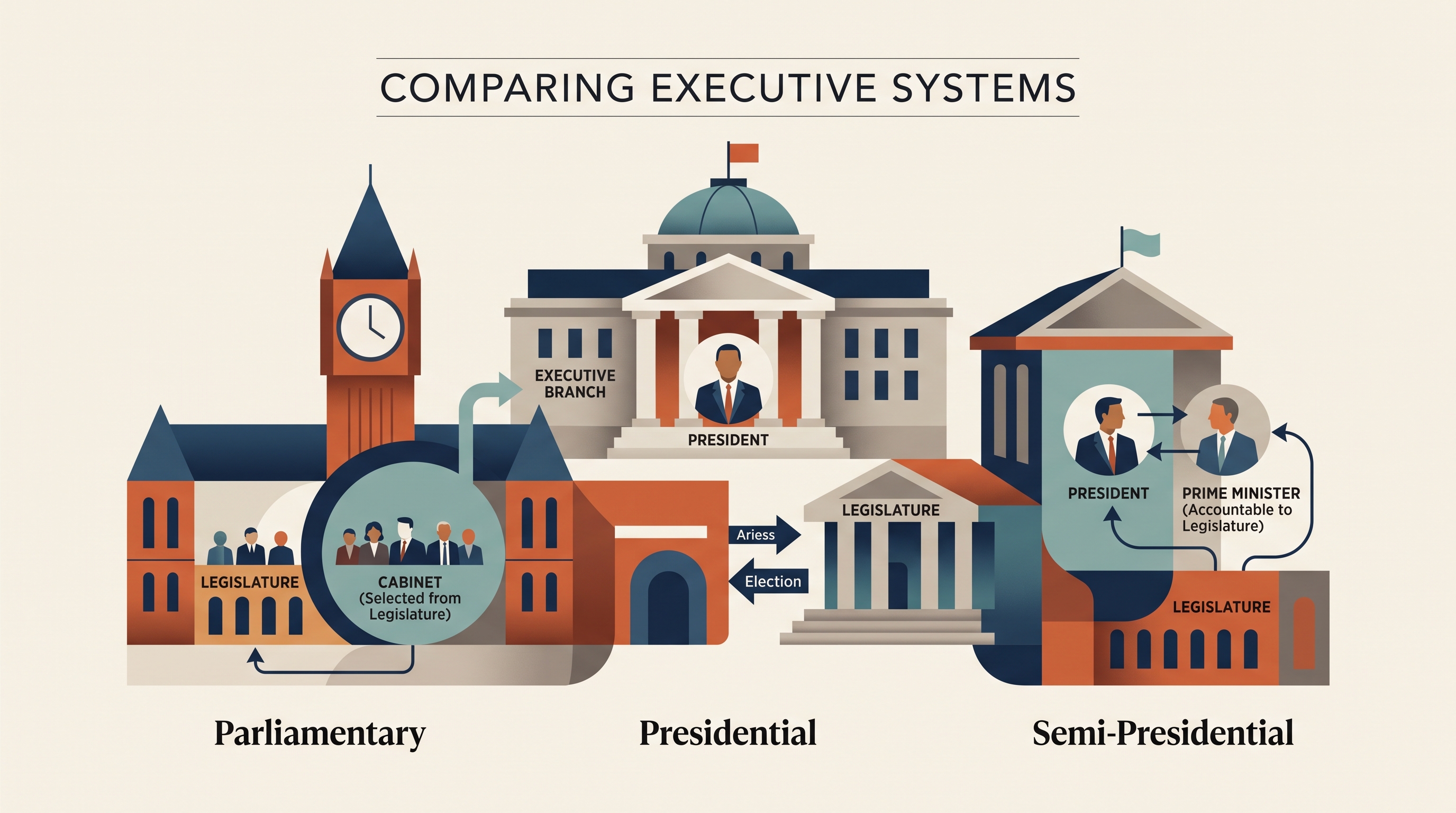
| Parliamentary | Head of government is usually selected from the legislature; head of state may be separate | Legislature determines who leads the government | Legislature can question the executive and remove the cabinet through a vote of no confidence | United Kingdom |
| Presidential | President serves as both head of state and head of government | President and legislature have separate, fixed-term, popular elections | Legislature generally removes cabinet members or the president only through impeachment | Mexico, Nigeria |
| Semi-presidential | President is head of state and commander in chief; prime minister is head of government | President and legislature have separate popular elections | Prime minister must be approved by the legislature; cabinet is accountable to both president and legislature | Russia |
Parliamentary systems: the legislature and executive are connected
PAU-3.A.1: Parliamentary systems, such as the United Kingdom, combine lawmaking and executive functions, allowing the national legislature to select and remove the head of government and cabinet.
In a parliamentary system, the executive normally emerges from the legislature rather than being elected separately by the entire country. The legislature can question the executive and cabinet ministers, making oversight a routine part of governing. If the government loses legislative support, the legislature may pass a vote of no confidence, a formal declaration that it no longer accepts the cabinet’s authority.
Worked example: the United Kingdom
Suppose the governing party or coalition in the United Kingdom loses the support of enough legislators to control a majority. The legislature can challenge ministers, reject government proposals, and ultimately remove the cabinet through a vote of no confidence. The executive therefore depends directly on continuing legislative confidence.
The key mechanism is not simply that Parliament makes laws. It is that Parliament helps determine who governs and can withdraw that support. Executive-legislative relations are therefore closely fused.
Presidential systems: separate electoral mandates
PAU-3.A.2: Presidential systems, such as Mexico and Nigeria, feature a cabinet mostly responsible to the elected executive, separate fixed-term popular elections for the national legislature and president, and a top executive leader who serves as both head of state and head of government.
A presidential system separates the electoral bases of the executive and legislature. Voters elect the president and the national legislature in distinct elections, and both generally serve fixed terms. The president leads the cabinet, directs the bureaucracy, and holds authority over the military.
Because the president and legislature possess separate mandates, the legislature does not ordinarily remove the cabinet simply because it disagrees with policy. Removal generally requires impeachment, a formal process for charging and potentially removing a public official for serious misconduct.
Worked example: Mexico
Mexico illustrates the presidential model identified in the required content. The president serves as both head of state and head of government, and the presidency has a single-term limit. The legislature and president receive their authority through separate popular elections, so neither institution automatically controls the other.
Semi-presidential systems: divided executive authority
PAU-3.A.3: Semi-presidential systems, such as Russia, feature separate popular elections for the president and national legislature. The president can nominate a prime minister, who must be approved by the legislature; cabinet members are accountable to both the president and the legislature.
A semi-presidential system divides executive power. The president serves as head of state and commander in chief, while the prime minister serves as head of government. This arrangement creates two executive centers rather than one.
The division can provide checks on executive power, but it can also produce tension when the president and legislative majority disagree. Political stability depends partly on whether the president, prime minister, and legislature can coordinate authority rather than compete for it.
Misconception check: “Separate branches always mean equal power”
Misconception: A system is presidential whenever it has a president, or parliamentary whenever it has a legislature.
Correction: The decisive issue is the relationship among institutions. A president may be mainly head of state in a semi-presidential system, while the prime minister leads government. In a parliamentary system, the legislature can select and remove the head of government. In a presidential system, the president and legislature are separately elected and normally serve fixed terms.
Skill 1.B: Concept Application — Explain political systems, principles, institutions, processes, policies, and behaviors. Apply it by identifying the institutional rule that allocates power, then connecting that rule to executive-legislative relations and possible political stability.
Retrieval check
A country elects its president and legislature separately for fixed terms. The president leads the cabinet, serves as both head of state and head of government, and can generally be removed only through impeachment. Which system is this, and what evidence proves it?
Answer: A presidential system; the evidence is the separate fixed-term elections, unified executive roles, and impeachment-based removal process.
Source Materials
- AP Comparative Government and Politics Course and Exam Description
- AP Comparative Government and Politics Course and Exam Description Clarifications and Corrections
- AP Comparative Government and Politics Course Overview
- AP Comparative Government and Politics Course at a Glance
- AP Comparative Government and Politics Course at a Glance Poster
- AP Comparative Government and Politics
- AP Comparative Government and Politics
- AP Comparative Government and Politics Sample Syllabus 1
- AP Comparative Government and Politics-AP Students-College Board
- AP Comparative Government and Politics-Wikipedia
- AP Comparative Government and Politics Cheat <http://sheets-albert.io>Sheets-Albert.io
- AP Comparative Government and Politics-GOA