AP Comparative Government and Politics
123 study materials · 50 sections
AP Comparative Government and Politics students working the current College Board Course and Exam Description, including first-time students with no prior background, plus teachers reviewing the page for CED alignment.; Teach every official CED unit and every numbered topic at topic granularity.; Develop every AP skill / science-practice code explicitly and by name.; Replace description with teaching: worked contextual examples, named misconceptions, and in-flow retrieval checks.; Build an exam-practice unit covering every task type on the current exam.
Course Sections
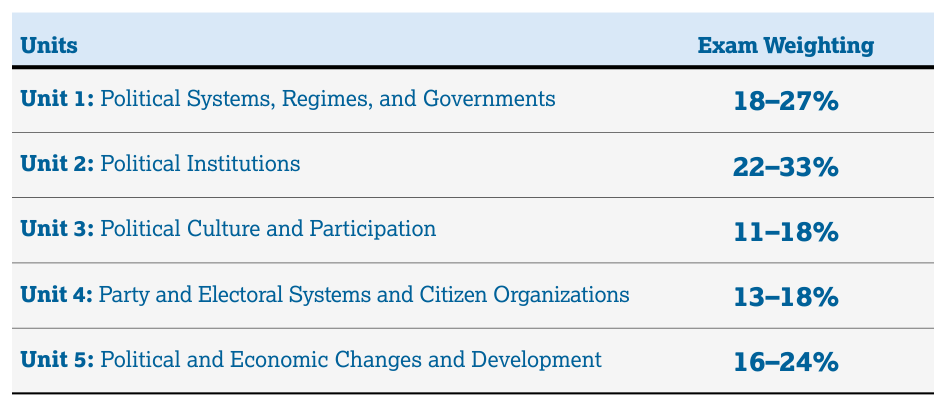
Course Framework, Skills and Reasoning Processes
Key concepts: Purpose and structure of the AP Program · Course framework and alignment with higher education expectations · Disciplinary practices and related skills · Instructional model: exploring, teaching, and assessing learning · Formative assessment and actionable feedback · AP Classroom Progress Checks · AP Question Bank and its organization by topics and skills · Teacher responsibility for curriculum design and pacing · The six AP Comparative Government and Politics countries · Interdisciplinary analysis using economics, sociology, history, and geography
Political science asks more than who governs: it asks how power is organized, why institutions are obeyed, how citizens participate, and why similar political problems produce different outcomes in different countries.
1.1 The Practice of Political Scientists
Key concepts: political legitimacy · political stability · authority · comparative political science · similarities and differences between political systems · quantitative sources · qualitative sources · author’s claims and perspective
A comparative political scientist asks a deceptively simple question: What is similar, what is different, and why does the difference matter? Comparing China, Iran, Mexico, Nigeria, Russia, and the United Kingdom requires more than memorizing institutions.
1.2 Defining Political Organizations
Key concepts: Political systems and regimes · Civil society organizations · Nongovernmental organizations (NGOs) · Organizations autonomous from the state · Regime type and civil society strength · Roles of civil society organizations · Electoral regulatory organizations · Multinational corporations (MNCs) and state sovereignty
A government is never the only organized force in a society. Religious associations, neighborhood groups, professional bodies, news organizations, businesses, and nongovernmental organizations can all shape what citizens demand and what governments are able—or willing—to do.
1.3 Democracy vs. Authoritarianism
Key concepts: Democracy · Claiming and maintaining power in a country · Religious influence in a democracy
A government can claim power through elections yet maintain power by restricting competition, controlling information, or weakening opponents. The central comparative question is therefore not merely Who governs?
1.4 Democratization
Key concepts: Democratization · Press freedom · Press Freedom Index · Quantitative analysis of political data · Relationship between largest-party seat share and democratization in Nigeria · Press-freedom trends · Drawing conclusions from data · Mexico’s level of democratization · Iran’s regime type · Competitive elections and political actors
Democratization is the process through which a political system becomes more democratic by expanding meaningful political participation, competitive elections, accountability, and protected freedoms. It is not a switch that moves a country permanently from “authoritarian” to “democratic”; it can advance, stall,…
1.5 Sources of Power and Authority
Key concepts: sources of power and authority · political systems and regimes · dynamic balance of power between government and citizens · legitimacy · elections · governmental transparency · constitutional provisions · checks and balances · unitary systems · federal systems
A government may possess laws, offices, and police forces yet still struggle to make citizens obey. Power is the ability to influence behavior or produce an outcome; authority is power regarded as rightful or accepted.
1.6 Change in Power and Authority
Key concepts: Change in power and authority · Centralization and decentralization of power · Unitary systems of government · Federal systems of government · Distribution of power between national and regional governments · Peaceful versus violent political change · Sovereignty · Social cleavages · Policy-making efficiency · Sources of power and authority
Power rarely stays in one place forever. A government may pull authority toward the national capital, transfer responsibilities to provinces or states, or lose control through rebellion, revolution, or external pressure.
1.7 Federal and Unitary Systems
Key concepts: Federal systems · Unitary systems · Decentralization and local autonomy · Division of power between national and regional governments · Social cleavages · Federalism as a response to regional needs · Centralized government and uniform policies · Political systems in Mexico, Nigeria, Russia, and the United Kingdom
A federal system divides political power between a national government and regional governments, while a unitary system concentrates ultimate authority in the national government. The key question is not whether regions have offices or local officials, but whether they possess constitutionally protected powers or…
1.8 Political Legitimacy
Key concepts: political legitimacy · devolution and delegation of power · regional governments · corruption perception · Transparency International Corruption Perception Index · transparency · democracy · rule of law · judicial independence · checks and balances
A government can possess power without possessing political legitimacy. Legitimacy is the public acceptance that a government has the right to rule, not merely the ability to make people obey.
1.9 Sustaining Legitimacy
Key concepts: Sustaining legitimacy · Thesis about sustaining legitimacy · Alternate perspective · Simplifying complex issues · Providing people with answers
A government can sustain legitimacy not only by being effective, but by making political life feel understandable and answerable: citizens must be able to interpret events, identify who is responsible, and believe that the system offers credible answers to major problems.
1.10 Political Stability
Key concepts: Political stability · Fragile States Index · State fragility · Rule of law · Rule by law · Judicial independence · Institutional trust · Economic liberalization · Nationalism and patriotism · Social movements and political change
A state is politically stable when its governing institutions maintain order, manage conflict, and continue functioning without frequent crises, coups, violent challenges, or breakdowns in authority.
2.1 Parliamentary, Presidential, and Semi-Presidential Systems
Key concepts: Parliamentary systems · Presidential systems · Semi-presidential systems · Head of state · Head of government · Executive-legislative relations · Cabinet accountability · Fixed-term elections · Impeachment · Allocation of political power
A political system answers a deceptively practical question: who gets to choose, supervise, and remove the executive? The answer reveals how power is allocated among the legislature, the executive, and—in many systems—the voters.
2.2 Comparing Parliamentary, Presidential, and Semi-Presidential Systems
Key concepts: Parliamentary systems · Presidential systems · Semi-presidential systems · Country comparison · Institutional obstacles to policymaking · Divided branch powers · Executive-legislative relations · Prime minister approval by the legislature · Cabinet accountability · Comparing course countries by relevant categories
The central comparative question is not simply who leads, but how many institutional obstacles stand between leadership and policy. A parliamentary government usually concentrates executive and legislative authority, while a presidential government divides those powers; a semi-presidential government deliberately…
2.3 Executive Systems
Key concepts: Mexico’s mixed system · Limits on judicial power · United Kingdom judiciary · Common law · Rule of law · Judicial removal for misconduct · Judicial age limits
A judiciary can be powerful without being unlimited. Mexico and the United Kingdom illustrate two different ways a political system places boundaries around courts: Mexico uses institutional balance in a mixed political system, while the United Kingdom relies on common law, removal procedures, and age limits to…
2.4 Executive Term Limits
Key concepts: Executive term limits · Advantages of term limits · Focus on governing rather than winning elections · Opportunities for new leaders · New ideas and policies · Political institutions reflect the allocation of power · Defensible claim or thesis about executive term limits
Executive term limits determine whether a successful executive may keep seeking office—or must eventually hand power to someone else. The central question is not simply whether limits are “good” or “bad,” but whether replacing leaders improves accountability and policy stability more than it disrupts effective…
2.5 Removal of Executives
Key concepts: Removal of Executives · Forces
A president can lose office without losing an election, and a prime minister can fall without a national vote. Removal of executives means ending an executive’s authority before the normal end of the officeholder’s term through a constitutional or political procedure.
2.6 Legislative Systems
Key concepts: Legislative systems · Legislative selection processes · Restrictions on legislative power · Formal constraints on the legislative branch · Effectiveness of formal constraints · Indirect elections · Direct elections with ideological vetting · Single-member district plurality systems · Mixed electoral systems · Proportional representation
A legislature does more than vote on bills: it converts political demands into laws, represents citizens or organized interests, approves public spending, and may supervise the executive branch.
2.7 Independent Legislatures
Key concepts: Independent legislatures · Liberties · Progression of topics within each unit
A legislature is independent when it can debate, amend, reject, and oversee government action without being controlled by the executive. The key question is not whether a country has a parliament or congress—it is whether that institution can make meaningful choices when the executive disagrees.
2.8 Judicial Systems
Key concepts: Judicial power · Checks and balances · Separation of powers · Rule of law · Rule by law · Limits on judicial power · Executive or political control of law · United Kingdom · Mexico · Preventing branch overreach
A judicial system does more than punish lawbreakers: it interprets laws, resolves disputes, reviews government action, and helps prevent any one branch from becoming politically dominant.
2.9 Independent Judiciaries
Key concepts: Independent judiciaries · Separation of powers · Checks and balances · Fundamental rights and liberties · Judicial independence · Corruption and judicial reform · Striking down unconstitutional laws · Political stability · Government control of the judiciary · Judicial rulings strengthening government power
A court can exist without being independent: the decisive question is whether judges can apply the law even when their ruling threatens the interests of the executive, legislature, ruling party, or military.
3.1 Civil Society
Key concepts: Civil society · Civil society organizations as nongovernmental groups formed by citizens to promote an agenda · Monitoring and lobbying government · Exposing government corruption · Representing members’ interests · Providing members with organizational experience · State protections and legal constraints on civil society · Civil society advocacy for human rights and environmental issues · Ethnic-minority and regional-interest advocacy · Causal analysis linking government policies to civil society activity
A government may control laws and institutions, but citizens can still organize outside the state to influence what government does. Civil society is the sphere of voluntary, nongovernmental activity in which citizens form groups to promote an agenda, represent interests, monitor officials, or demand rights.
3.2 Political Culture
Key concepts: Political Culture · Political Culture and Participation · Political Socialization · Citizen Behavior · The State · Political Systems
Political culture is the pattern of political values, beliefs, attitudes, and behaviors that shapes how people understand government and decide whether—and how—to participate in politics.
3.3 Political Ideologies
Key concepts: Political platforms · Political ideologies · Social movements · Political parties · Political tactics · Protests · Legislative processes · Political change
Political ideologies turn broad beliefs about society and government into political action: they help parties decide what policies to support, while social movements pressure institutions from outside them.
3.4 Political Values and Beliefs
Key concepts: Political culture · Political values and beliefs · Political ideology · Tension between social order and individual liberty · State–citizen relationships · Citizen control of government policymaking · Political socialization · Rule of law · Civil society and democratization · Polling-data analysis of political attitudes
A government can protect individual freedom, enforce social order, or attempt both—but citizens’ political culture determines what they expect that balance to look like. Building on the ideological commitments examined earlier, political culture develops when those commitments shape citizens’ expectations,…
3.5 Nature and Role of Political Participation
Key concepts: Nature and role of political participation · Conventional political participation · Violent political behavior · Political participation under authoritarian regimes · Government management and limitation of citizen participation · Environmentalism as a political value linked to participation · Social and economic equality as political values linked to participation · Applying pressure on governments · Using data to analyze political systems, principles, institutions, processes, policies, and behaviors
Political participation is the set of actions through which citizens try to influence government decisions, public policies, or the distribution of political power. It can look routine—casting a ballot, joining a party, contacting a representative—or confrontational, including protest and, when legal avenues seem…
3.6 Forces that Impact Political Participation
Key concepts: Political participation by individuals and groups · State–society interactions · Population characteristics and demands shaping political patterns · Social cleavages such as ethnicity, religion, and class · Perceived legitimacy of government · Political opposition and electoral competition in authoritarian regimes · Globalization and neoliberalism as influences on political participation · Cultural influences, including Western influences, on domestic politics · Devolution and delegation of power to regional governments · Political participation as an effect of decentralization
Political participation changes when citizens decide whether the government is responsive, legitimate, and worth engaging—or when social divisions, economic pressures, and regime rules make participation easier or riskier.
3.7 Civil Rights and Civil Liberties
Key concepts: Civil rights · Civil liberties · Government protection and restriction of liberties · Democratization · Democratic consolidation · Authoritarian and democratic regime placement · Media constraints · Political participation and voting access · Mass political protests and social movements · Rule of law and judicial protection
A government can call an election while restricting speech, limit protests while protecting due process, or expand voting while weakening press freedom. The key question is not whether a regime imposes any limits, but which rights it protects, which liberties it restricts, and how extensively it controls political…
3.8 Political and Social Cleavages
Key concepts: Social cleavages · Political cleavages · Class, ethnicity, religion, and territory as bases of cleavages · Separatist movements · Autonomy movements · Ethnic and regional divisions · Multinational states · Political stability · Long-term regime stability · Comparative analysis of cleavages across countries
A country can have one government, one territory, and one legal citizenship while containing several politically meaningful communities with competing interests. These internal divisions are social cleavages: durable divisions within society that structure how groups understand their interests, organize…
3.9 Challenges from Political and Social Cleavages
Key concepts: Political cleavages · Social cleavages · Government legitimacy · Voting behavior · Party systems · Informal political networks · Ethnicity and identity politics · Religious radicalism and terrorism · Migration and demographic change · Economic liberalization and social divisions
Political and social cleavages become dangerous when governments cannot manage the relationships they create among citizens, groups, and regions. A division that once shaped voting or informal political networks can become a crisis of government legitimacy—the belief that a government has the right to rule—when…
4.1 Electoral Systems and Rules
Key concepts: Electoral systems and election rules · Competitive versus restrictive electoral regimes · Direct and indirect elections · Proportional representation · Single-member district plurality systems · Party-system formation · Representation of minority and women candidates · Constituency accountability and geographic representation · Ballot-access and candidate-selection rules · Term-limit policies
An election can look competitive on paper while the rules quietly decide who may compete, how votes become seats, and whether voters can hold one identifiable representative accountable.
4.2 Objectives of Election Rules
Key concepts: Objectives and functions of election rules · Electoral regulatory organizations · Fairness and efficiency in elections · Enforcement of election rules · Democratic consolidation · Electoral competition · Political representation · Independent election-management bodies · Authoritarian actions and electoral accountability · Effects of election-rule changes
Election rules do more than count votes: they decide who may compete, how votes become representation, and whether citizens can trust the result. A rule that appears administrative—such as requiring an independent election commission—can therefore alter the balance of power between voters, governing elites, and…
4.3 Political Party Systems
Key concepts: Political party systems · Proportional representation · Multiparty systems · Political party representation in legislatures · Degree of competition · Party structure · Laws regulating political parties · Citizen participation · Political movements · National Electoral Institute (IFE)
A legislature can contain dozens of registered parties yet still be dominated by only two powerful organizations. Nigeria illustrates this distinction: its multiparty system includes about 30 registered parties, but the People’s Democratic Party (PDP) and the All Progressives Congress (APC) have historically been…
4.4 Role of Political Party Systems
Key concepts: Political party systems ranging from dominant-party systems to multiparty systems · China’s one-party political system and Communist Party of China (CPC) control · China’s use of party-system rules to maintain centralism and order · China’s allowance of eight other political parties despite CPC control · Russia’s dominant-party system · Legal and procedural mechanisms used to suppress opposition in Russia · Election rules as a factor shaping political party systems · Comparing similarities and differences among countries’ party systems · Political culture’s relationship to citizen behavior and the role of the state · Implications of party-system differences for political institutions and processes
China and Russia demonstrate that the decisive question is not simply how many parties exist, but whether party-system rules allow meaningful competition for governing power.
4.5 Impact of Social Movements and Interest Groups
Key concepts: Social movements · Interest groups · Citizen organizations · Grassroots social movements · Civil society organizations · Political and social change · Peak associations (SPAs) · Pluralist interests · Corporatist interests · State control over citizen organizations
A government may win an election and still face powerful political pressure from outside formal institutions. Workers demanding safer conditions, farmers resisting land policies, businesses seeking lower taxes, or citizens campaigning for civil liberties can organize into social movements and interest groups that…
4.6 Pluralist and Corporatist Interests
Key concepts: Pluralist interests · Corporatist interests · Unit 4: Party and Electoral Systems and Citizen Organizations · Topic 4.6 curriculum · Relationships between overarching educational goals and specific content knowledge · Hierarchical curriculum structure
A political system reveals how it treats organized interests: does the state let many groups compete for influence, or does it organize representation through a limited set of officially recognized organizations?
5.1 Impact of Global Economic and Technological Forces
Key concepts: Economic globalization · Technological forces · Sovereignty · Global interconnectedness · Worldwide markets · Economic liberalization · Reduction of state control over economies · International trade institutions · Foreign direct investment · Domestic political backlash
A product assembled in several countries, financed by foreign capital, and sold through a digital platform illustrates a central political reality: economic activity increasingly crosses borders that governments once controlled more directly.
5.2 Political Responses to Global Market Forces
Key concepts: Global market forces · Political responses to economic globalization · Economic liberalization · Private ownership of industry · State ownership and re-nationalization · Joint ventures with foreign companies · Domestic economic conditions · Domestic demands · State control or influence over domestic politics · Oil and natural-gas industries
Governments do not respond to global market forces in one uniform way: they may privatize state industries, invite foreign investment, form partnerships with international companies, or reclaim industries for the state.
5.3 Challenges from Globalization
Key concepts: Globalization and economic liberalization · Challenges to state sovereignty · Multinational corporations (MNCs) · Economic dependence and loss of autonomy · Government incentives to encourage globalization · Political and economic effects of globalization · Environmental consequences of globalization · Resource extraction and foreign-owned economic interests · Nationalism as a response to globalization · Social conflict and protest movements
Globalization connects economies across political borders, but the same connections that bring investment and jobs can reduce a government’s freedom to regulate its own economy.
5.4 Policies and Economic Liberalization
Key concepts: Economic liberalization · Economic globalization · Free-market mechanisms · Economic and political equality · Social cleavages · Economic development and growth · Human development, wealth, and inequality · Government responses to separatist violence, drug trafficking, and discrimination · Data analysis and limitations · Effects of liberalization on political policies and behaviors
Economic liberalization occurs when a state reduces its direct control over the economy and expands the role of free-market mechanisms—systems in which prices, production, and investment are influenced more by competition and private decisions than by government direction.
5.5 International and Supranational Organizations
Key concepts: International organizations · Supranational organizations · International Monetary Fund (IMF) · World Bank · Domestic policymakers · National sovereignty · Globalization · Political legitimacy · International agreements and rules · Regime stability
International organizations can influence a government without directly ruling its territory: money, trade rules, and regional agreements can turn international decisions into domestic political choices.
5.6 Adaptation of Social Policies
Key concepts: Adaptation of social policies · Political, cultural, and economic change · Government creation of new social policies · Gender equity · Health care policy · Gender quotas in Mexico · Unequal gender access to education in northern and southern Nigeria
A government’s social policy changes when society changes—or when existing policies no longer solve political problems. Adaptation of social policies means creating or revising government policies to respond to political, cultural, and economic conditions while improving citizens’ lives and often strengthening…
5.7 Impact of Industrialization and Economic Development
Key concepts: Impact of industrialization and economic development · Rapid industrialization · Economic development · Changes in governmental policies · Regime stability · Policy adaptation to environmental, political, economic, and cultural conditions · Argumentation · Refutation, concession, and rebuttal · Political and economic changes and development
Rapid industrialization can force a government to rewrite its policies because factories, cities, energy systems, and social identities change faster than existing institutions can manage.
5.8 Causes and Effects of Demographic Change
Key concepts: Demographic change · Political causes of demographic change · Political consequences of demographic change · Environmental consequences of climate change · Conflict · Nigeria · Economic development · Unit 5: Political and Economic Changes and Development · Enduring Understanding LEG-4 · Defensible claims and lines of reasoning
Demographic change is a shift in the size, distribution, or composition of a population over time. A population may grow, shrink, move from rural to urban areas, or cross national borders; each change alters the demands placed on government.
5.9 Impact of Natural Resources
Key concepts: Natural resource exploitation · Globalization · Developing nations · Foreign entities · Rentier state · Nigeria · National revenue · Resource rents · State sovereignty · Democratic and authoritarian regimes
Natural resources can strengthen a state’s economy while simultaneously weakening its sovereignty, legitimacy, and political stability. Oil, gas, minerals, and other valuable resources generate income—but the political consequences depend on who controls that income and how it is distributed.
AP Practice 1
Key concepts: Transparency in AP course expectations · Evidence-based reasoning and independent judgment · Respectful debate and classroom inclusivity · Informed choice and access to AP courses · Equitable access to challenging curricula · Comparative government disciplinary practices · Data interpretation, comparison, and application · Evidence-based argumentation · Big ideas and cross-cutting conceptual understanding · Rule of law and limits on arbitrary government decisions
AP Comparative Government and Politics is an introductory college-level course equivalent to a one-semester college course, and it has no prerequisites. Its central discipline is comparison: students examine political structures, policies, and challenges across China, Iran, Mexico, Nigeria, Russia, and the United…
AP Practice 2
Key concepts: Regime stability and control of the military · Transitions from dictatorship to theocracy · Representation of religious, ethnic, and minority groups · Contradictory policies and challenges of policy implementation · Civil service and executive leadership changes · The United Kingdom’s ceremonial monarchy · Single-member and multimember electoral districts · Two-round elections and candidate vetting · One-party dominance and Mexico’s multiparty system · Using data on human development, wealth, and inequality to analyze political consequences
A political system can look stable while changing underneath: a ruling party may retain military control, a monarch may remain politically ceremonial, and regional institutions may broaden representation while also producing contradictory policies.
AP Practice 3
A government can liberalize its economy—reducing state controls, opening markets, or encouraging private ownership—while still trying to preserve sovereignty, the state’s supreme authority to govern its territory and make decisions without being controlled by another state.
AP Practice 4
An argument essay asks you to do more than state an opinion: you must make a defensible claim, support it with comparative evidence, explain the political mechanism connecting evidence to the claim, and address an alternative perspective.
AP Practice 5
A percentage can reveal a political pattern, but it cannot explain that pattern by itself: comparison requires identifying what the data show and connecting the pattern to a defensible political explanation.
AP Practice 6
An argument essay earns points not for sounding forceful, but for connecting a defensible claim to accurate comparative evidence and explicit political reasoning. The central question is simple: Can you prove a comparative political argument rather than merely state an opinion?
Source Materials
- AP Comparative Government and Politics Course and Exam Description
- AP Comparative Government and Politics Course and Exam Description Clarifications and Corrections
- AP Comparative Government and Politics Course Overview
- AP Comparative Government and Politics Course at a Glance
- AP Comparative Government and Politics Course at a Glance Poster
- AP Comparative Government and Politics
- AP Comparative Government and Politics
- AP Comparative Government and Politics Sample Syllabus 1
- Figure — AP Comparative Government and Politics Course and Exam Description (p. 1)
- Figure — AP Comparative Government and Politics Course and Exam Description (p. 1)
- Figure — AP Comparative Government and Politics Course and Exam Description (p. 19)
- Figure — AP Comparative Government and Politics Course and Exam Description (p. 27)

Study AP Comparative Government and Politics on Lykke
This course page is free to open: signed out, you can read its first two sections, and signing in, on any plan, opens the rest. The free Lykke Chrome extension syncs your own Canvas courses, so ChatGPT, Claude and Muse can answer from your classes and deadlines. It only reads Canvas.
Add the free extensionSign in to open every section