AP Physics 1
51 study materials · 47 sections
AP Physics 1 students working the current College Board Course and Exam Description, including first-time students with no prior background, plus teachers reviewing the page for CED alignment.; Teach every official CED unit and every numbered topic at topic granularity.; Develop every AP skill / science-practice code explicitly and by name.; Replace description with teaching: worked contextual examples, named misconceptions, and in-flow retrieval checks.; Build an exam-practice unit covering every task type on the current exam.
Course Sections
Course Framework, Skills and Reasoning Processes
Key concepts: AP Physics 1 course framework · Science practices and reasoning processes · Explaining relationships between physical quantities · Applying and justifying mathematical routines · Designing experiments and analyzing data · Making connections across course topics · Qualitative graph sketching · Selecting a logical computational pathway · Using functional dependence between variables · Supporting claims with evidence or reasoning
Physics becomes powerful when a moving object is more than a number in an equation: it becomes a physical system that can be represented, measured, modeled, tested, and explained.
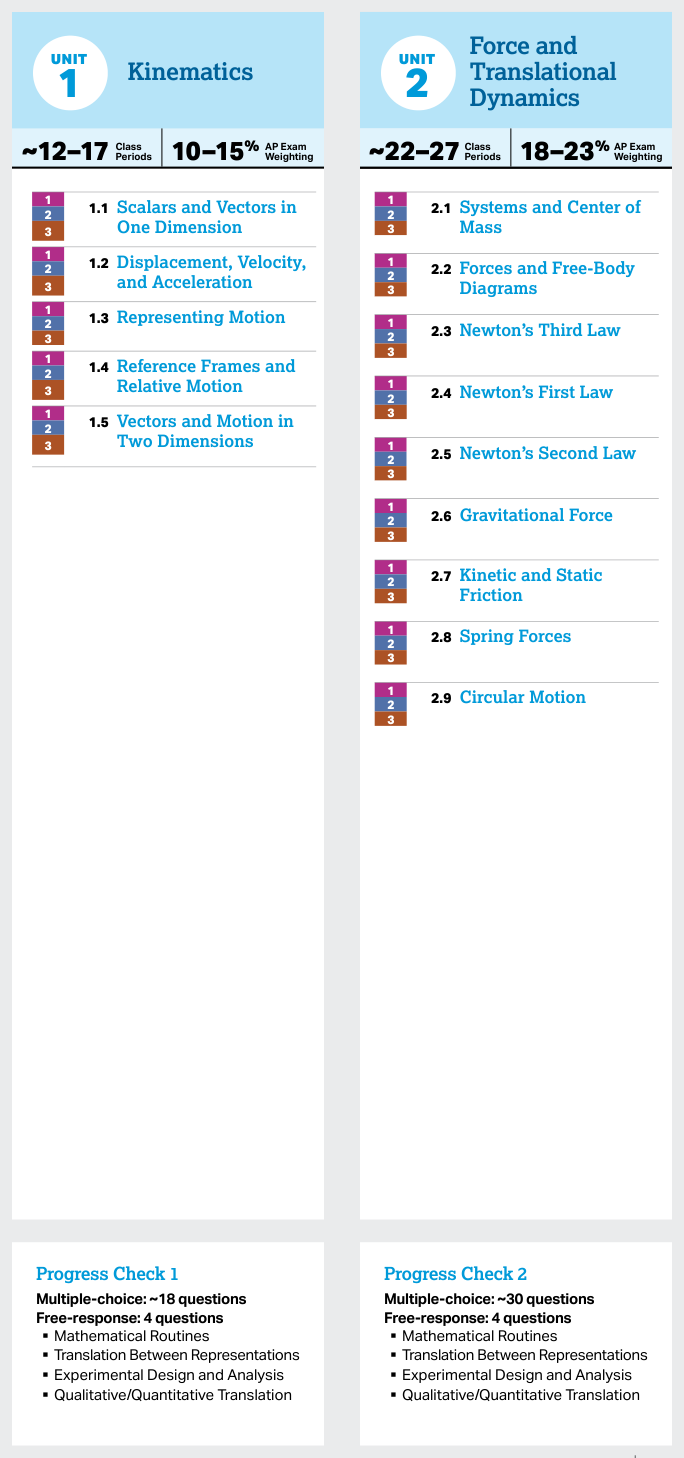
1.1 Scalars and Vectors in One Dimension
Key concepts: Scalars and vectors in one dimension · Physical quantities · Comparing physical quantities between scenarios or at different times and locations · Representing physical situations with diagrams, tables, charts, or schematics · Applying an appropriate law, definition, or theoretical relation · Science Practice 1 · Science Practice 2 · Science Practice 3
A scalar tells you how much of a physical quantity exists, while a vector tells you both how much and in which direction. A car traveling at $20\ \text{m/s}$ and a car traveling at $20\ \text{m/s}$ in the opposite direction have the same speed but different velocities because velocity includes direction.
1.2 Displacement, Velocity, and Acceleration
Key concepts: Displacement, velocity, and acceleration in one-dimensional motion · Qualitative sketches of graphs representing physical-system behavior · Comparing physical quantities across scenarios, times, or locations · Calculating or estimating unknown quantities with units · Vectors represented visually as arrows with direction and length proportional to magnitude · Average velocity · Average acceleration · Constant-acceleration kinematic relationships · Simple harmonic motion displacement, velocity, and acceleration · Extrema and zeros of displacement, velocity, and acceleration in harmonic motion
Over a trip, an object can have zero net displacement even while having nonzero velocity and acceleration during parts of the trip.
1.3 Representing Motion
Key concepts: Representing physical situations with diagrams, tables, charts, and schematics · Creating qualitative sketches of graphs to show features of a model or behavior · Applying physical laws, definitions, theoretical relationships, and models to make claims · Simple harmonic motion of a mass-spring oscillator · Energy bar charts for a spring oscillator · Rolling without slipping · Rotational inertia of a uniform disk · Inelastic collision of a falling block with a moving cart · Pulley systems with a lightweight string · Interpreting motion through experimental setups and labeled force diagrams
A motion problem becomes much easier when the physical situation is translated into several representations: a sketch of the objects, a free-body diagram, a data table, a graph, and an equation.
1.4 Reference Frames and Relative Motion
Key concepts: Reference frames · Relative motion · Motion described relative to a reference frame · Measurements from a given reference frame · Relationships between objects in a single scenario · One-dimensional relative motion · Accelerating (non-inertial) reference frames · Models and representations of physical systems · Qualitative sketches of graphs · Applying laws, definitions, theoretical relationships, or models to make claims
A passenger sitting on a moving train is at rest relative to the train but moving relative to the ground. Both descriptions are correct because motion is measured relative to a reference frame—the coordinate system and observer chosen to describe position and time.
1.5 Vectors and Motion in Two Dimensions
Key concepts: Vectors and vector components · Motion in two dimensions · Projectile motion · Predicting a projectile’s landing spot · Quantitative graphs from data · Applying physical laws to make claims · Newton’s second law · Circular motion · Conservation of energy · Relationships between physical quantities in different scenarios
A projectile can move rightward while accelerating downward, because its motion has independent perpendicular components. Learning Objective 1.5.B: describe the motion of an object moving in two dimensions.
2.1 Systems and Center of Mass
Key concepts: Center of mass of a system · Weighted-average position of mass · Center of mass along a given axis · Modeling a system as a single object located at its center of mass · Finding the center of mass by visual inspection of symmetrical objects
A balanced seesaw does not “care” about every particle separately; for many translational questions, it behaves as though all of its mass were concentrated at one representative location: its center of mass.
2.2 Forces and Free-Body Diagrams
Key concepts: Forces and translational dynamics · Free-body diagrams · Forces represented as vectors · Contact forces · Interatomic electric forces · Newton’s First Law · Systems and center of mass · Force diagrams for rigid systems and torque · Newton’s Third Law · Using physical principles and experimental evidence to support claims
A force is an interaction between two objects or systems that can change an object’s motion, shape, or internal condition. The key question is never “What force does this object have?” but “What other object or system is interacting with it?”
2.3 Newton’s Third Law
Key concepts: Newton’s third law · Paired forces exerted on each object · Equal-and-opposite interaction forces · Momentum changes of interacting objects · Ideal strings and tension · Strings with nonnegligible mass · Ideal pulleys · Force representations and diagrams
When a skateboard pushes backward against the ground, the ground pushes the skateboard forward with exactly the same force. Newton’s third law is not a rule about one object’s net force; it is a rule about the paired interaction between two objects.
2.4 Newton’s First Law
Key concepts: Newton’s first law · Balanced and unbalanced forces · Forces balanced in one dimension but unbalanced in another · Velocity changes in the direction of the unbalanced force · Observing motion and applied forces · Bowling Ball and Broom investigation · System concept in applying Newton’s laws · Newton’s second law derived from lab data · Conservation of energy · Kinetic and potential energy
A bowling ball can keep rolling even after the broom stops pushing it. The crucial question is not “What force keeps it moving?” but “What is the net force while it moves?”
2.5 Newton’s Second Law
Key concepts: Newton’s Second Law relating net force, mass, and acceleration · Net force as the rate of change of momentum · Constant-mass form of Newton’s Second Law · Acceleration as the slope of a velocity-time graph · The relationship between net force and acceleration · The relationship between mass and acceleration · Using diagrams, tables, charts, or schematics to represent physical situations · Deriving symbolic expressions from known quantities · Applying Newton’s Second Law to motion on a rough inclined ramp · Experimental investigation of Newton’s Second Law using carts, tracks, and probeware
A velocity changes only when the net force—the vector sum of all external forces on a system—is nonzero. Newton’s Second Law turns that statement into a quantitative rule connecting force, mass, and acceleration.
2.6 Gravitational Force
Key concepts: Gravitational field versus gravitational force · Weight as the gravitational force on an object · Apparent weightlessness · Gravitational force and circular motion · Direction of force vectors · Buoyant force versus gravitational force · Acceleration and density · Newton’s third law for internal friction forces · Gravitational potential-energy graphs · Repeated trials and reliability of measurements
A gravitational field tells you what gravity could do at a location; a gravitational force tells you what gravity does to a particular object placed there.
2.7 Kinetic and Static Friction
Key concepts: Kinetic friction · Static friction · Coefficient of kinetic friction · Coefficient of static friction · Normal force · Relative motion, slipping, and sliding · Independence of friction from contact area · Energy dissipation by kinetic friction · Maximum static friction · Friction in physical scenarios and comparisons
A box can remain motionless while you push it because static friction quietly matches your push—until a limiting value is reached and the box slips.
2.8 Spring Forces
Key concepts: Hooke’s law and spring force · Spring stretch and compression · Restoring force and equilibrium · Mass–spring oscillations · Force diagrams for a block attached to a spring · Centripetal force in circular motion · Radial direction of centripetal force · Relationship between spring stretch and speed · Negligible friction in spring systems · Conservation of energy in spring motion
A spring can pull a rapidly rotating block inward strongly enough to keep it moving in a circle—but only because the spring is stretched first.
2.9 Circular Motion
Key concepts: Uniform circular motion · Centripetal force · Spring force and Hooke’s law · Tangential speed and angular speed · Radius of circular motion · Force analysis for an object moving in a circle · Motion on a frictionless horizontal table · Equilibrium and unstretched spring length · Deriving equations from force relationships · Checking qualitative and quantitative consistency
A block moving at constant speed around a circle is accelerating even when its speedometer reading never changes. The reason is that velocity includes direction, and the direction changes continuously; therefore, a net force must point toward the center of the circular path.
3.1 Translational Kinetic Energy
Key concepts: Translational kinetic energy · Linear motion of an object's center of mass · Mass · Velocity (speed) · Scalar quantity
An object has translational kinetic energy when its center of mass moves from one place to another. A rolling bicycle, a sliding book, and a spacecraft traveling through space all possess translational kinetic energy because their overall motion is linear, even if the objects also rotate.
3.2 Work
Key concepts: Sphere · Tangent (tan) · Variable v representing speed
A force does work when it transfers energy to or from a system through a displacement. Pushing a motionless wall can feel exhausting, but if the wall does not move, the wall does not receive mechanical work from your push.
3.3 Potential Energy
Key concepts: Potential energy associated with conservative forces · Conservation of mechanical energy · Gravitational potential energy · Elastic spring potential energy · Kinetic energy and energy bar charts · Thermal energy from friction · Energy transformations in multi-component systems · Total mechanical energy versus position · Using geometric displacement on an incline · Comparing energy and speed at different positions
A compressed spring, a raised block, and a sliding object can all store energy in different ways—but only certain forces allow that stored energy to be recovered without depending on the path taken.
3.4 Conservation of Energy
Key concepts: Conservation of energy · Work–energy principle · Positive and negative work · Energy transformations caused by forces · Energy bar charts and system diagrams · Gravitational potential energy and kinetic energy · Rotational inertia and rotational kinetic energy · Symbolic derivation from known quantities · Energy conservation in ramps and vertical-loop motion · Conservation of momentum and kinetic energy in collisions
A cart can speed up, slow down, climb, dip, and loop without energy disappearing: energy changes form while the total energy of a chosen system remains constant.
3.5 Power
Key concepts: Power
A machine that transfers the same amount of energy in less time is more powerful. Power measures the rate at which work is done, or equivalently the rate at which energy is transferred.
4.1 Linear Momentum
Key concepts: Linear momentum and impulse · Force–time graphs and momentum change · Velocity–time graphs and kinetic-energy change · Linear and angular quantities in rolling motion · Rolling while slipping versus pure rolling · Effect of friction on linear and angular speed · Translation between analogous linear and angular relationships · Using linear graphs to determine physical quantities · Spring-mass oscillations and period relationships
A rolling wheel can translate across the floor while rotating about its center, so its motion carries two linked descriptions: linear momentum for the motion of its center of mass and angular motion for its spin.
4.2 Change in Momentum and Impulse
Key concepts: Impulse · Change in linear momentum · Impulse-momentum theorem · Momentum bar charts · Effects of bouncing versus sticking collisions · Conservation of momentum in a selected system · Change in velocity and momentum during interactions · Transfer of kinetic energy in collisions · Experimental investigation of impulse and momentum
A dart that bounces from a cart can make the cart move faster than a dart that sticks to it—even when the dart has the same mass and incoming speed in both trials.
4.3 Conservation of Linear Momentum
Key concepts: Conservation of linear momentum for an isolated system · Perfectly inelastic collisions in which objects stick together · Momentum as the product of mass and velocity · Initial and final momentum of a multi-object system · Impulse–momentum theorem and its relation to Newton’s second law · Negligible external forces and friction in momentum-conservation problems · Using symbolic derivations to predict physical quantities · Qualitative reasoning and justification using physical principles and experimental evidence
Linear momentum is conserved when a system experiences negligible net external impulse: the system’s total momentum before an interaction equals its total momentum afterward. That single idea can predict the motion of colliding objects even when mechanical energy is transformed into sound, thermal energy, or…
4.4 Elastic and Inelastic Collisions
Key concepts: Elastic collisions · Inelastic collisions · Conservation of momentum · Conservation of kinetic energy · Kinetic energy and speed · Position-versus-time graphs · Center of mass motion · Velocity as the slope of a position-versus-time graph · Collision-system modeling and external forces · Predicting changes using functional relationships
A collision can conserve the system’s total momentum while not conserving its kinetic energy. The key question is therefore not “Was momentum conserved?”—for an isolated two-object system, it is—but “What happened to the kinetic energy?”
5.1 Rotational Kinematics
Key concepts: Angular speed as a function of time · Angular acceleration and the slope of an angular-speed–time graph · Rotation of a beam about a fixed hinge · Effect of cutting a string on rotational motion · Negligible-friction rotational dynamics · Qualitative interpretation of rotational graphs · Torque-dependent angular acceleration · Identifying and correcting discrepancies in prior work · Trigonometric dependence in tension equations
A beam released from a hinge does not generally spin with constant angular acceleration: gravity’s turning effect changes as the beam falls. That single fact determines the shape of its angular-speed graph.
5.2 Connecting Linear and Rotational Motion
Key concepts: Connecting linear and rotational motion · Relationship between linear and angular quantities for a rotating rigid body · Tangential velocity and angular velocity · Tangential acceleration and angular acceleration · Rigid-body rotation about a fixed axis · Rolling motion without slipping · Applying laws, definitions, and theoretical relationships to make claims · Calculating unknown quantities with units from known quantities · Creating quantitative graphs with appropriate scales and units · Rolling while slipping is beyond the scope of AP Physics 1
A rotating wheel can have one angular velocity but many different linear velocities: points farther from the axle travel faster because they sweep through the same angle along larger circular arcs.
5.3 Torque
Key concepts: Torque · Angle · Radial distance or lever arm (r) · Density · Cosine relationship
A force can make an object accelerate without making it rotate, depending on where and how the force acts. Pushing a door near its hinges is difficult; pushing at the handle is effective because the turning effect depends on both the force and its distance from the axis.
5.4 Rotational Inertia
Key concepts: Rotational inertia · Moment of inertia of disks and hoops · Dependence of rotational inertia on mass and radius · Torque produced by a tangential force · Relationship between torque, rotational inertia, and angular acceleration · Angular momentum and equal torque applied for equal time · Rotational kinetic energy and work · Rolling objects and acceleration down an incline · Experimental effects of wheel rotational inertia on measured acceleration and g_exp · Using physical models to explain observable rotational motion
A wheel does not resist changes in rotation merely because it has mass; it resists them according to where its mass is located relative to the axis.
5.5 Rotational Equilibrium and Newton’s First Law in Rotational Form
Key concepts: Rotational equilibrium · Newton’s First Law in rotational form · Translational equilibrium · Net force as a vector sum · Free-body diagrams · Force diagrams · Torque · Forces and torques exerted on an object · Learning objectives and essential knowledge · Science practices: deriving symbolic expressions and applying laws
A rigid object can have zero net torque and still accelerate through space, or have zero net force and still begin rotating. The key is that translational and rotational equilibrium are separate conditions.
5.6 Newton’s Second Law in Rotational Form
Key concepts: Newton’s second law in rotational form · Net torque and angular acceleration · Rotational inertia · Angular momentum and its rate of change · Angular impulse · Torque produced by friction · Rolling motion on an incline · Single-plane rotation boundary · Qualitative proportional relationships among torque, inertia, and angular acceleration
A rotating object changes its angular velocity when its rotational dynamics produce angular acceleration. For a rigid body rotating about a fixed axis with constant rotational inertia, the cause is the net torque:
6.1 Rotational Kinetic Energy
Key concepts: Rotational kinetic energy · Translational kinetic energy · Rotational inertia · Energy partition between translational and rotational motion · Conservation of mechanical energy · Rolling motion · Comparison of objects with different rotational inertia · Force and torque analysis of rolling objects · Motion down an incline · Quantitative and qualitative energy representations
A rolling object can arrive at the bottom of an incline with less translational speed than a sliding object because some of its energy is carried by rotation.
6.2 Torque and Work
A force can make an object move without making it rotate, and it can make an object rotate without doing much translational work. The difference is where the force acts and which part of the displacement is aligned with the force.
6.3 Angular Momentum and Angular Impulse
Key concepts: Angular momentum · Angular impulse · Rotational impulse–momentum theorem · Torque as the source of angular impulse · Torque-versus-time graphs · Area under a torque–time curve · Change in angular momentum · Direction of torque and angular impulse · Angular impulse delivered to an object or rigid system
A brief twist of a wrench can change a wheel’s rotation, but the important quantity is not torque alone: a torque acting for a time interval delivers angular impulse, changing the object’s angular momentum.
6.4 Conservation of Angular Momentum
Key concepts: Angular momentum conservation · Net external torque and its role in conservation · System boundaries and the environment · Transfer of angular momentum · Angular momentum of orbiting objects · Relationship between orbital radius and tangential speed · Torque versus force in rotational dynamics · Block-spring systems involving rotation and energy
Angular momentum stays constant only when the chosen system experiences zero net external torque over the interval being analyzed.
6.5 Rolling
A rolling object moves forward while rotating, so its motion combines translation of its center of mass with rotation about its center. A bicycle tire, a bowling ball, and a wheel on a ramp all obey the same central condition when they roll without slipping:
6.6 Motion of Orbiting Satellites
Key concepts: Rolling while slipping · Relative motion between the contact point and the surface · Kinetic friction · Energy dissipation due to kinetic friction · Mechanical-energy loss · Forces and torques in qualitative modeling · Motion of orbiting satellites · Gravitational force
An orbiting satellite is continuously falling toward a massive central object, but its sideways motion carries it forward so that it keeps missing the object.
Unit 7: Oscillations — Exam-Style Practice
Exam-style free-response practice for AP Physics 1 Unit 7: simple harmonic motion, its frequency and period, representing and analyzing SHM, and the energy of simple harmonic oscillators.
8.1 Internal Structure and Density
Key concepts: Internal structure and density · Fluids as the subject of Unit 8
A fluid can flow because its particles are not locked into a fixed shape, but the particles still occupy space and contribute mass. Density measures how much mass is packed into a given volume:
8.2 Pressure
A sharp heel can hurt more than a flat shoe even when both support the same person because pressure depends on how much area receives a force.
8.3 Fluids and Newton’s Laws
Key concepts: Pressure as force per unit area · Fluid pressure in a column · Dependence of fluid pressure on depth · Dependence of fluid pressure on density · Absolute (total) pressure versus pressure due to the fluid alone · Applying Newton’s laws to fluids · Using experimental data as evidence for a claim · Creating and interpreting graphs with appropriate scales and units · Deriving symbolic expressions from known quantities · Designing experimental procedures and comparing physical quantities
Pressure forces on a fluid surface can produce a net force, and that net force determines whether a fluid element accelerates, remains at rest, or pushes another object upward.
8.4 Fluids and Conservation Laws
Key concepts: Conservation of mass flow rate in incompressible fluids · Fluid–Earth system energy differences · Gravitational potential energy differences between locations · Functional dependence between physical variables · Applying laws, definitions, theoretical relationships, or models · Predicting changes in physical quantities · Representing data with appropriate scales and units · Plotting and interpreting data
A narrow section of pipe can make water move faster without creating extra water: when an incompressible fluid enters a region, the same mass flow rate must leave it.
AP Practice 1
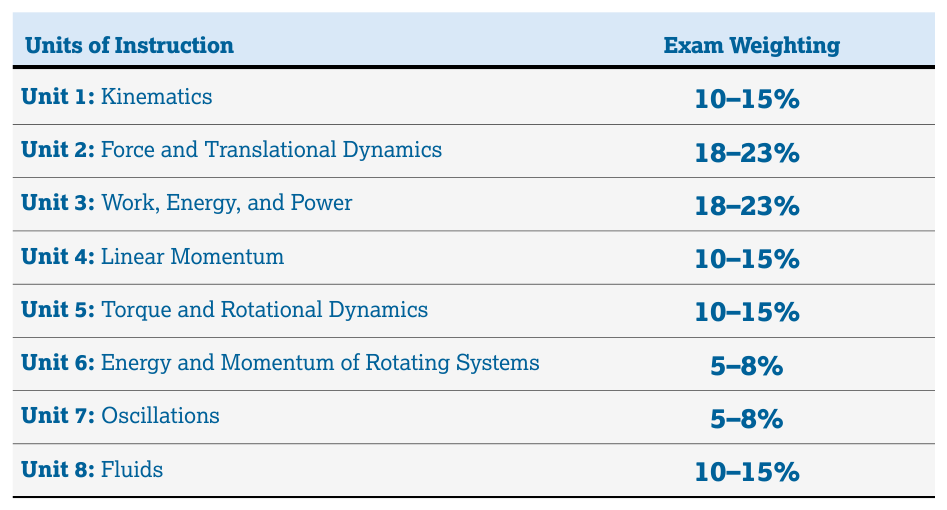
Key concepts: AP Physics 1 Algebra-Based course framework effective Fall 2024 · AP course principles: evidence-based reasoning and independent thinking · Respectful debate and inclusion of diverse perspectives in AP classrooms · Multiple-choice exam structure updates · Inquiry-based laboratory instruction · Science practices in AP Physics 1 · Hands-on laboratory work and course time allocation · The eight AP Physics 1 course units · Multiple representations in kinematics · Momentum of rotating systems, oscillations, and fluids
AP Physics 1 is an algebra-based, introductory college-level physics course whose framework is effective beginning in Fall 2024. Its central question is not merely “Which equation applies?” but How can evidence, representations, mathematics, and physical principles justify a claim about what a system does?
AP Practice 2
Key concepts: AP Physics exam structure and timing · Position-time and velocity-time representations · Newton’s second law and system analysis · Static friction and coefficient of friction · Kinetic (sliding) friction · Circular motion and centripetal acceleration · Tangential and net acceleration · Tension in strings with nonnegligible mass · Gravitational field near Earth’s surface · Motion and force modeling using equations and narratives
A motion graph is not merely a picture of motion: its slope, curvature, and changing direction make testable claims about velocity, acceleration, and force. A strong multiple-choice solution moves through a chain:
AP Practice 3
A strong physics investigation does more than produce a number: it connects a question, a controlled procedure, measured data, a mathematical model, and an evidence-based claim.
AP Practice 4
A strong experimental-design response does more than name an equation: it turns a physical question into measurable variables, a controlled procedure, evidence-based analysis, and a defensible claim.
AP Practice 5
A strong physics response can begin with a picture or a sentence and end with an equation. The crucial skill is moving accurately between those forms: this practice focuses on qualitative-to-quantitative translation, especially turning a physical description and diagram into a symbolic model, then using that model…
AP Practice 6
A successful physics investigation turns a physical question into measurable evidence: identify the variables, design a procedure, represent the data, and use a physical model to justify a conclusion.
Source Materials
- Review the Exam Updates (.pdf)
- AP Physics 1: Algebra-Based Course and Exam Description
- AP Physics 1 Course Overview
- AP Physics 1 Course at a Glance
- AP Physics 1 Course at a Glance Poster
- Adopt AP Physics 1: Algebra-Based
- AP Physics 1: Algebra-Based
- AP Physics 1: Algebra-Based
- Figure — AP Physics 1: Algebra-Based Course and Exam Description (p. 1)
- Figure — AP Physics 1: Algebra-Based Course and Exam Description (p. 14)
- TOPICS
- Framework V.1 | 13 13

Study AP Physics 1 on Lykke
This course page is free to open: signed out, you can read its first two sections, and signing in, on any plan, opens the rest. The free Lykke Chrome extension syncs your own Canvas courses, so ChatGPT, Claude and Muse can answer from your classes and deadlines. It only reads Canvas.
Add the free extensionSign in to open every section