From the free course AP Physics 1 on Lykke
2.4 Newton’s First Law
Key concepts: Newton’s first law · Balanced and unbalanced forces · Forces balanced in one dimension but unbalanced in another · Velocity changes in the direction of the unbalanced force · Observing motion and applied forces · Bowling Ball and Broom investigation · System concept in applying Newton’s laws · Newton’s second law derived from lab data · Conservation of energy · Kinetic and potential energy
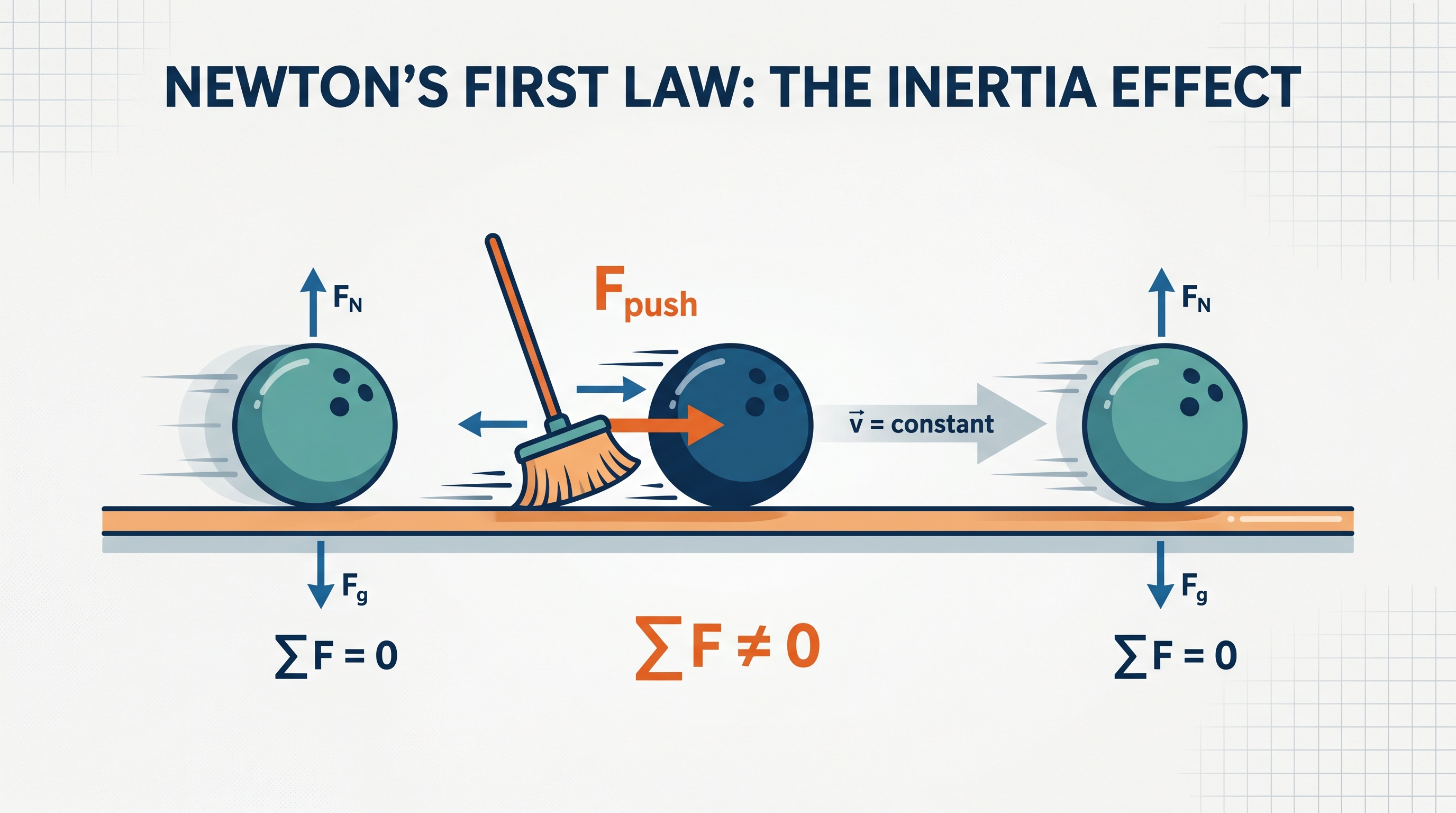
A bowling ball can keep rolling even after the broom stops pushing it. The crucial question is not “What force keeps it moving?” but “What is the net force while it moves?”
2.4 Newton’s First Law
A bowling ball can keep rolling even after the broom stops pushing it. The crucial question is not “What force keeps it moving?” but “What is the net force while it moves?”
Constant velocity means zero net force
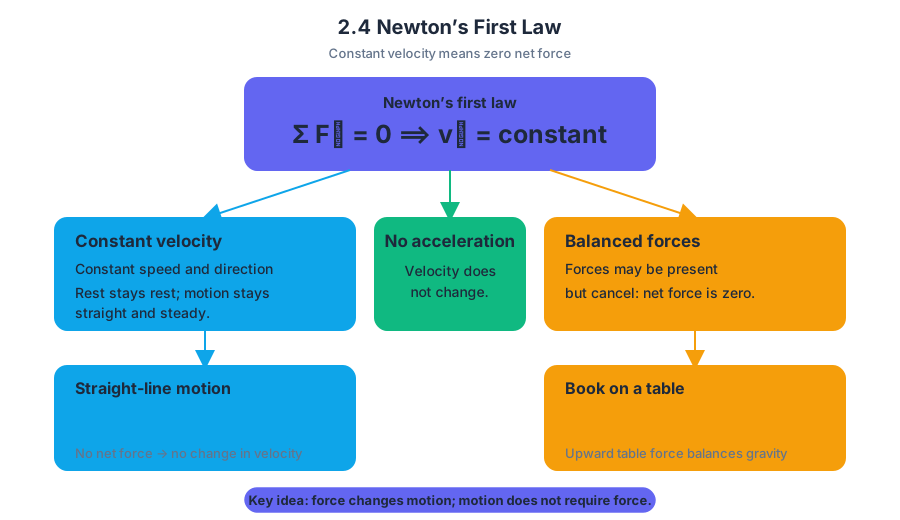
Newton’s first law states that an object’s velocity remains constant when the net force on the system is zero:
$$\sum \vec{F}=0 \quad \Longrightarrow \quad \vec{v}=\text{constant}$$
Constant velocity includes both constant speed and constant direction. An object at rest remains at rest, while an object already moving continues in a straight line at constant speed—unless a nonzero net force changes its motion.
Key idea: Motion does not require a net force. A net force is required to change velocity.
A force can be present without producing acceleration if other forces balance it. For example, a book resting on a table has a downward gravitational force and an upward table force. These forces cancel, so the book’s velocity remains zero.
Balanced in one direction, unbalanced in another
Forces must be analyzed by components. Forces may be balanced in one dimension but unbalanced in another, and the system’s velocity changes only in the direction of the unbalanced force. This is the essential knowledge statement 2.4.A.4.
Consider a puck sliding east while a magnetic force pulls it north. If the horizontal forces balance,
$$\sum F_x=0,$$
then its eastward velocity component remains constant. If the northward force is unbalanced,
$$\sum F_y\neq 0,$$
then the puck gains a northward velocity component. Its path curves, even though there is no horizontal acceleration.
The phrase “the object accelerates” is therefore incomplete. A better claim identifies the direction:
$$\vec{a}\text{ points in the direction of }\sum\vec{F}.$$
Misconception check: “Balanced forces mean no motion”
Balanced forces mean no change in velocity, not necessarily no velocity. A spacecraft traveling far from planets can move at constant velocity with essentially zero net force. Likewise, a cart can roll at constant velocity while small resistive and driving forces cancel.
Bowling Ball and Broom investigation
In the Bowling Ball and Broom investigation, observations connect force directly to changes in motion. A broom first applies a force to a nearly stationary bowling ball. While the push acts, the ball’s velocity changes; after the broom is removed, the ball continues moving, although friction may gradually reduce its speed.
The evidence supports two linked conclusions:
- During the push, the ball experiences a nonzero net force and its velocity changes.
- After the push, if the net force is approximately zero, the ball’s velocity remains approximately constant.
A stronger push produces a larger rate of velocity change, provided the system and mass remain fixed. This observation leads toward Newton’s second law, but the first-law conclusion comes first: without an unbalanced force, the observed velocity does not change.
Choosing the system
A system is the object or collection of objects selected for analysis. For the bowling-ball observation, the system might be the ball alone. The broom, floor, Earth, and air are then outside the system and can exert external forces on it.
This choice matters because “net force” means the vector sum of forces acting on the selected system. In a modified Atwood’s machine, for example, the measured acceleration depends on whether the system is defined as one hanging mass, both masses, or the masses plus the connecting apparatus. Lab data can be used to test a relationship between net force and acceleration only after the system boundary and external forces are stated clearly.
Inertial reference frames
An inertial reference frame is a frame from which an observer verifies Newton’s first law. This is the essential knowledge statement 2.4.A.5. A laboratory floor is usually treated as approximately inertial; a rapidly turning carousel is not, because objects appear to accelerate even when no ordinary interaction force explains the motion in that frame.
AP skills in action
This topic develops four suggested skills:
- 1.C — Create qualitative sketches of graphs that represent features of a model or the behavior of a physical system. Sketch velocity as constant after the broom stops, or sketch acceleration as nonzero only while the push creates a net force.
- 2.A — Derive a symbolic expression from known quantities by selecting and following a logical mathematical pathway. Resolve forces into components and use $\sum F_x=0$ or $\sum F_y=0$ to identify which velocity component can change.
- 3.B — Apply an appropriate law, definition, theoretical relationship, or model to make a claim. Use Newton’s first law when $\sum\vec F=0$, rather than claiming that motion itself requires force.
- 3.C — Justify or support a claim using evidence from experimental data, physical representations, or physical principles or laws. Cite the bowling ball’s observed velocity before, during, and after the broom’s push.
Retrieval check: A cart moves east at constant velocity. A vertical force is added while the horizontal forces remain balanced. Which velocity component changes, and why? Answer: The vertical component changes because the net force is vertical; the eastward component remains constant because $\sum F_x=0$.