From the free course AP Physics 1 on Lykke
4.3 Conservation of Linear Momentum
Key concepts: Conservation of linear momentum for an isolated system · Perfectly inelastic collisions in which objects stick together · Momentum as the product of mass and velocity · Initial and final momentum of a multi-object system · Impulse–momentum theorem and its relation to Newton’s second law · Negligible external forces and friction in momentum-conservation problems · Using symbolic derivations to predict physical quantities · Qualitative reasoning and justification using physical principles and experimental evidence
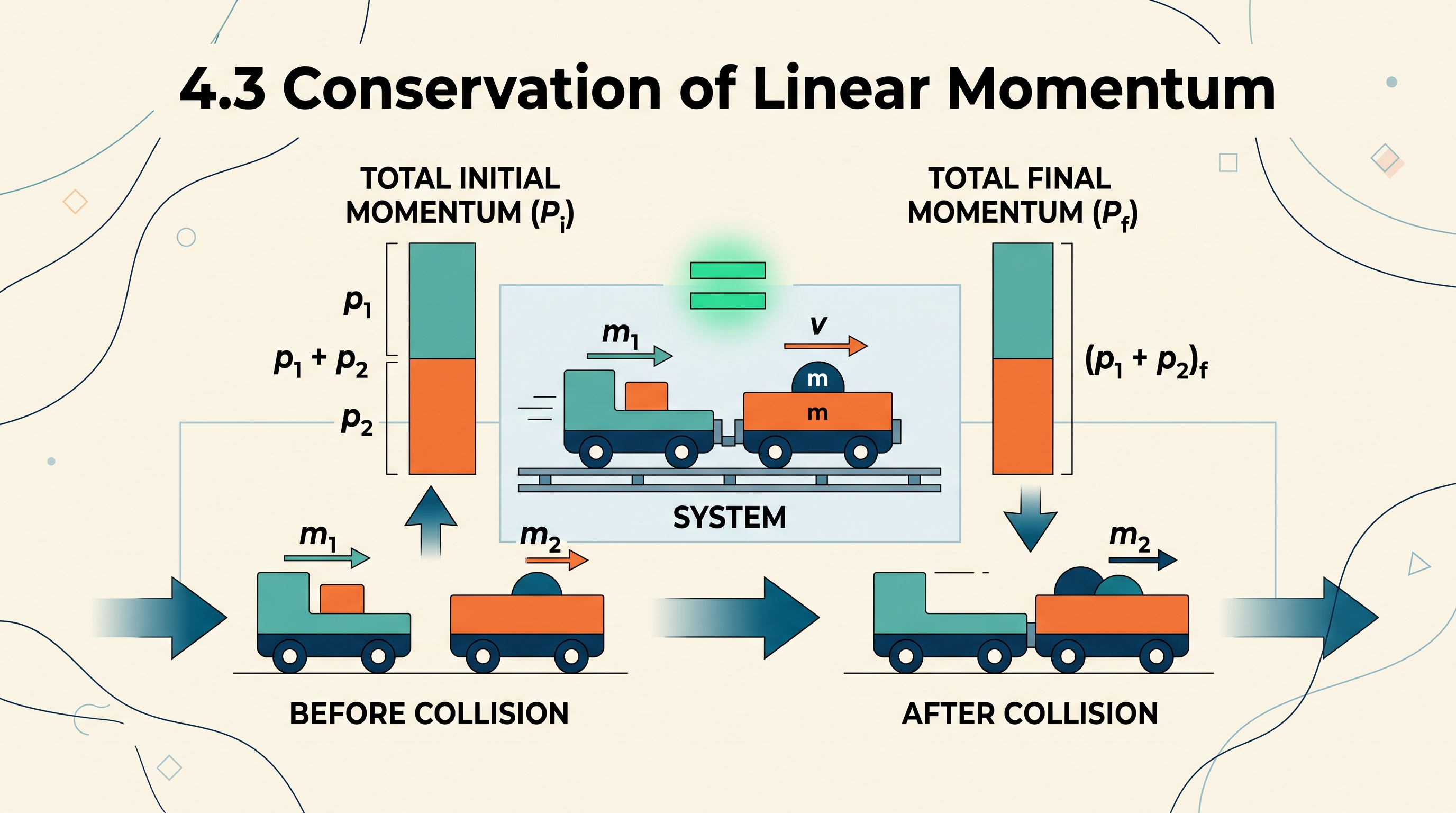
Linear momentum is conserved when a system experiences negligible net external impulse: the system’s total momentum before an interaction equals its total momentum afterward. That single idea can predict the motion of colliding objects even when mechanical energy is transformed into sound, thermal energy, or…
4.3 Conservation of Linear Momentum
Linear momentum is conserved when a system experiences negligible net external impulse: the system’s total momentum before an interaction equals its total momentum afterward. That single idea can predict the motion of colliding objects even when mechanical energy is transformed into sound, thermal energy, or deformation.
4.3.A — Learning Objective: Describe the behavior of a system using conservation of linear momentum.
Momentum belongs to a system
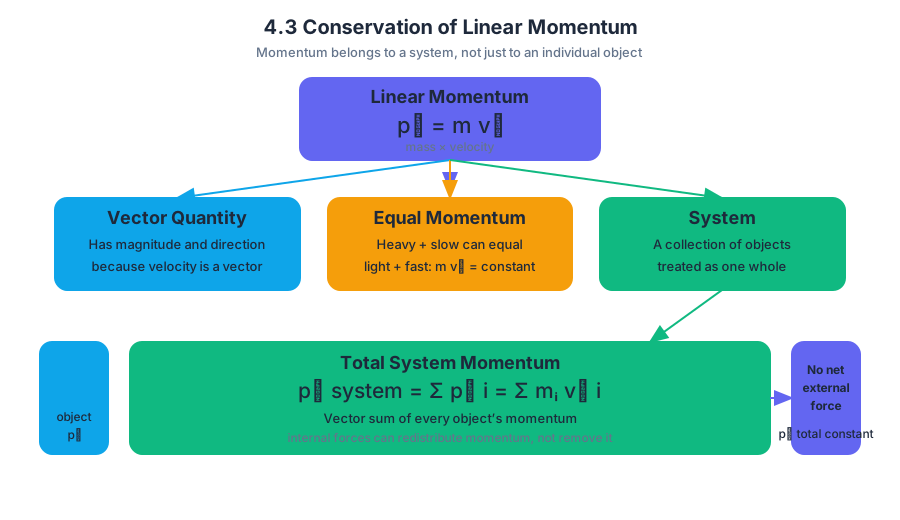
Linear momentum is the product of an object’s mass and velocity:
$$\vec{p}=m\vec{v}$$
Because velocity is a vector, momentum has both magnitude and direction. A heavy, slowly moving object can have the same momentum as a light, rapidly moving object, provided the products $m\vec{v}$ are equal.
A collection of objects can be treated as one system. The system’s total momentum is the vector sum of the momenta of all its objects:
$$\vec{p}_{\text{system}}=\sum_i \vec{p}_i=\sum_i m_i\vec{v}_i$$
Its center-of-mass velocity is therefore
$$\vec{v}_{\text{cm}}=\frac{\sum \vec{p}_i}{\sum m_i} =\frac{\sum m_i\vec{v}_i}{\sum m_i}$$
If the net external force is zero, the center of mass moves at constant velocity. Internal forces may radically change the individual objects’ velocities, but they cannot change the total momentum of the complete system.
The conservation condition
The practical test is not whether any force acts. The test is whether the chosen system receives a significant net external impulse. If that impulse is negligible,
$$\vec{p}_i=\vec{p}_f$$
Equivalently, the total momentum change is zero:
$$\Delta \vec{p}_{\text{system}}=\vec{0}$$
A frictionless horizontal collision is a classic example. The blocks exert large forces on each other, but those forces are internal to the two-block system. The normal force from the surface and gravity act vertically, so they do not change the system’s horizontal momentum.
This is why system boundaries matter. For a block alone, the collision force from the other block is external, so the block’s momentum changes. For both blocks together, the collision forces are an internal action-reaction pair, so their impulses cancel in the total.
Perfectly inelastic collision: objects stick
A perfectly inelastic collision is a collision in which the objects stick together and share one final velocity. Consider Block 1, of mass $M_1$, moving right at speed $v_0$, striking stationary Block 2, of mass $M_2$, on a frictionless horizontal surface.
Before impact, the system’s horizontal momentum is
$$p_i=M_1v_0+M_2(0)$$
After the blocks stick, their combined mass is $M_1+M_2$, and both move with velocity $v_f$:
$$p_f=(M_1+M_2)v_f$$
Applying conservation of momentum,
$$M_1v_0=(M_1+M_2)v_f$$
so
$$\boxed{v_f=\frac{M_1v_0}{M_1+M_2}}$$
The final velocity points right because the initial system momentum points right.
Functional dependence and limiting reasoning
The equation predicts how changing $M_2$ affects $v_f$. Increasing $M_2$ increases the denominator while leaving the numerator unchanged, so the final speed decreases. If $M_1\gg M_2$, then $M_1+M_2\approx M_1$, giving
$$v_f\approx\frac{M_1v_0}{M_1}=v_0$$
Thus a much lighter stationary block barely slows the moving block. If instead $M_2$ is comparable to or much larger than $M_1$, the speed reduction is substantial. This qualitative estimate should agree with the symbolic equation.
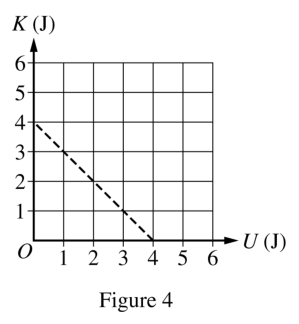
Misconception check — “Sticking means momentum is lost.” Sticking means kinetic energy is generally not conserved; some energy becomes thermal energy, sound, or deformation. Momentum is still conserved whenever the system’s net external impulse is negligible.
A dropped block: conserve only the useful component
Suppose Block 2 is dropped vertically onto sliding Block 1 and sticks. Block 2 initially has zero horizontal velocity, even though it has downward velocity. Immediately after sticking, the combined blocks move horizontally:
$$M_1v_{1,i}+M_2v_{2,i,x}=(M_1+M_2)v_f$$
Since $v_{2,i,x}=0$,
$$v_f=\frac{M_1v_{1,i}}{M_1+M_2}$$
The horizontal speed decreases because the original horizontal momentum must now be shared by more mass. Vertical momentum is not conserved for the blocks alone because the surface exerts an external vertical impulse.
Momentum, impulse, and evidence
The impulse-momentum relationship follows directly from Newton’s second law for constant mass:
$$\vec{F}_{\text{net}}=\frac{\Delta\vec{p}}{\Delta t} =m\frac{\Delta\vec{v}}{\Delta t} =m\vec{a}$$
For a complete system, an external impulse changes total momentum:
$$\vec{J}{\text{ext}}=\Delta\vec{p}{\text{system}}$$
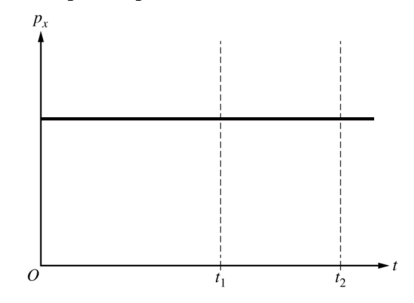
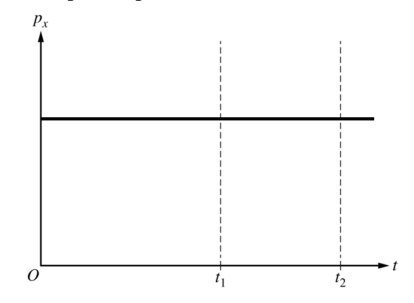
A momentum-versus-time graph has slope equal to the net external force. A force-versus-time graph has area equal to the external impulse. These representations help distinguish a real momentum change from an internal exchange.
The topic explicitly develops 1.B: Create quantitative graphs with appropriate scales and units, including plotting data; 2.A: Derive a symbolic expression from known quantities by selecting and following a logical mathematical pathway; 2.D: Predict new values or factors of change of physical quantities using functional dependence between variables; 3.A: Create experimental procedures that are appropriate for a given scientific question; and 3.C: Justify or support a claim using evidence from experimental data, physical representations, or physical principles or laws.
A strong experimental claim might combine a system diagram, measured velocities before and after a collision, a momentum calculation, and a graph. Agreement within measurement uncertainty supports conservation; noticeable external friction or an unaccounted force suggests that the system boundary or “negligible impulse” assumption must be reconsidered.
Retrieval check: Two carts stick together. Cart 1 has momentum $+6\ \mathrm{kg,m,s^{-1}}$ and Cart 2 is initially at rest. If their total mass is $3\ \mathrm{kg}$, what is their final velocity? Why is the answer not determined by conservation of mechanical energy?


Source Materials
- Review the Exam Updates (.pdf)
- AP Physics 1: Algebra-Based Course and Exam Description
- AP Physics 1 Course Overview
- AP Physics 1 Course at a Glance
- AP Physics 1 Course at a Glance Poster
- Adopt AP Physics 1: Algebra-Based
- AP Physics 1: Algebra-Based
- AP Physics 1: Algebra-Based
- Figure 1. When Block 1 collides with Block 2, the blocks stick together. Friction between the blocks and the surface is negligible.
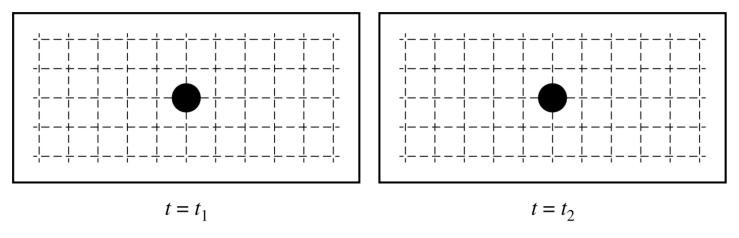
- i. Briefly explain why the two graphs must be the same, using physics principles.
- ii. Referencing d1 and d2, describe your reasoning for drawing the arrows the length that you did in
- (ii) For including a conservation of momentum equation Point A3