From the free course AP Physics 1 on Lykke
8.4 Fluids and Conservation Laws
Key concepts: Conservation of mass flow rate in incompressible fluids · Fluid–Earth system energy differences · Gravitational potential energy differences between locations · Functional dependence between physical variables · Applying laws, definitions, theoretical relationships, or models · Predicting changes in physical quantities · Representing data with appropriate scales and units · Plotting and interpreting data
A narrow section of pipe can make water move faster without creating extra water: when an incompressible fluid enters a region, the same mass flow rate must leave it.
8.4 Fluids and Conservation Laws
A narrow section of pipe can make water move faster without creating extra water: when an incompressible fluid enters a region, the same mass flow rate must leave it. Conservation laws connect that flow constraint to changes in pressure, speed, and gravitational potential energy.
Conservation of mass flow rate
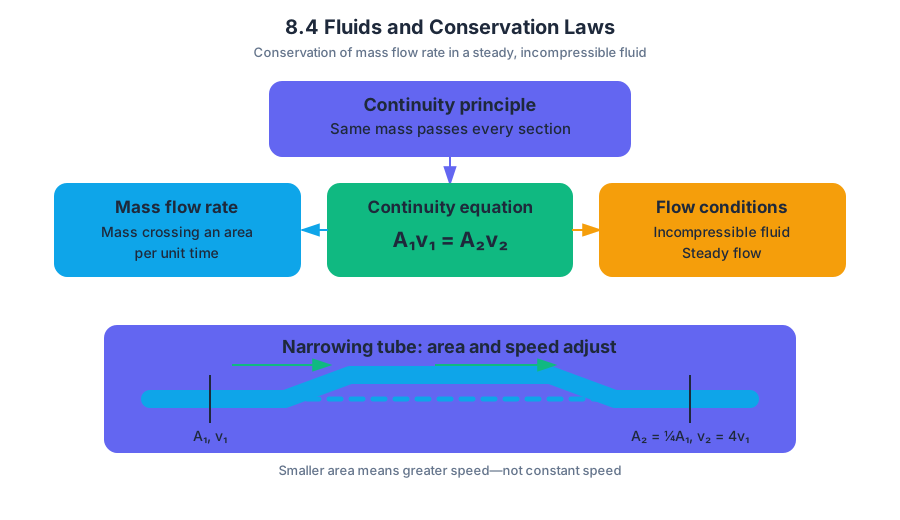
Mass flow rate is the mass passing a cross section per unit time. For an incompressible fluid flowing steadily through a tube, the flow rate is conserved. The relevant continuity relationship is
$$ A_1v_1=A_2v_2 $$
where $A$ is cross-sectional area and $v$ is the fluid speed perpendicular to that area.
If a pipe narrows so that $A_2=\frac{1}{4}A_1$, then
$$ A_1v_1=\frac{1}{4}A_1v_2 \qquad\Rightarrow\qquad v_2=4v_1. $$
The fluid moves four times faster in the narrow section. The equation does not say that speed is always constant; it says that area and speed adjust so the same amount of incompressible fluid passes each location.
This is the required idea in 8.4.A.2, supported by 8.4.A.1.i: in a fluid-filled tube open at both ends, the rate at which matter enters must equal the rate at which matter exits. A pressure difference can cause the fluid to flow, as stated in 8.4.A.1, but once steady flow is established, continuity determines how speed changes from place to place.
Energy differences in the fluid–Earth system
A fluid–Earth system can store energy in several forms. For a fluid element of mass $m$, gravitational potential energy is
$$ U_g=mgy, $$
so the difference between two locations is
$$ \Delta U_g=mg(y_2-y_1). $$
A higher location has greater gravitational potential energy when $g$ is approximately constant. Per unit volume, the corresponding energy difference is $\rho g(y_2-y_1)$, where $\rho$ is fluid density.
For steady, incompressible, nonviscous flow along a streamline, conservation of mechanical energy is expressed by Bernoulli’s equation:
$$ P_1+\frac{1}{2}\rho v_1^2+\rho gy_1
P_2+\frac{1}{2}\rho v_2^2+\rho gy_2. $$
Here $P$ is pressure energy per unit volume, $\frac{1}{2}\rho v^2$ is kinetic energy per unit volume, and $\rho gy$ is gravitational potential energy per unit volume. If viscosity or turbulence converts mechanical energy into thermal energy, this ideal relationship must be modified; it should not be applied automatically.
Worked comparison: a narrowing, rising pipe
Water flows from location $1$ to location $2$. Let $\rho=1000\ \mathrm{kg/m^3}$, $v_1=1.0\ \mathrm{m/s}$, $A_2=\frac14A_1$, and $y_2=y_1+2.0\ \mathrm{m}$. Suppose $P_1=1.50\times10^5\ \mathrm{Pa}$.
First use continuity:
$$ v_2=\frac{A_1}{A_2}v_1=4(1.0)=4.0\ \mathrm{m/s}. $$
The kinetic-energy density increases by
$$ \Delta\left(\frac12\rho v^2\right)
\frac12(1000)\left(4.0^2-1.0^2\right)
7500\ \mathrm{Pa}. $$
The gravitational-potential-energy density increases by
$$ \rho g\Delta y=(1000)(9.8)(2.0)=19600\ \mathrm{Pa}. $$
Bernoulli’s equation gives
$$ P_2=P_1+\frac12\rho(v_1^2-v_2^2)+\rho g(y_1-y_2), $$
so
$$ P_2
150000-7500-19600
122900\ \mathrm{Pa}. $$
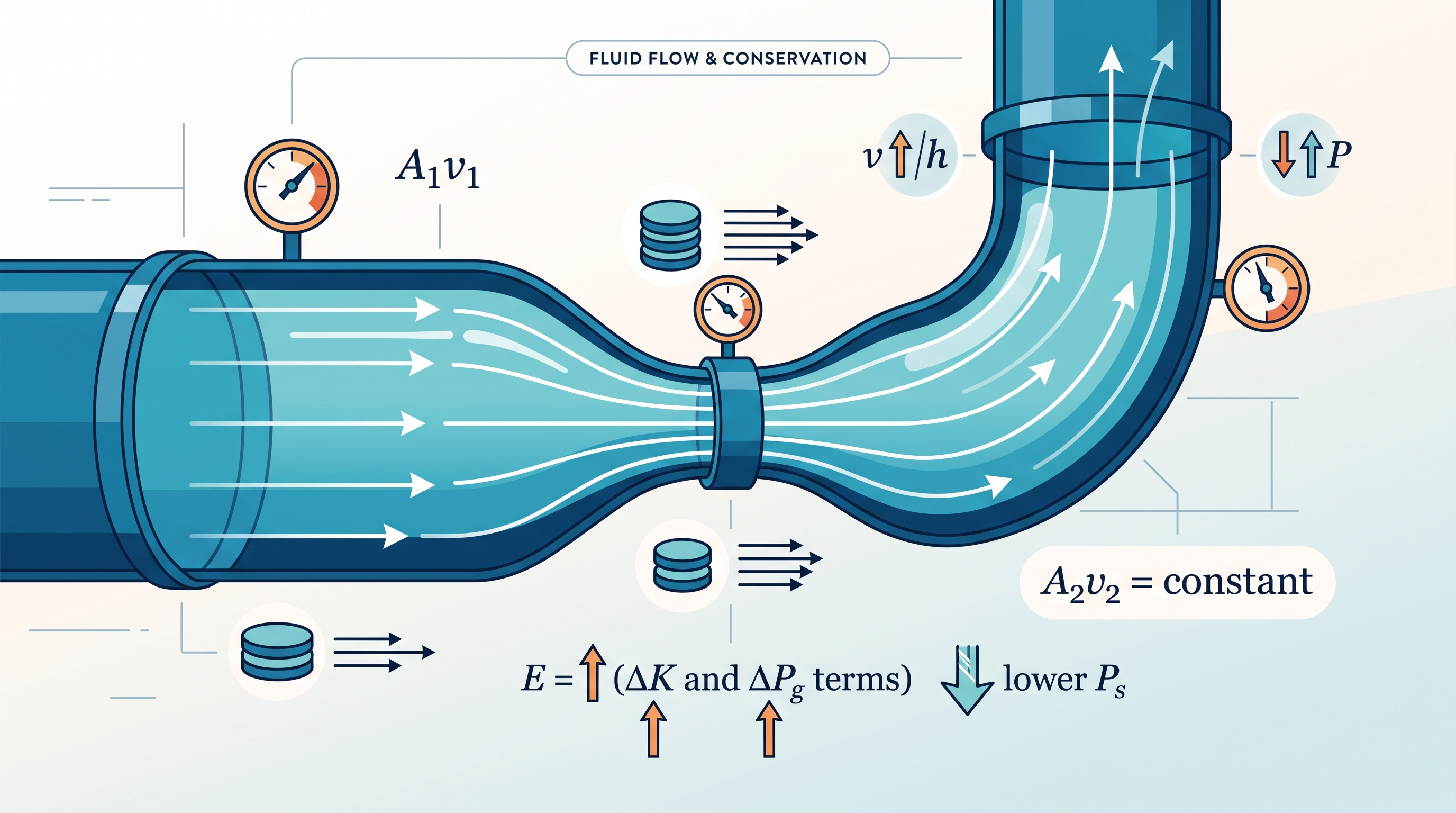
The fluid gains energy density because it rises and speeds up. That energy comes from a decrease in pressure energy: $P_2<P_1$. A narrower pipe alone would tend to lower pressure as speed increases; raising the pipe creates an additional pressure decrease because the fluid also gains gravitational potential energy.
Using functional dependence to predict changes
Skill 2.D — Predict new values or factors of change of physical quantities using functional dependence between variables is especially powerful here. From continuity, $v\propto A^{-1}$: halving area doubles speed. From gravitational potential energy, $U_g\propto m$, $U_g\propto g$, and $U_g\propto y$, so doubling the height difference doubles the gravitational-energy difference when the other quantities remain fixed.
The topic also develops 2.A — Derive a symbolic expression from known quantities by selecting and following a logical mathematical pathway, 2.C — Compare physical quantities between two or more scenarios or at different times and locations in a single scenario, and 3.B — Apply an appropriate law, definition, theoretical relationship, or model to make a claim. A strong response identifies the system, states assumptions, writes continuity or Bernoulli’s equation, and then interprets the sign and factor of change.
Data, procedures, and common traps
For an investigation, 3.A — Create experimental procedures that are appropriate for a given scientific question might require measuring tube diameter, timing a known volume of collected fluid, and repeating measurements at several locations or flow rates. Under 1.B — Create quantitative graphs with appropriate scales and units, including plotting data, graph variables that test the model: for example, plot $v$ against $1/A$ to test $v\propto1/A$, label axes with units, and use a scale that displays all measurements clearly.
Misconception check: “Faster fluid always means lower pressure.” Not by itself. Bernoulli’s equation compares all energy terms. A fluid can speed up while moving downward, gaining kinetic energy partly from gravitational potential energy; pressure need not decrease by the same amount, or may even increase depending on the height change and other conditions.
Retrieval check: A pipe’s area decreases by a factor of $3$, and the fluid is incompressible. What happens to its speed? If the pipe then rises, which two terms in Bernoulli’s equation increase, and what must happen to pressure if no other energy source or loss is present?