From the free course AP Physics 1 on Lykke
1.2 Displacement, Velocity, and Acceleration
Key concepts: Displacement, velocity, and acceleration in one-dimensional motion · Qualitative sketches of graphs representing physical-system behavior · Comparing physical quantities across scenarios, times, or locations · Calculating or estimating unknown quantities with units · Vectors represented visually as arrows with direction and length proportional to magnitude · Average velocity · Average acceleration · Constant-acceleration kinematic relationships · Simple harmonic motion displacement, velocity, and acceleration · Extrema and zeros of displacement, velocity, and acceleration in harmonic motion
Over a trip, an object can have zero net displacement even while having nonzero velocity and acceleration during parts of the trip.
1.2 Displacement, Velocity, and Acceleration
Over a trip, an object can have zero net displacement even while having nonzero velocity and acceleration during parts of the trip.
A runner who leaves a starting line, travels $50\ \text{m}$ east, and returns to the starting line has displacement $\Delta x = 0$, but the runner’s velocity is nonzero while moving and acceleration is generally nonzero while speeding up, slowing down, or reversing direction.
Displacement: the interval-to-interval change in position
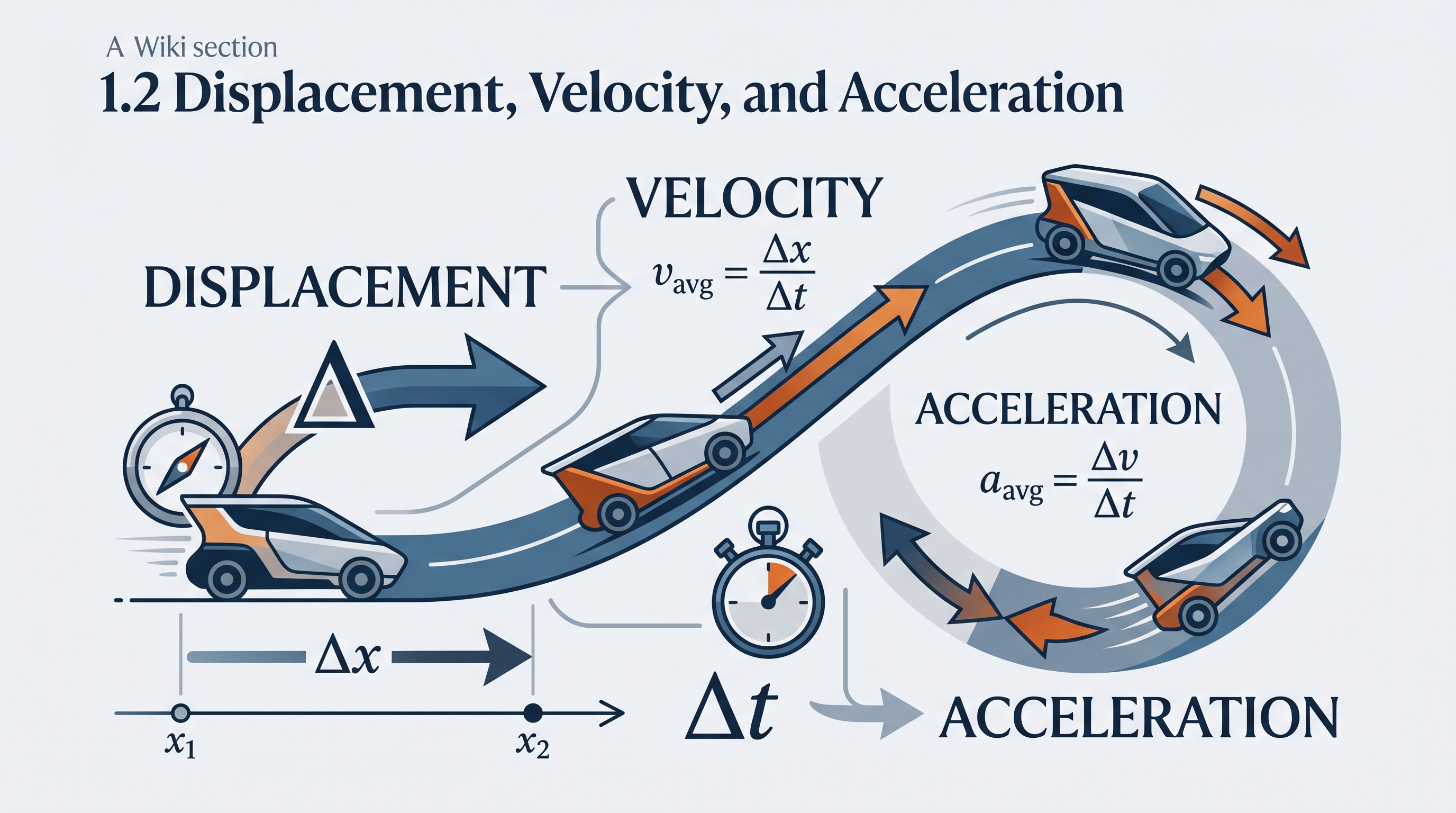
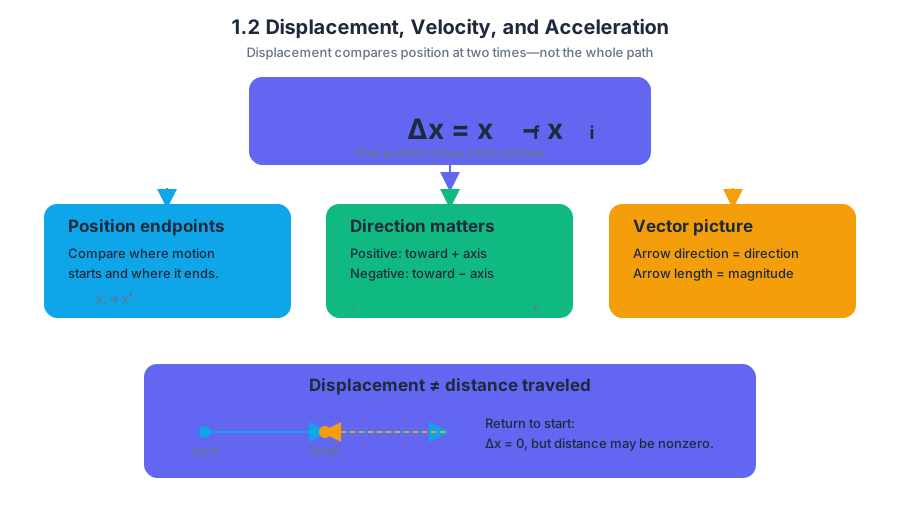
Displacement is the change in position over a time interval:
$$ \Delta x = x_f-x_i $$
The sign records direction along the chosen one-dimensional axis. A positive displacement means the final position lies in the positive direction from the initial position; a negative displacement means it lies in the negative direction. Displacement is not the same as total distance traveled: distance counts the entire path, while displacement compares only the beginning and ending positions.
Key distinction: Returning to the starting position makes displacement zero, not necessarily distance, velocity, or acceleration zero.
A vector can be represented visually by an arrow: its direction shows the vector’s direction, and its length is proportional to its magnitude. Thus, a displacement arrow pointing east and twice as long as another represents twice the displacement magnitude in the same direction.
Average velocity and average acceleration
Average velocity is displacement divided by the elapsed time:
$$ v_{\text{avg}}=\frac{\Delta x}{\Delta t} $$
Because displacement is directional, average velocity is directional as well. Average acceleration is the change in velocity divided by the time interval:
$$ a_{\text{avg}}=\frac{\Delta v}{\Delta t} $$
Acceleration describes how velocity changes, not merely whether an object is moving. An object can accelerate while its speed decreases, such as when a car moving east brakes and its acceleration points west.
Worked example — braking bicycle. A bicycle travels east at $12\ \text{m/s}$ and slows to $4\ \text{m/s}$ in $2.0\ \text{s}$. Taking east as positive,
$$ a_{\text{avg}}=\frac{v_f-v_i}{\Delta t} =\frac{4\ \text{m/s}-12\ \text{m/s}}{2.0\ \text{s}} =-4.0\ \text{m/s}^2 $$
The negative sign means the acceleration points west. The bicycle still has positive velocity, so it continues east while slowing.
Named misconception — “negative acceleration means slowing down.” Not always. An object slows down when acceleration and velocity point in opposite directions. If both are negative, the object moves in the negative direction and speeds up.
Constant-acceleration relationships
When acceleration is constant in one dimension, three equations connect velocity, time, position, and displacement:
$$ v_x=v_{x0}+a_xt $$
$$ x=x_0+v_{x0}t+\frac{1}{2}a_xt^2 $$
$$ v_x^2=v_{x0}^2+2a_x(x-x_0) $$
Here, $x_0$ and $v_{x0}$ are the initial position and velocity, while $x$ and $v_x$ are the position and velocity at time $t$. Choose the equation whose known quantities match the problem; do not use the third equation when time is essential to the requested result.
Worked example — dropped package. A package is released from rest and falls for $3.0\ \text{s}$ near Earth. Let upward be positive, so $v_{x0}=0$ and $a_x=-9.8\ \text{m/s}^2$.
Final velocity:
$$ v_x=0+(-9.8\ \text{m/s}^2)(3.0\ \text{s}) =-29.4\ \text{m/s} $$
Displacement:
$$ x-x_0=0+\frac{1}{2}(-9.8\ \text{m/s}^2)(3.0\ \text{s})^2 =-44.1\ \text{m} $$
The package is $44.1\ \text{m}$ below its release point and is moving downward at $29.4\ \text{m/s}$.
Qualitative motion and harmonic motion
A qualitative sketch should show physically meaningful features: whether position is increasing or decreasing, whether velocity is positive or negative, and whether acceleration points in the positive or negative direction. In simple harmonic motion, such as a mass attached to an ideal spring, these quantities repeatedly reach maxima, minima, and zeros.
At maximum positive displacement, the object momentarily stops, so velocity is zero; acceleration points toward equilibrium and has large negative magnitude. At equilibrium, displacement is zero and speed is greatest; acceleration is zero. At maximum negative displacement, velocity is again zero, while acceleration points back toward equilibrium in the positive direction.
This pattern exposes another misconception: zero velocity does not imply zero acceleration. At a turning point, velocity is instantaneously zero, but the acceleration is what reverses the motion.
AP skills in action
Topic 1.2 Displacement, Velocity, and Acceleration explicitly develops 1.C: Create qualitative sketches of graphs that represent features of a model or the behavior of a physical system; 2.B: Calculate or estimate an unknown quantity with units from known quantities, by selecting and following a logical computational pathway; 2.C: Compare physical quantities between two or more scenarios or at different times and locations in a single scenario; 3.B: Apply an appropriate law, definition, theoretical relationship, or model to make a claim; and 3.C: Justify or support a claim using evidence from experimental data, physical representations, or physical principles or laws.
Retrieval check: A cart moves from $x=2\ \text{m}$ to $x=-6\ \text{m}$ in $4\ \text{s}$. What are its displacement and average velocity? If its velocity changes from $-3\ \text{m/s}$ to $5\ \text{m/s}$ during that interval, what is its average acceleration?
Answer: $\Delta x=-8\ \text{m}$, $v_{\text{avg}}=-2\ \text{m/s}$, and $a_{\text{avg}}=2\ \text{m/s}^2$. The cart’s displacement and average velocity are negative, but its average acceleration is positive because its velocity increased by $8\ \text{m/s}$.