From the free course AP Physics 1 on Lykke
6.6 Motion of Orbiting Satellites
Key concepts: Rolling while slipping · Relative motion between the contact point and the surface · Kinetic friction · Energy dissipation due to kinetic friction · Mechanical-energy loss · Forces and torques in qualitative modeling · Motion of orbiting satellites · Gravitational force
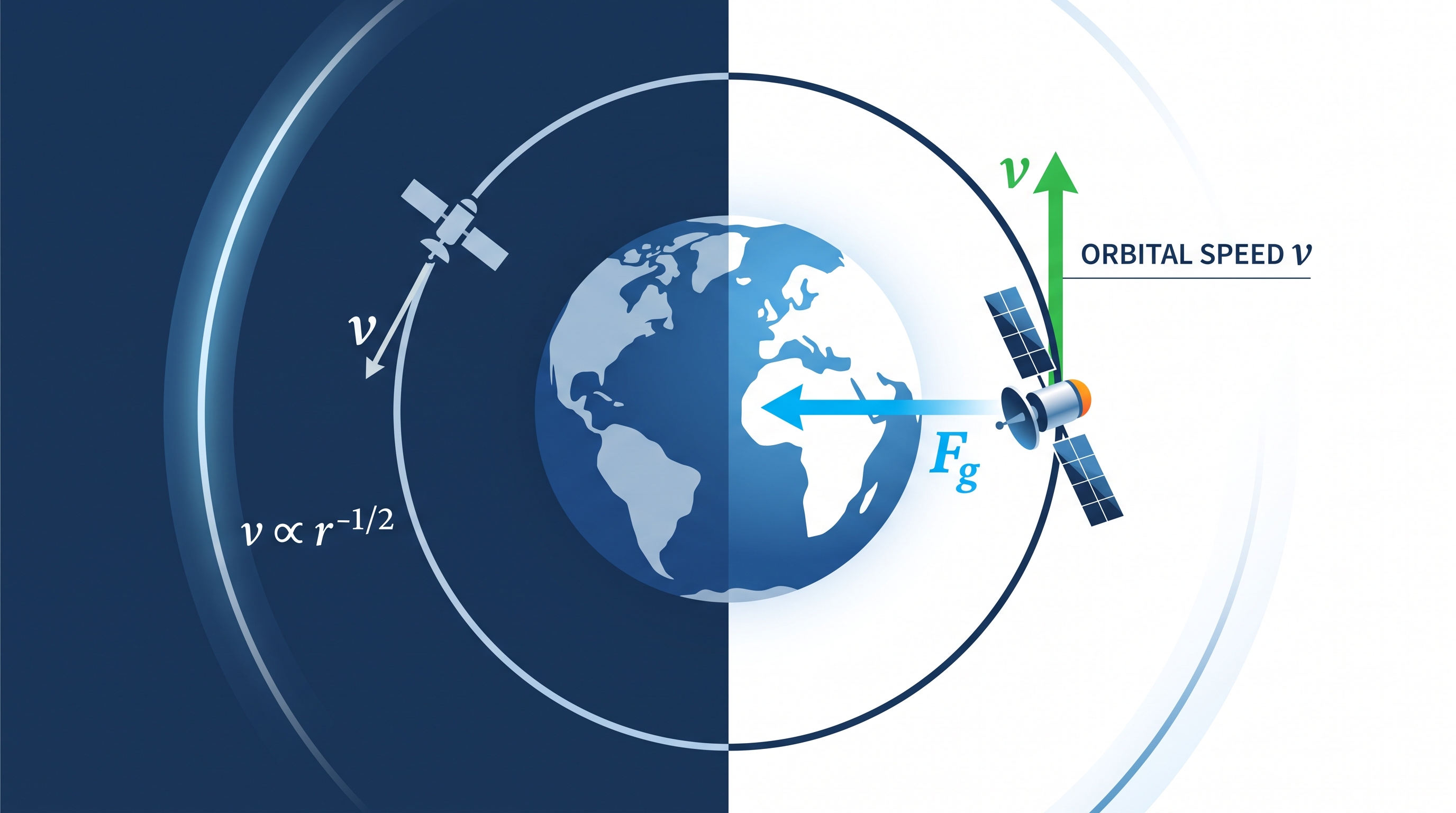
An orbiting satellite is continuously falling toward a massive central object, but its sideways motion carries it forward so that it keeps missing the object.
6.6 Motion of Orbiting Satellites
An orbiting satellite is continuously falling toward a massive central object, but its sideways motion carries it forward so that it keeps missing the object. A different kind of motion appears when a rotating object slips against a surface: kinetic friction then acts at a contact point that moves relative to the surface, removing mechanical energy.
Orbiting satellites: gravity supplies the centripetal force
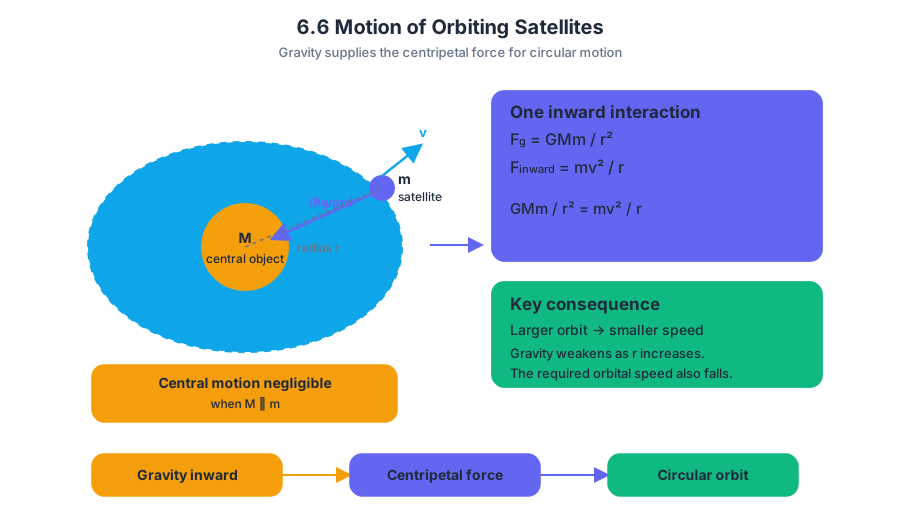
For a system containing a massive central object and a satellite whose mass is negligible compared with it, the central object’s motion can be treated as negligible. The satellite’s acceleration points toward the central object, so the inward gravitational force provides the centripetal force required for circular motion.
Essential Knowledge 6.6.A.1: In a system consisting only of a massive central object and an orbiting satellite with mass that is negligible in comparison to the central object’s mass, the motion of the central object itself is negligible.
For a circular orbit of radius $r$, the gravitational force and centripetal-force requirement describe the same inward interaction:
$$ F_g = \frac{G M m}{r^2} $$
$$ F_{\text{net,inward}} = \frac{m v^2}{r} $$
Therefore,
$$ \frac{G M m}{r^2}=\frac{m v^2}{r}. $$
The satellite’s mass cancels:
$$ v=\sqrt{\frac{G M}{r}}. $$
This result gives an important qualitative conclusion: a satellite in a larger circular orbit moves more slowly, not faster. The inward force is smaller at larger $r$, and the required orbital speed is also smaller.
The force model is compact:
- The satellite experiences a gravitational force directed toward the central object.
- The satellite’s velocity is tangent to the orbit.
- The inward acceleration changes the direction of velocity continuously.
- In an ideal circular orbit, gravity does no work because the force is perpendicular to the instantaneous displacement.
- The satellite therefore maintains constant speed while its velocity changes direction.
Worked example: comparing two circular orbits
A satellite moves from a circular orbit of radius $r$ to one of radius $4r$ around the same central object. Using $v=\sqrt{GM/r}$,
$$ \frac{v_2}{v_1}
\sqrt{\frac{GM/(4r)}{GM/r}}
\frac{1}{2}. $$
The satellite in the larger orbit has half the speed. Its gravitational force is also one-sixteenth as large because $F_g\propto r^{-2}$, while its required centripetal acceleration is one-fourth as large because $a_c=v^2/r$.
Misconception check — “A satellite needs a forward force to keep orbiting.”
It does not need a separate forward force in the ideal model. Its tangential velocity carries it forward; gravity continually bends that velocity inward. If gravity disappeared, the satellite would move in a straight line tangent to the orbit.
Rolling while slipping: where kinetic friction does work
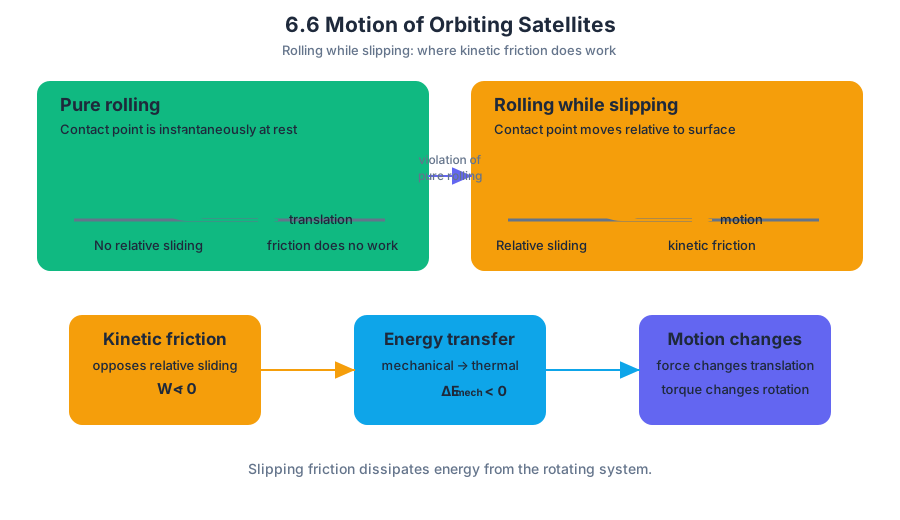
A rotating system is rolling while slipping when it both rotates and translates, but the point of contact does not remain instantaneously at rest relative to the surface. The pure-rolling condition established earlier is therefore violated: the contact point and the surface have relative motion.
Essential Knowledge 6.5.C.2: When a rotating system is slipping relative to another surface, the point of application of the force of kinetic friction exerted on the system moves with respect to the surface, so the force of kinetic friction will dissipate energy from the system.
Because the contact point moves relative to the surface, kinetic friction does work. Friction usually points opposite the relative sliding, so the work done by friction on the mechanical system is negative:
$$ W_f<0. $$
That negative work transfers energy into thermal energy and decreases the system’s mechanical energy:
$$ \Delta E_{\text{mech}}=W_{\text{nonconservative}}<0. $$
The force can also produce a torque about the object’s center of mass. Thus slipping friction may change both the object’s translational speed and its angular speed.
Qualitative force-and-torque model
Imagine a bowling ball thrown forward with almost no spin. The bottom of the ball initially slides forward relative to the floor. Kinetic friction acts backward on the ball, reducing its linear speed, while the frictional torque increases its angular speed in the direction needed for rolling. The slipping decreases until the translational and rotational motions satisfy the pure-rolling condition.
The reverse can occur if a ball spins too rapidly for its forward speed. Friction then acts in the opposite horizontal direction, changing the linear and angular motion in the opposite senses. The exact time dependence is beyond the required qualitative model; the essential prediction is that kinetic friction opposes relative motion, produces a torque, and dissipates mechanical energy.
Boundary statement: Rolling friction—the resistance associated with an object that is already rolling without slipping—is beyond the scope of AP Physics 1. The relevant energy loss here comes from kinetic friction during slipping.
Skill connection and retrieval check
The satellite model is assessed through Science Practice 1, Skill 1.C: Create qualitative sketches of graphs that represent features of a model or physical situation. A useful sketch should show a satellite’s tangential velocity and inward gravitational force separately, or show how orbital speed varies qualitatively with orbital radius. For slipping, a force diagram plus a torque arrow communicates why linear and angular speeds change together but not identically.
Retrieval check: A satellite’s orbital radius increases while it remains in a circular orbit. Does its speed increase or decrease, and why? A disk slides to the right while rotating too slowly for rolling. Which way does kinetic friction act, and what happens qualitatively to its linear speed, angular speed, and mechanical energy?
Answers: The satellite’s speed decreases because $v\propto r^{-1/2}$. For the disk, friction acts opposite the relative sliding at the contact point; it reduces the sliding and changes the disk’s translation and rotation through force and torque. Its mechanical energy decreases because kinetic friction does negative work.