From the free course AP Physics 1 on Lykke
5.3 Torque
Key concepts: Torque · Angle · Radial distance or lever arm (r) · Density · Cosine relationship
A force can make an object accelerate without making it rotate, depending on where and how the force acts. Pushing a door near its hinges is difficult; pushing at the handle is effective because the turning effect depends on both the force and its distance from the axis.
5.3 Torque
A force can make an object accelerate without making it rotate, depending on where and how the force acts. Pushing a door near its hinges is difficult; pushing at the handle is effective because the turning effect depends on both the force and its distance from the axis.
The turning effect of a force
Torque, represented by the symbol $\tau$, measures how strongly a force tends to rotate an object about a chosen axis. Its unit is the newton-meter, written $\text{N}\cdot\text{m}$.
Torque is the rotational counterpart of a force’s ability to produce linear acceleration.
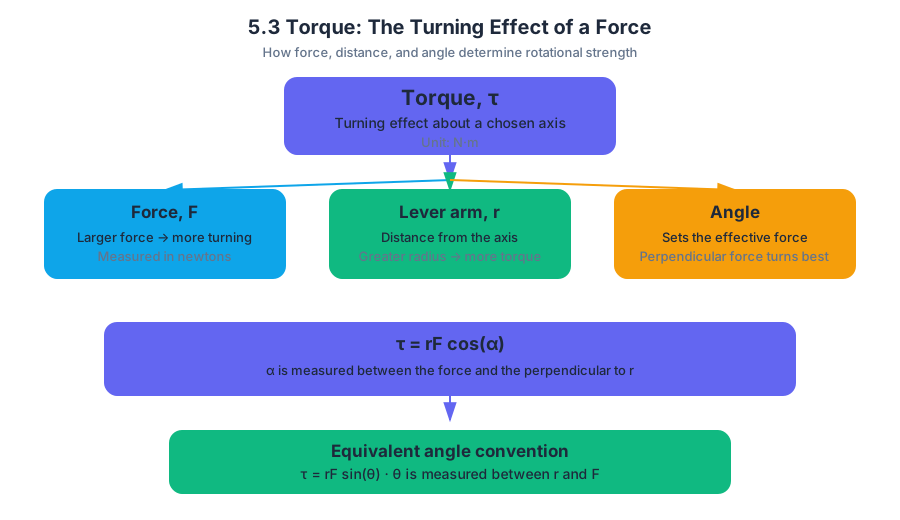
The torque magnitude depends on three ingredients:
- the force magnitude, $F$;
- the radial distance, or lever arm, $r$, from the axis to the point where the force acts;
- the angle between the radial direction and the force direction.
A form commonly shown on the AP Physics 1 reference sheet is
$$ \tau = rF\cos(\text{angle}). $$
In this cosine form, the angle is measured between the applied force and the direction perpendicular to the radius. If instead the angle is measured between $\vec r$ and $\vec F$, the equivalent relation is
$$ \tau = rF\sin\theta. $$
The two expressions describe the same physics; they use complementary angle conventions.
Why the lever arm matters
The lever arm is the distance $r$ from the rotation axis to the point of application of the force. Increasing $r$ increases torque when the force and angle remain unchanged:
$$ \tau \propto r. $$
Doubling the distance from the hinge doubles the torque. This is why a long wrench loosens a bolt more easily than a short wrench when the same force is applied.
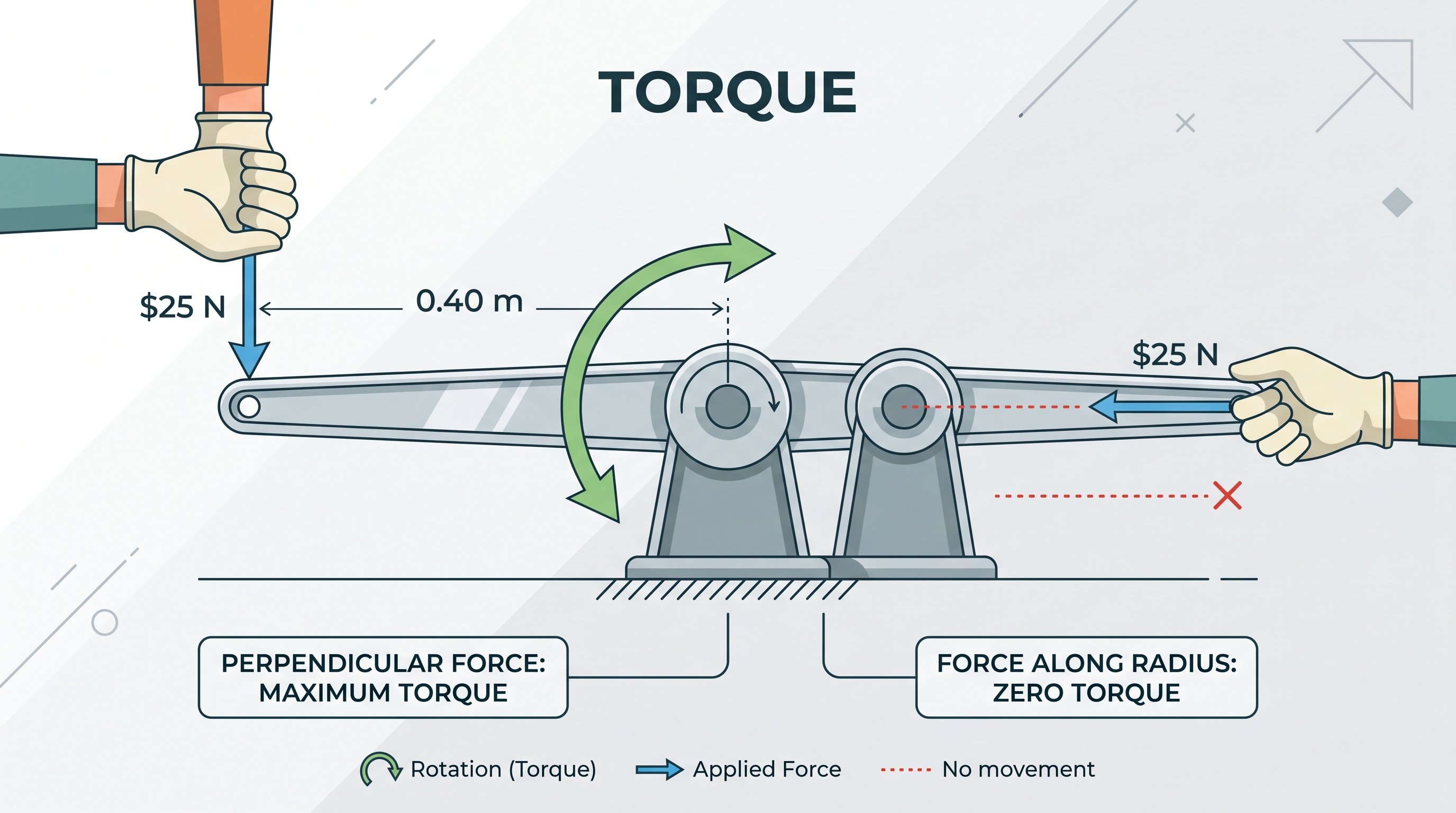
The angle determines how much of the force produces rotation. A force directed perpendicular to the radius gives the greatest torque. A force directed along the radius gives no torque because its line of action points toward or away from the axis rather than around it.
Worked example: opening a hatch
A student pushes a hatch with a force of $40\ \text{N}$. The force is applied $0.75\ \text{m}$ from the hinge, and the angle measured in the cosine form is $20^\circ$ from the perpendicular direction. The torque magnitude is
$$ \tau = rF\cos(20^\circ). $$
Substitute the values:
$$ \tau = (0.75\ \text{m})(40\ \text{N})\cos(20^\circ) $$
$$ \tau \approx (30)(0.940) $$
$$ \boxed{\tau \approx 28\ \text{N}\cdot\text{m}}. $$
The force produces a counterclockwise or clockwise torque depending on which side of the hinge it is applied and which direction it pushes. A complete free-body or rotational diagram should show the axis, the radius vector, the force vector, and the angle convention.
Misconception check — “A larger force always means a larger torque.” Not necessarily. A large force applied directly toward the axis can produce $\tau=0$, while a smaller force applied far from the axis and perpendicular to the radius can produce substantial torque.
Density and physical quantities
Density is a quantity describing how much mass is contained in a given volume:
$$ \rho = \frac{m}{V}. $$
Its SI unit is $\text{kg}/\text{m}^3$. Density is not a factor in the torque expression itself. However, it can be used to determine an object’s mass from its volume when mass is needed in a larger rotational-dynamics problem. The constants and conversion information associated with torque may therefore list density alongside quantities such as angle, torque, and angular speed, even though density does not appear in $\tau=rF\cos(\text{angle})$.
AP reasoning in action
This topic primarily uses Science Practice 1: Creating Representations, especially a diagram that identifies the rotation axis, radius, force, and angle. It also uses Science Practice 2: Mathematical Routines when students select the correct trigonometric form, substitute values, track units, and reason proportionally. Science Practice 3: Scientific Questioning and Argumentation appears when students justify why one force placement or direction produces more torque than another.
A strong representation should make the rotational cause visible rather than merely listing numbers. Before calculating, ask: What is the axis? How far from it does the force act? Which component of the force is perpendicular to the radius?
Retrieval check
A force of $25\ \text{N}$ acts $0.40\ \text{m}$ from an axis directly perpendicular to the radius. What is the torque magnitude?
$$ \tau=(0.40\ \text{m})(25\ \text{N})\cos(0^\circ) =\boxed{10\ \text{N}\cdot\text{m}}. $$
If the same force points directly along the radius, the torque is $\boxed{0\ \text{N}\cdot\text{m}}$, regardless of the value of $F$ or $r$.