From the free course AP Physics 1 on Lykke
AP Practice 5
A strong physics response can begin with a picture or a sentence and end with an equation. The crucial skill is moving accurately between those forms: this practice focuses on qualitative-to-quantitative translation, especially turning a physical description and diagram into a symbolic model, then using that model…
AP Practice 5
A strong physics response can begin with a picture or a sentence and end with an equation. The crucial skill is moving accurately between those forms: this practice focuses on qualitative-to-quantitative translation, especially turning a physical description and diagram into a symbolic model, then using that model to compare outcomes.
Task focus: Translate a physical situation into representations, derive a symbolic relationship, and use that relationship to calculate or compare quantities.
This task combines Science Practice 1: Creating Representations and Science Practice 2: Mathematical Routines. It may also require 1.A. Create diagrams, tables, charts, or schematics to represent physical situations, 1.C. Create qualitative sketches of graphs that represent features of a model or the behavior of a physical system, 2.A. Derive a symbolic expression from known quantities by selecting and following a logical mathematical pathway, 2.B. Calculate or estimate an unknown quantity with units from known quantities, by selecting and following a logical computational pathway, and 2.C. Compare physical quantities between two or more scenarios or at different times and locations in a single scenario.
An original translation task: launching a cart
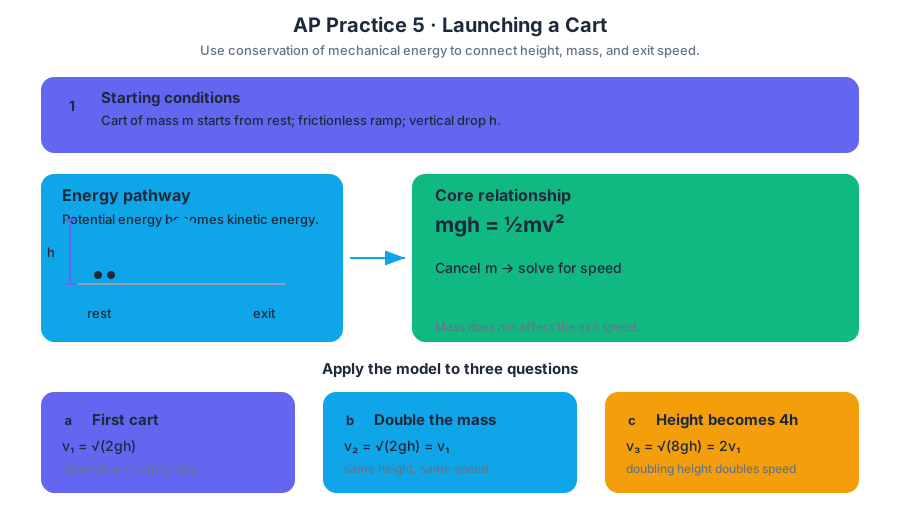
A laboratory cart of mass $m$ starts from rest at the top of a frictionless ramp. The cart descends through a vertical height $h$ and leaves the ramp with speed $v$. A second cart has mass $2m$ and descends through the same vertical height on the same frictionless ramp.
(a) Derive an expression for the speed $v$ of the first cart in terms of $g$ and $h$.
(b) Determine the speed of the second cart as it leaves the ramp.
(c) The ramp is changed so that the first cart descends through vertical height $4h$. Compare its new exit speed with the original speed.
Step 1: Build the physical representation
The important information is not the ramp’s length or angle. The cart’s vertical drop determines the change in gravitational potential energy. Because the ramp is frictionless, no mechanical energy is transformed into thermal energy.
A useful representation labels the initial and final states:
- Initial: $v_i = 0$, gravitational potential energy $U_i = mgh$
- Final: $v_f = v$, gravitational potential energy chosen as $U_f = 0$
- System: cart plus Earth
- External work that changes mechanical energy: none
This is 1.A. Create diagrams, tables, charts, or schematics to represent physical situations in action. The system boundary matters: including Earth allows gravitational potential energy to appear in the energy model.
Step 2: Derive before substituting
For the cart–Earth system, conservation of mechanical energy gives
$$ K_i + U_i = K_f + U_f. $$
Substitute the conditions at the two locations:
$$ 0 + mgh = \frac{1}{2}mv^2 + 0. $$
Cancel the mass $m$ and solve symbolically:
$$ gh = \frac{1}{2}v^2 $$
$$ v^2 = 2gh $$
$$ \boxed{v = \sqrt{2gh}}. $$
This earns the reasoning associated with 2.A. Derive a symbolic expression from known quantities by selecting and following a logical mathematical pathway. Notice why a symbolic derivation is more powerful than immediately inserting numbers: it exposes which variables matter and which cancel.
Step 3: Translate the comparison
For the second cart, the mass is $2m$, but the vertical drop remains $h$:
$$ 2mgh = \frac{1}{2}(2m)v_2^2. $$
The factor $2m$ appears on both sides and cancels:
$$ v_2 = \sqrt{2gh}. $$
Therefore,
$$ \boxed{v_2 = v}. $$
The heavier cart exits with the same speed, provided the ramp is frictionless and both carts start from rest at the same height. This is 2.C. Compare physical quantities between two or more scenarios or at different times and locations in a single scenario.
For a drop of $4h$,
$$ v_3 = \sqrt{2g(4h)} = \sqrt{8gh} = 2\sqrt{2gh}. $$
Since $v = \sqrt{2gh}$,
$$ \boxed{v_3 = 2v}. $$
The height is multiplied by $4$, but the speed is multiplied by only $2$ because speed depends on the square root of height. That proportional reasoning is often more important than the arithmetic.
Misconception check: “More mass means more speed”
Misconception: A heavier cart must reach the bottom faster because gravity pulls on it more strongly.
Correction: The heavier cart does experience a larger gravitational force, $F_g = mg$, but it also has proportionally greater inertia. In the energy equation, the same mass multiplies both the available gravitational energy and the kinetic-energy term, so mass cancels.
Examiner-rewarded reasoning would include the correct system, a valid conservation equation, a symbolic derivation, and a comparison justified by that expression. A bare answer such as “the speeds are equal” does not show the physical pathway.
Timing and error review
Spend about $2$ minutes identifying the system and representations, $4$ minutes deriving the expression, and $2$ minutes checking units and proportionality. Afterward, classify any error: representation error, principle-selection error, algebra error, comparison error, or unit error.
Quick retrieval check: If the ramp were rough and the cart lost mechanical energy to friction, would the exit speed be greater than, equal to, or less than $\sqrt{2gh}$? Explain using the system’s energy accounting.

Source Materials
- Review the Exam Updates (.pdf)
- AP Physics 1: Algebra-Based Course and Exam Description
- AP Physics 1 Course Overview
- AP Physics 1 Course at a Glance
- AP Physics 1 Course at a Glance Poster
- Adopt AP Physics 1: Algebra-Based
- AP Physics 1: Algebra-Based
- AP Physics 1: Algebra-Based
- AP Physics 1 Past Exam Questions — AP Central
- Khan Academy — AP/College Physics 1
- AP Physics 1 — AP Students
- YouTube — Flipping Physics