From the free course AP Physics 1 on Lykke
2.7 Kinetic and Static Friction
Key concepts: Kinetic friction · Static friction · Coefficient of kinetic friction · Coefficient of static friction · Normal force · Relative motion, slipping, and sliding · Independence of friction from contact area · Energy dissipation by kinetic friction · Maximum static friction · Friction in physical scenarios and comparisons
A box can remain motionless while you push it because static friction quietly matches your push—until a limiting value is reached and the box slips.
2.7 Kinetic and Static Friction
A box can remain motionless while you push it because static friction quietly matches your push—until a limiting value is reached and the box slips.
The two friction regimes
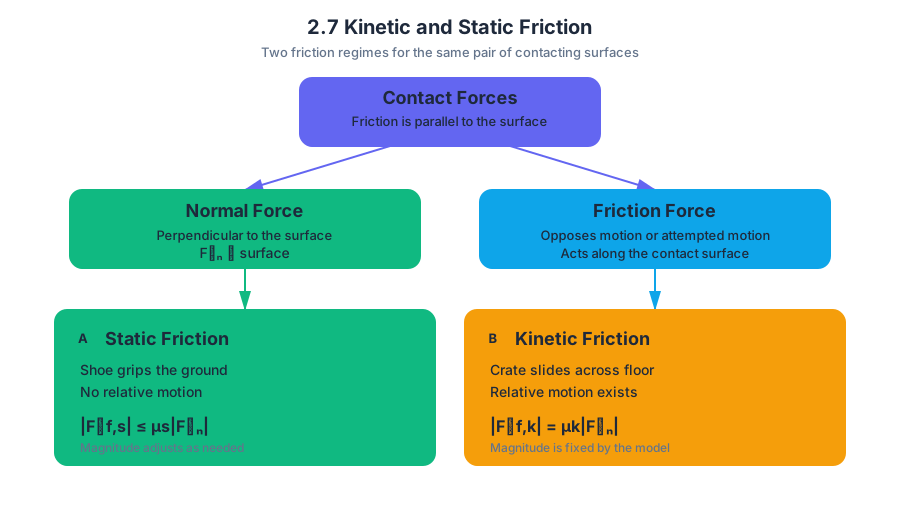
Friction is a contact force parallel to the surfaces in contact. Its direction opposes the relative motion or the attempted relative motion between those surfaces. The normal force is the perpendicular component of the force exerted by a surface on an object, directed away from the surface:
$$\vec F_n \perp \text{surface}$$
The same pair of surfaces can therefore experience two different friction models:
| Situation | Friction type | Relative motion? | Magnitude model |
|---|---|---|---|
| A shoe grips the ground without sliding | Static friction | No | $\lvert \vec F_{f,s}\rvert \leq \mu_s\lvert \vec F_n\rvert$ |
| A crate slides across the floor | Kinetic friction | Yes | $\lvert \vec F_{f,k}\rvert = \mu_k\lvert \vec F_n\rvert$ |
The vertical bars indicate magnitudes, which are nonnegative numbers. The symbols $\vec F_{f,s}$, $\vec F_{f,k}$, and $\vec F_n$ represent vector forces with directions. Friction acts along the contact surface; the normal force acts perpendicular to it.
Kinetic friction: sliding surfaces
Under 2.7.A: Describe kinetic friction between two surfaces, kinetic friction occurs when two surfaces in contact move relative to each other. Its direction is opposite the motion of each surface relative to the other surface. The coefficient of kinetic friction, $\mu_k$, describes how strongly the materials resist sliding and depends on the material properties of the surfaces in contact.
For a block sliding across a level floor, the vertical forces balance:
$$\lvert \vec F_n\rvert = mg$$
If the coefficient of kinetic friction is $\mu_k = 0.30$ and the block has mass $m = 5.0\ \mathrm{kg}$, then using $g = 9.8\ \mathrm{m/s^2}$:
$$\lvert \vec F_n\rvert = (5.0\ \mathrm{kg})(9.8\ \mathrm{m/s^2}) = 49\ \mathrm{N}$$
$$\lvert \vec F_{f,k}\rvert = \mu_k\lvert \vec F_n\rvert = (0.30)(49\ \mathrm{N}) = 14.7\ \mathrm{N}$$
The kinetic-friction force points opposite the block’s velocity relative to the floor. If the block moves right, friction points left; if it later moves left, friction reverses and points right.
A useful surprise is that this model does not depend on the size of the surface area of contact. A block resting on its broad face and the same block resting on its narrow face can have the same friction magnitude if the material pair and normal-force magnitude are unchanged.
Misconception check — “Friction always equals $\mu F_n$.”
The equation $\lvert \vec F_{f,k}\rvert = \mu_k\lvert \vec F_n\rvert$ applies to kinetic friction, when surfaces are sliding. It does not automatically describe static friction.
Static friction: gripping without slipping
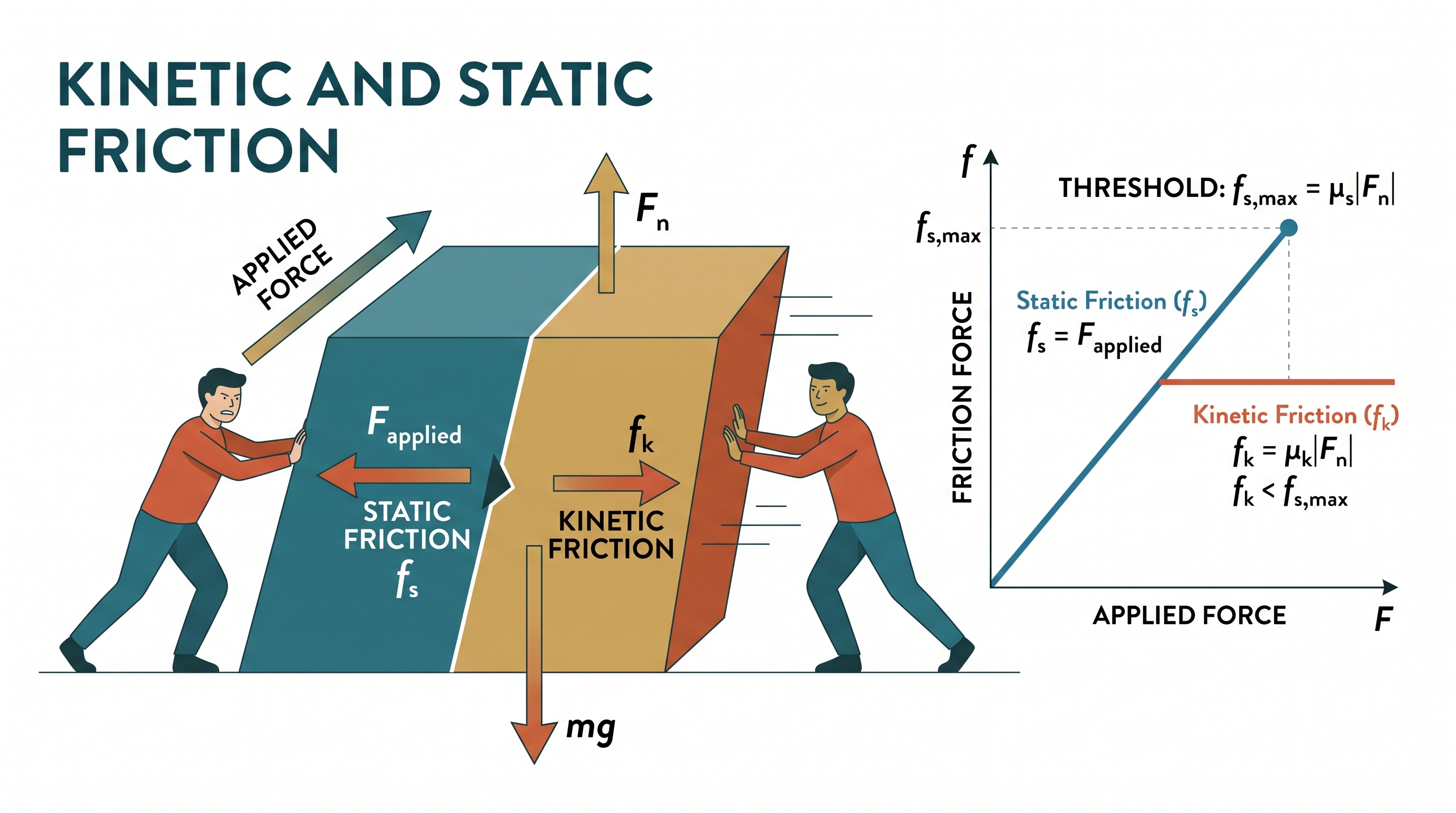
Static friction occurs when two surfaces are in contact but do not move relative to each other. It is responsive, not automatically maximal: it takes whatever value is needed to prevent slipping, up to a limit:
$$\lvert \vec F_{f,s}\rvert \leq \mu_s\lvert \vec F_n\rvert$$
The largest possible static-friction magnitude is
$$\lvert \vec F_{f,s,\mathrm{max}}\rvert = \mu_s\lvert \vec F_n\rvert$$
This threshold is the boundary between gripping and slipping. Once the required friction would exceed this maximum, the surfaces begin moving relative to each other and the model changes to kinetic friction.
Suppose a $10\ \mathrm{kg}$ box rests on a level floor with $\mu_s = 0.50$. Its normal-force magnitude is
$$\lvert \vec F_n\rvert = mg = (10\ \mathrm{kg})(9.8\ \mathrm{m/s^2}) = 98\ \mathrm{N}$$
Therefore,
$$\lvert \vec F_{f,s,\mathrm{max}}\rvert = (0.50)(98\ \mathrm{N}) = 49\ \mathrm{N}$$
A horizontal applied force of $20\ \mathrm{N}$ produces static friction of $20\ \mathrm{N}$ in the opposite direction, so the box remains at rest. An applied force of $49\ \mathrm{N}$ places it at the threshold of slipping. A force greater than $49\ \mathrm{N}$ cannot be balanced by static friction, so slipping begins.
For a given pair of surfaces, the coefficient of static friction is typically greater than the coefficient of kinetic friction:
$$\mu_s > \mu_k$$
That is why starting a heavy crate is usually harder than keeping it sliding.
Energy and relative motion
Slipping and sliding mean that two surfaces move relative to each other. During this motion, the point where kinetic friction is applied moves relative to the surface, so kinetic friction transfers mechanical energy into thermal energy. Kinetic friction therefore dissipates energy from the system.
Static friction does not necessarily dissipate energy in the same way. For example, a tire rolling without slipping has a contact point that is instantaneously at rest relative to the road; static friction can change the tire’s motion without the surfaces sliding across one another.
AP reasoning tools
This topic is assessed through the following official skills:
- 1.C: Create qualitative sketches of graphs that represent features of a model or the behavior of a physical system. A friction-versus-applied-force graph rises with the applied force during static contact, reaches $\mu_s\lvert \vec F_n\rvert$, and then typically drops to the smaller kinetic value.
- 2.B: Calculate or estimate an unknown quantity with units from known quantities, by selecting and following a logical computational pathway. Determine $\lvert \vec F_n\rvert$, then apply the appropriate friction model.
- 2.C: Compare physical quantities between two or more scenarios or at different times and locations in a single scenario. Compare friction when a block is stationary, at the threshold, and sliding.
- 3.B: Apply an appropriate law, definition, theoretical relationship, or model to make a claim. Justify whether an object slips by comparing the required static friction with $\mu_s\lvert \vec F_n\rvert$.
Retrieval check: A stationary block experiences a horizontal force of $12\ \mathrm{N}$, while $\mu_s\lvert \vec F_n\rvert = 20\ \mathrm{N}$. What are the magnitude and direction of static friction? Does the block slip?
Answer: Static friction has magnitude $12\ \mathrm{N}$ opposite the applied force, and the block does not slip. The maximum value is $20\ \mathrm{N}$, but the actual static-friction force need not reach that value.