From the free course AP Physics 1 on Lykke
6.5 Rolling
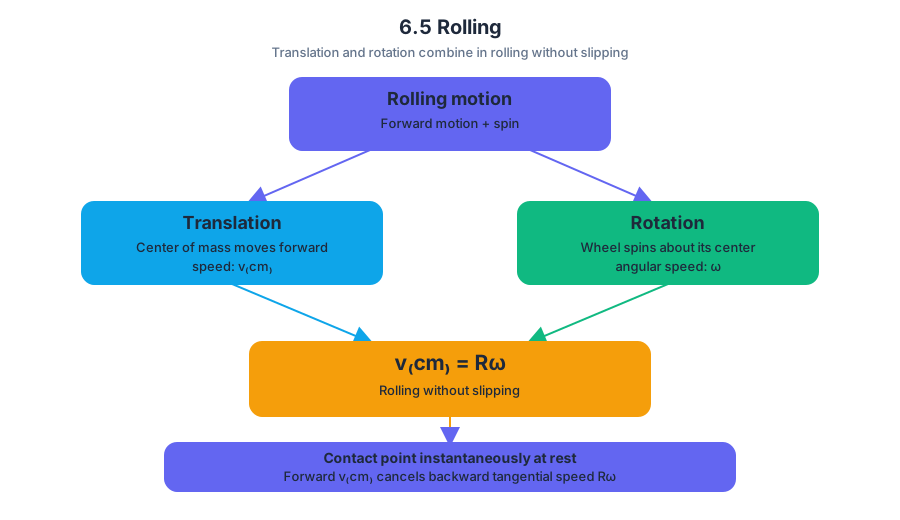
A rolling object moves forward while rotating, so its motion combines translation of its center of mass with rotation about its center. A bicycle tire, a bowling ball, and a wheel on a ramp all obey the same central condition when they roll without slipping:
6.5 Rolling
A rolling object moves forward while rotating, so its motion combines translation of its center of mass with rotation about its center. A bicycle tire, a bowling ball, and a wheel on a ramp all obey the same central condition when they roll without slipping:
$$v_{\mathrm{cm}} = R\omega$$
Here, $v_{\mathrm{cm}}$ is the speed of the center of mass, $R$ is the radius, and $\omega$ is the angular speed.
The condition means that the point of contact with the surface is instantaneously at rest relative to the surface. The center moves forward at speed $v_{\mathrm{cm}}$, while rotation gives the contact point a backward tangential speed $R\omega$; these cancel exactly.
Rolling without slipping
Rolling without slipping is a kinematic constraint, not a new kind of energy. It connects linear and angular variables:
$$s = R\theta,\qquad v_{\mathrm{cm}} = R\omega,\qquad a_{\mathrm{cm}} = R\alpha$$
The angle $\theta$ must be measured in radians. These equations apply when the object maintains contact and does not slide across the surface.
A rough surface is essential: static friction must be large enough to prevent slipping. In the ideal model, however, static friction does no work because the point where the friction force acts has zero instantaneous velocity relative to the surface. Static friction can still change the object’s translational and rotational kinetic energies separately; it simply transfers energy between those forms rather than removing mechanical energy.
Key idea: Static friction supplies the torque needed for rolling, while ideal static friction does no net work on the rolling object.
Energy of a rolling object
A rolling object has two kinetic-energy terms:
$$K = K_{\mathrm{trans}} + K_{\mathrm{rot}}$$
$$K = \frac{1}{2}Mv_{\mathrm{cm}}^2+\frac{1}{2}I\omega^2$$
Using $\omega = v_{\mathrm{cm}}/R$ gives
$$K=\frac{1}{2}Mv_{\mathrm{cm}}^2+\frac{1}{2}\frac{I}{R^2}v_{\mathrm{cm}}^2$$
The rotational inertia $I$ determines how much of the object’s energy is tied up in rotation.
For an object rolling down a ramp that is rough enough to enforce rolling without slipping but produces no energy loss, gravitational potential energy becomes both translational and rotational kinetic energy:
$$Mgh=\frac{1}{2}Mv_{\mathrm{cm}}^2+\frac{1}{2}I\omega^2$$
If the object starts from rest and drops through height $h$, then
$$v_{\mathrm{cm}}=\sqrt{\frac{2Mgh}{M+I/R^2}}$$
A smaller value of $I/(MR^2)$ produces a greater final speed.
Worked example: comparing rolling objects
A solid disk and a thin hoop have the same mass, radius, and starting height. Both roll without slipping down the same ramp. Which reaches the bottom with greater speed?
For a solid disk,
$$I_{\mathrm{disk}}=\frac{1}{2}MR^2$$
For a thin hoop,
$$I_{\mathrm{hoop}}=MR^2$$
The disk therefore has
$$v_{\mathrm{disk}}=\sqrt{\frac{2Mgh}{M+\frac{1}{2}M}} =\sqrt{\frac{4gh}{3}}$$
The hoop has
$$v_{\mathrm{hoop}}=\sqrt{\frac{2Mgh}{M+M}} =\sqrt{gh}$$
Since $\sqrt{4gh/3}>\sqrt{gh}$, the solid disk reaches the bottom faster. The disk’s mass is distributed closer to its axis, so it has less rotational inertia and requires less energy for rotation at a given translational speed.
This comparison does not mean the disk experiences a greater gravitational force. Both objects have the same weight. Their different speeds result from how their mass distribution divides the available energy between translation and rotation.
Acceleration down a ramp
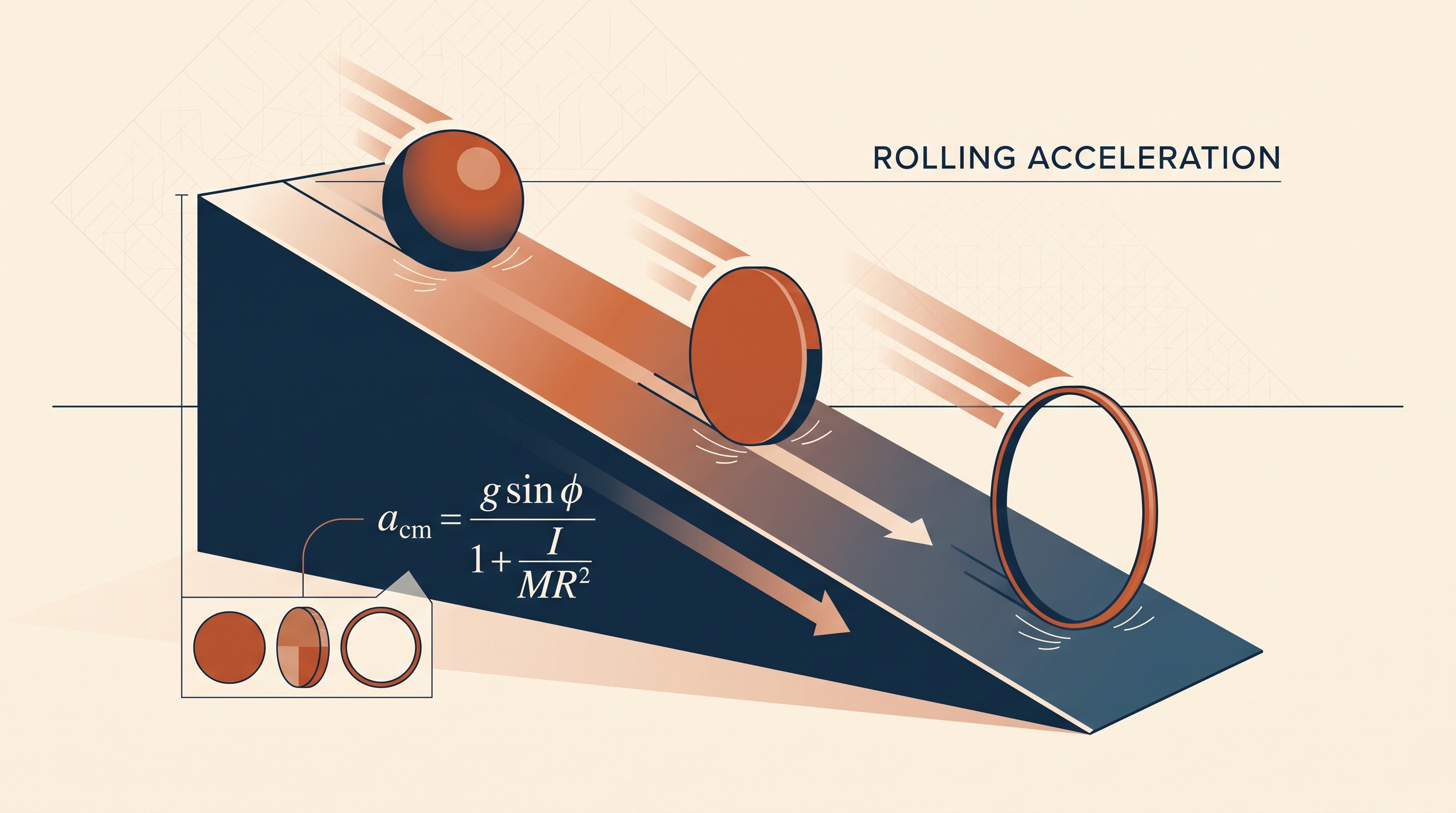
For an object rolling down an incline of angle $\phi$, the acceleration of its center of mass is
$$a_{\mathrm{cm}}=\frac{g\sin\phi}{1+\frac{I}{MR^2}}$$
The denominator captures rotational resistance. For a solid sphere, $I/(MR^2)=2/5$; for a solid disk, it is $1/2$; for a hoop, it is $1$. Thus, on the same ramp,
$$a_{\mathrm{sphere}}>a_{\mathrm{disk}}>a_{\mathrm{hoop}}$$
The rolling object with more mass concentrated farther from its axis accelerates more slowly.
Misconception check — “Friction always opposes motion and removes energy.” Friction opposes slipping, not necessarily the center-of-mass motion. In ideal rolling, static friction provides the torque that establishes the required angular acceleration, but it does not dissipate mechanical energy. If the object actually slips, kinetic friction acts, mechanical energy is converted into thermal energy, and the relation $v_{\mathrm{cm}}=R\omega$ no longer holds.
Retrieval check: A hoop and a solid sphere roll from rest down identical ramps without slipping. Without calculating, identify which has the greater final speed and explain why. The solid sphere is faster because its smaller ratio $I/(MR^2)$ leaves more of the gravitational energy available for translational motion.