From the free course AP Physics 1 on Lykke
3.3 Potential Energy
Key concepts: Potential energy associated with conservative forces · Conservation of mechanical energy · Gravitational potential energy · Elastic spring potential energy · Kinetic energy and energy bar charts · Thermal energy from friction · Energy transformations in multi-component systems · Total mechanical energy versus position · Using geometric displacement on an incline · Comparing energy and speed at different positions
A compressed spring, a raised block, and a sliding object can all store energy in different ways—but only certain forces allow that stored energy to be recovered without depending on the path taken.
3.3 Potential Energy
A compressed spring, a raised block, and a sliding object can all store energy in different ways—but only certain forces allow that stored energy to be recovered without depending on the path taken. Potential energy is energy associated with the arrangement of interacting objects.
Conservative forces: energy that remembers only position
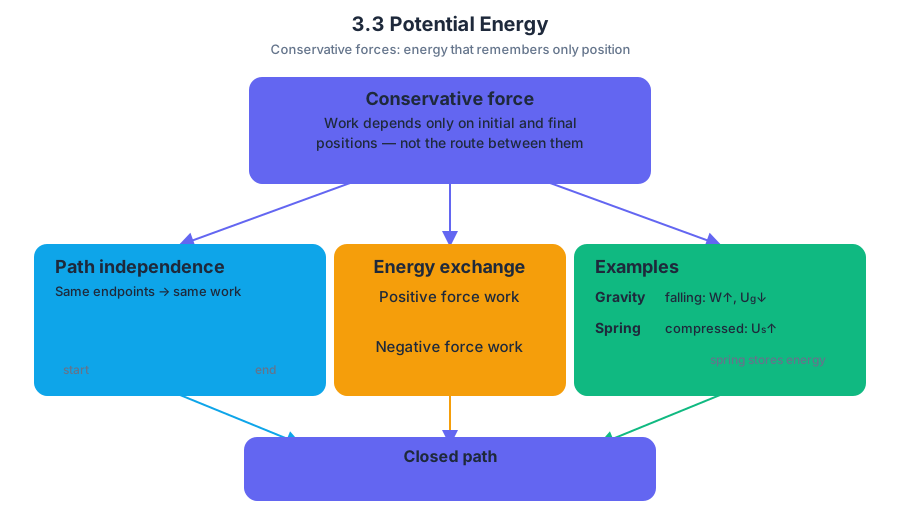
A conservative force is a force whose work depends only on the initial and final positions, not on the route between them. Gravity is conservative: lifting a book by $0.50\ \text{m}$ requires the same change in gravitational potential energy whether the book moves straight upward or along a winding path.
For a conservative force, the work done by that force equals the negative change in potential energy:
$$W_{\text{conservative}}=-\Delta U$$
The minus sign means that when a conservative force does positive work, the associated potential energy decreases. As a block falls, gravity does positive work while $U_g$ decreases; as a spring is compressed, the external agent does work that increases $U_s$.
Over a closed path, an object returns to its starting position, so the net work done by a conservative force is zero and the potential-energy change is also zero:
$$W_{\text{closed path}}=0,\qquad \Delta U_{\text{closed path}}=0$$
Gravitational potential energy
Near Earth’s surface, gravitational potential energy is determined by vertical position:
$$U_g=mgh=mg\Delta y$$
Here, $m$ is mass, $g$ is the magnitude of the gravitational field, and $\Delta y$ is the change in vertical position. The zero level for $U_g$ is arbitrary; changing it shifts every gravitational-potential value by the same amount but does not change measurable motion.
For a block moving a distance $d$ along an incline at angle $\theta$, the vertical displacement is not $d$. Geometry gives
$$\Delta y=d\sin\theta$$
so the gravitational-potential-energy change is
$$\Delta U_g=mgd\sin\theta$$
For example, a $2.0\ \text{kg}$ block moves $3.0\ \text{m}$ up a $30^\circ$ incline. Its vertical rise is
$$\Delta y=(3.0\ \text{m})\sin 30^\circ=1.5\ \text{m}$$
Thus,
$$\Delta U_g=(2.0)(9.8)(1.5)\ \text{J}=29.4\ \text{J}$$
Misconception check — distance along the ramp is height. The block travels $3.0\ \text{m}$, but it rises only $1.5\ \text{m}$. Gravitational potential energy responds to vertical displacement, not path length.
Elastic spring potential energy
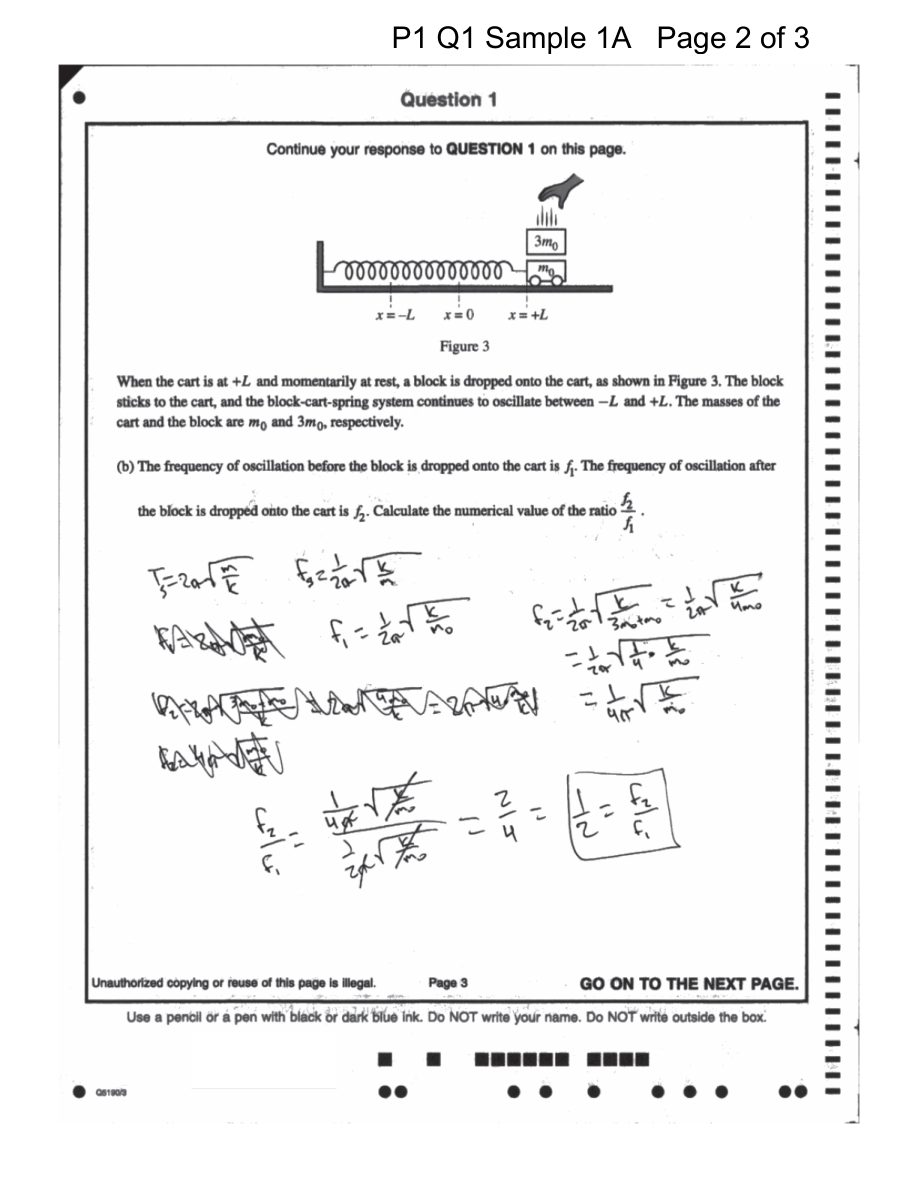
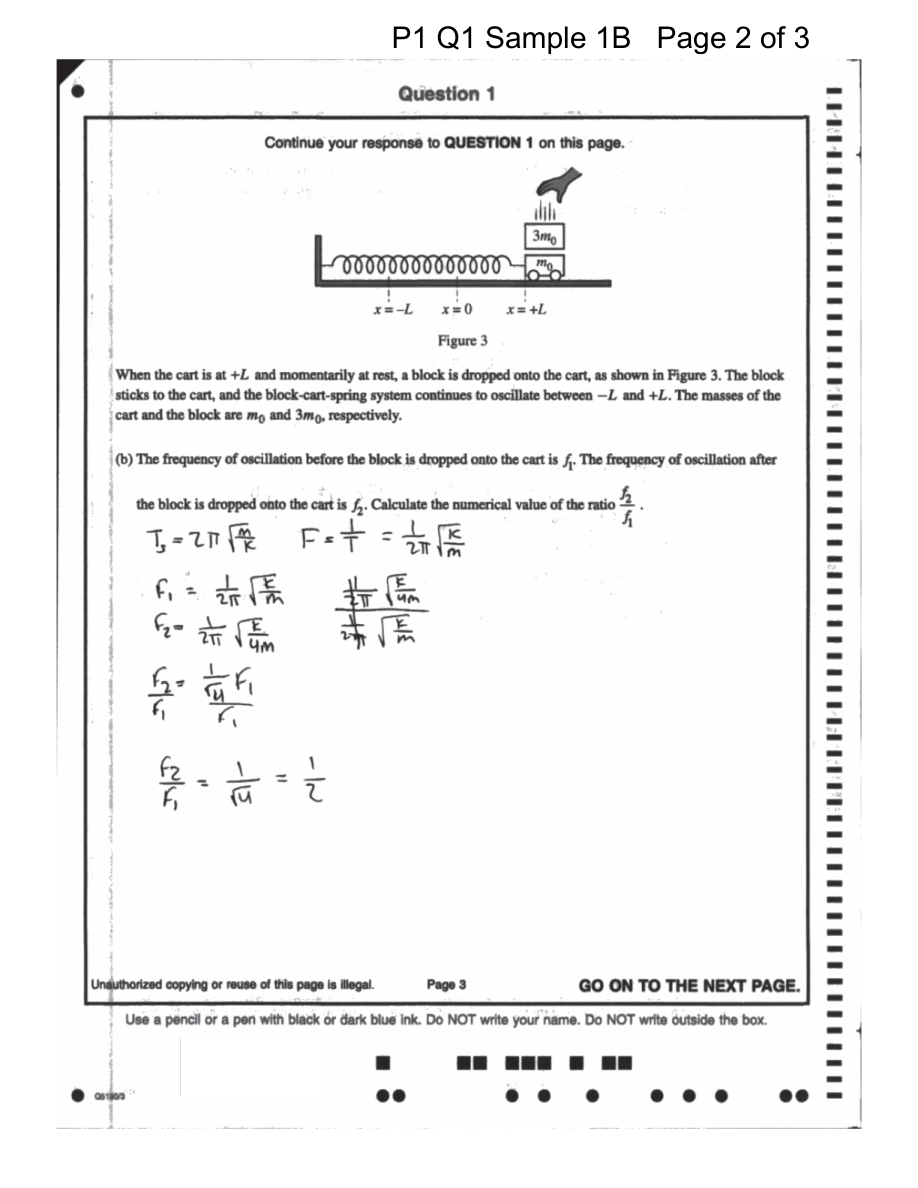
A spring stores energy when its length differs from its relaxed length. If $x$ is the compression or stretch magnitude and $k$ is the spring constant, the stored elastic potential energy is
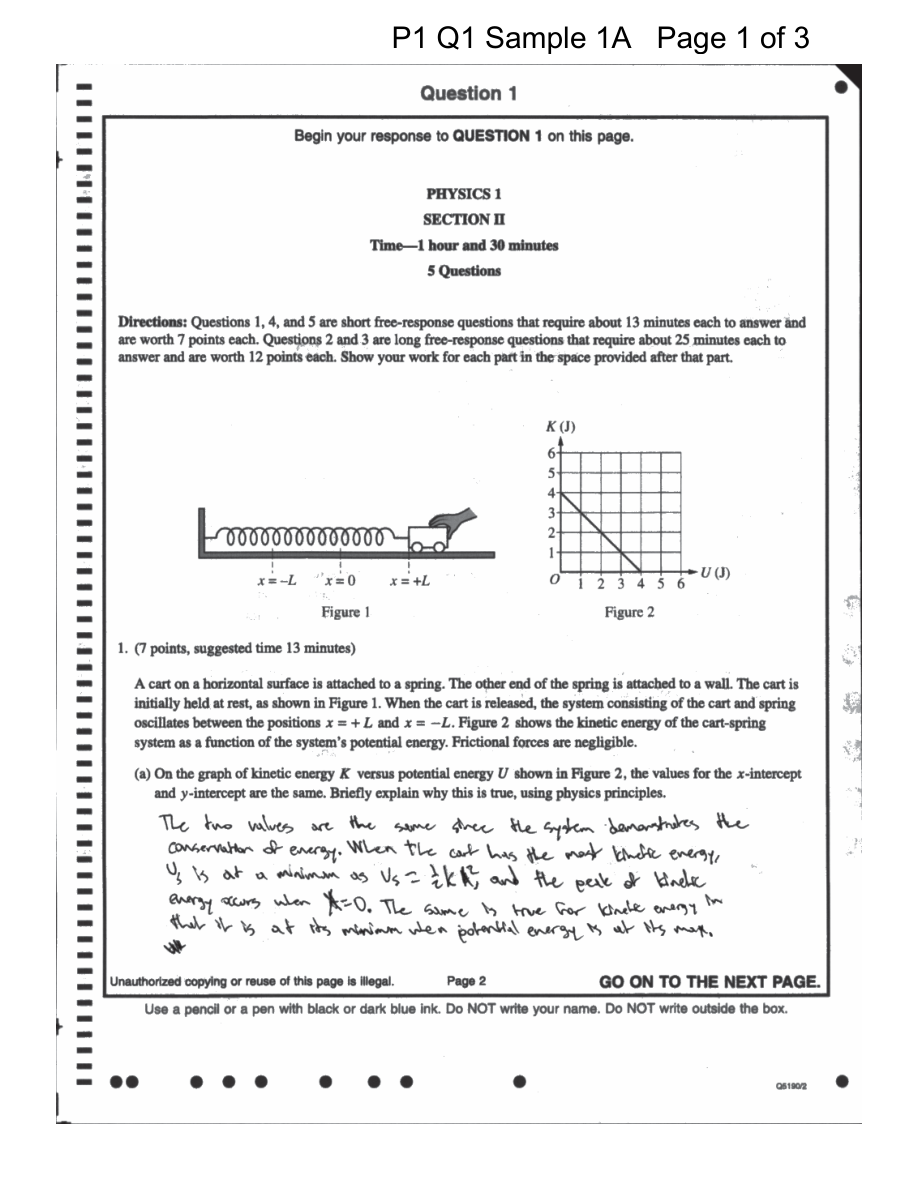
$$U_s=\frac{1}{2}kx^2$$
The square matters: doubling the deformation quadruples the stored energy. The energy is the same for compression and extension of equal magnitude in the ideal spring model.
Mechanical energy can move among translational kinetic energy, gravitational potential energy, and spring potential energy:
$$E_{\text{mechanical}}=K+U_g+U_s$$
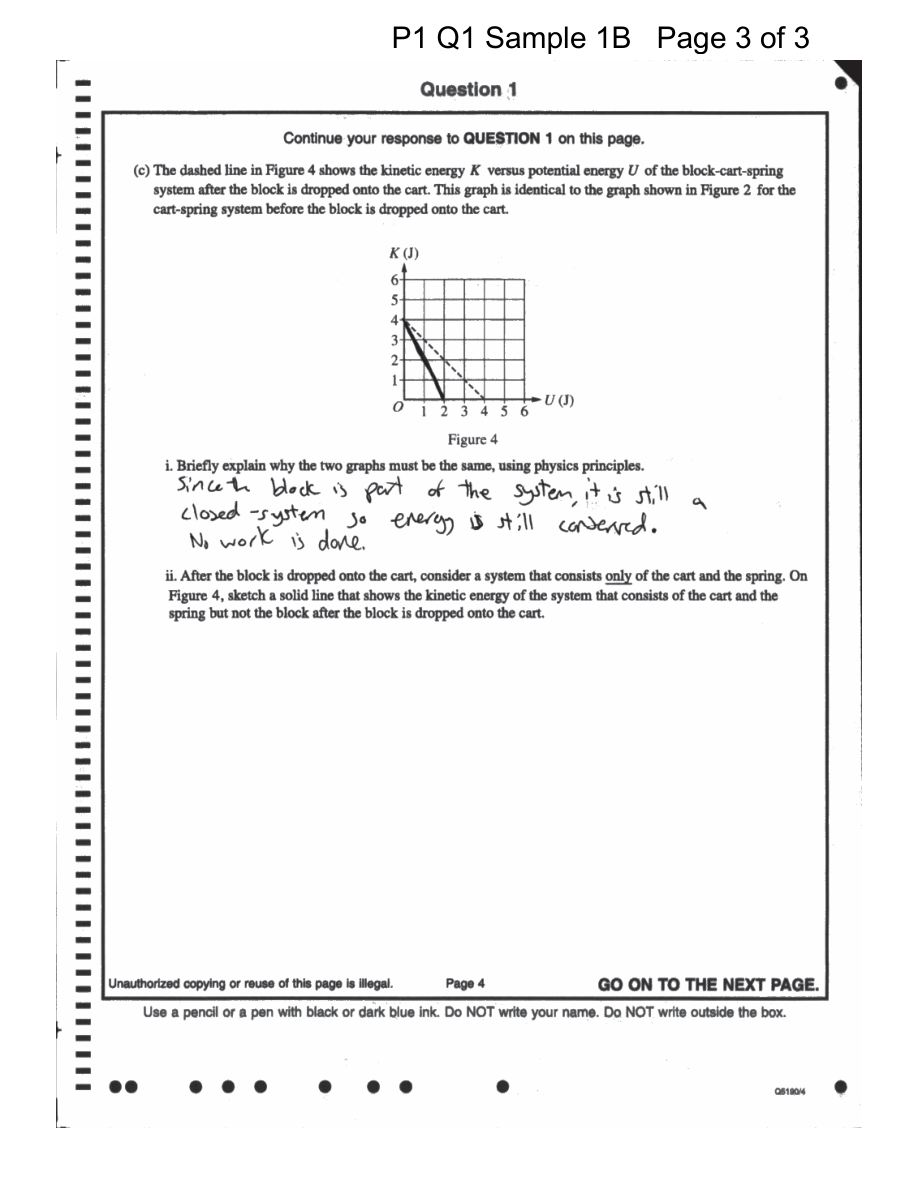
When no friction or other nonconservative energy transfer is present, the total remains constant. A falling object may convert $U_g$ into $K$; a spring launcher may convert $U_s$ into $K$; a block moving downward toward a spring may distribute energy among all three forms.
Energy bar charts and energy-versus-position graphs
An energy bar chart is a representation, not a picture of the object. Include only the energy forms specified for the system. For a system containing a block and Earth, a position might require only a $U_g$ bar; at another position, the chart might contain only $K$ and $U_g$.
In one worked representation, the total energy is $12E_0$. At $x=0$, the system has $U_g=12E_0$, with $K=0$ and $U_s=0$. At $x=6D$, the bars can be $K=6E_0$ and $U_g=6E_0$, still totaling $12E_0$.
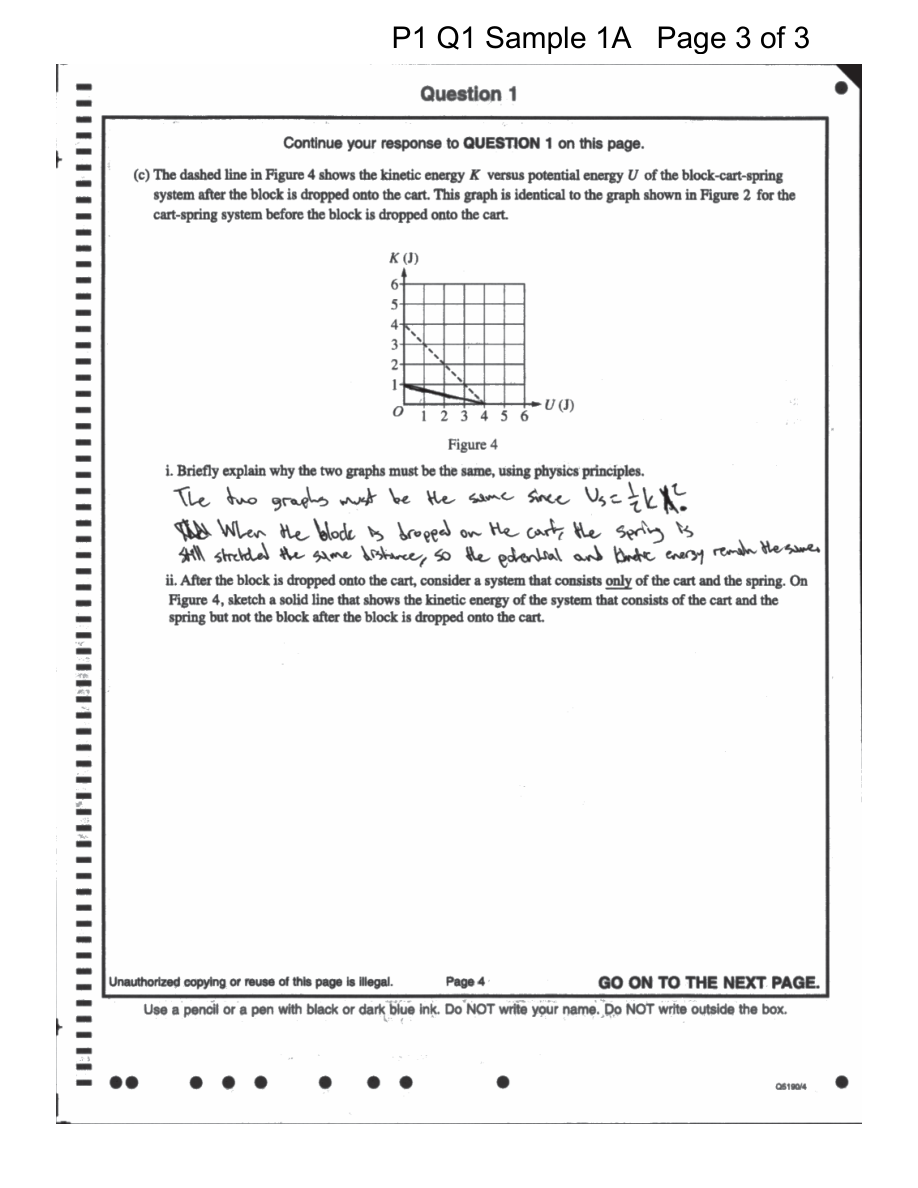
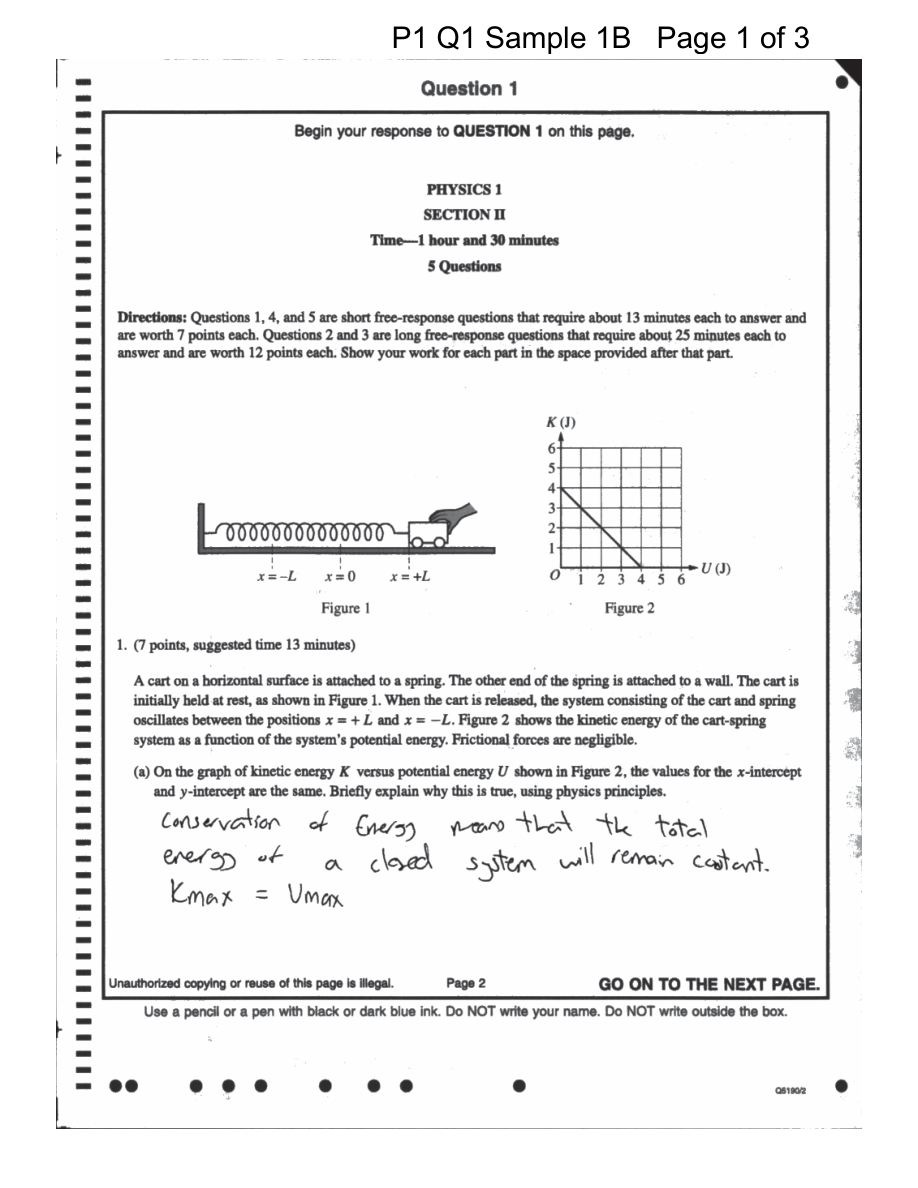
The same reasoning appears on an energy-versus-position graph. If mechanical energy is conserved, the total-energy graph is horizontal. In the stated example,
$$E=12E_0$$
from $x=8D$ to $x=12D$. Gravitational potential energy decreases linearly with position when the object moves down a straight incline at constant angle.
Comparing positions by total potential energy
At $x=9D$, suppose the gravitational potential energy is $U_g=3E_0$, while the spring potential energy is less than $E_0$. Since the total is $12E_0$,
$$K=12E_0-U_g-U_s$$
Because $U_s<E_0$,
$$K>12E_0-3E_0-E_0=8E_0$$
More than $8E_0$ remains as kinetic energy. The conclusion does not require knowing the exact spring energy.
If two positions in a conservative system have the same total potential energy,
$$U_{\text{total},1}=U_{\text{total},2}$$
then conservation of mechanical energy requires equal kinetic energies:
$$K_1=K_2$$
For the example, this means equal speeds at $x=8D$ and $x=9D$ only if the total potential energy is equal at those positions—not merely one component such as $U_g$.
Friction and thermal energy
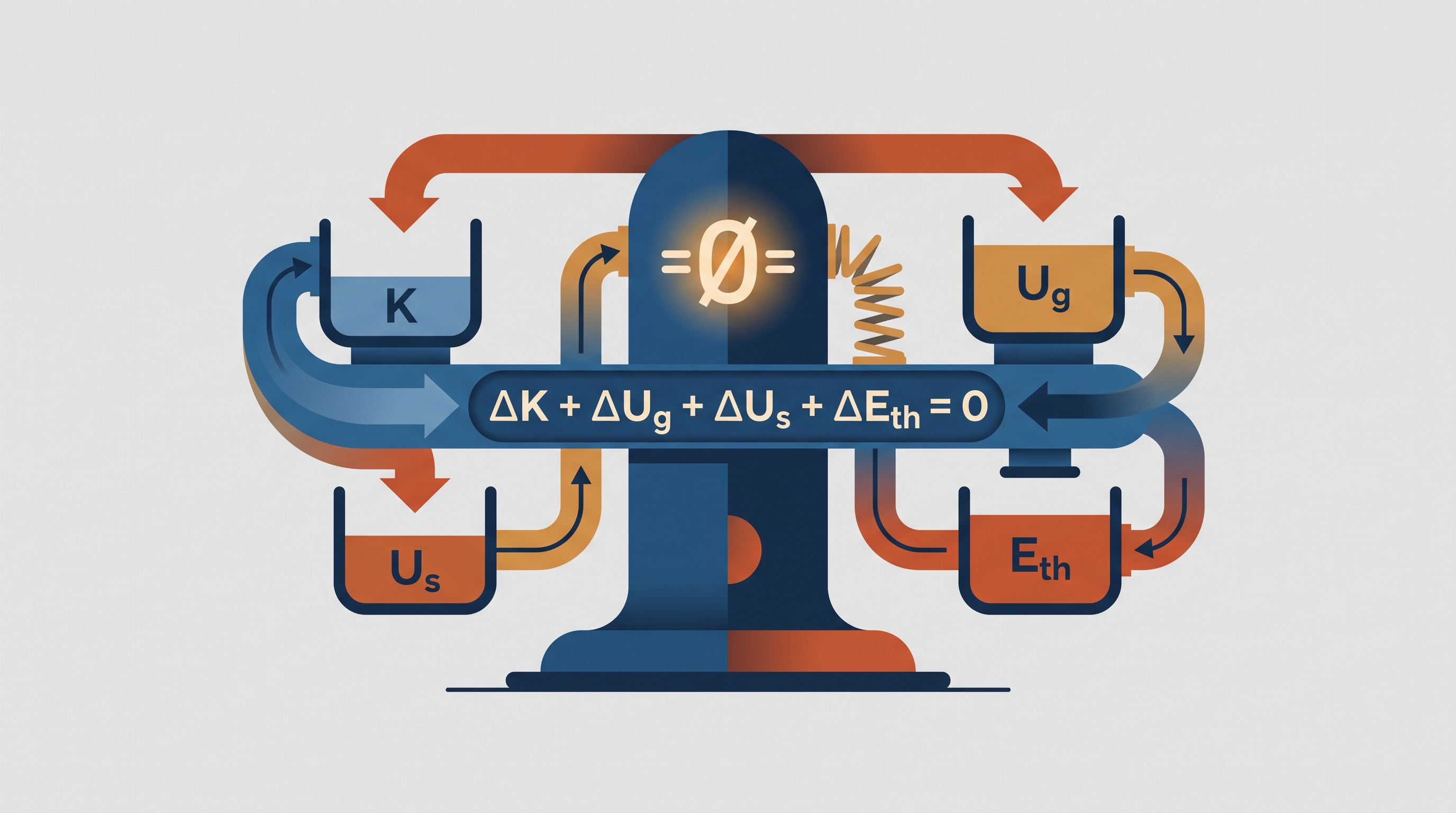
Friction is nonconservative. It transforms mechanical energy into thermal energy, so $K+U_g+U_s$ decreases even though energy is not destroyed. Whether the mechanical energy of a system increases, decreases, or remains constant depends on the system boundary: excluding Earth can make gravity an external energy transfer, while including Earth places gravitational potential energy inside the system.
Retrieval check: A block slides downward while compressing a spring and slowing because of friction. Which quantities can change: $K$, $U_g$, $U_s$, and thermal energy? State one equation that relates their changes. A complete response identifies that all four may change and uses an energy accounting statement such as
$$\Delta K+\Delta U_g+\Delta U_s+\Delta E_{\text{thermal}}=0$$
for an isolated total system.
Source Materials
- Review the Exam Updates (.pdf)
- AP Physics 1: Algebra-Based Course and Exam Description
- AP Physics 1 Course Overview
- AP Physics 1 Course at a Glance
- AP Physics 1 Course at a Glance Poster
- Adopt AP Physics 1: Algebra-Based
- AP Physics 1: Algebra-Based
- AP Physics 1: Algebra-Based
- Figure — Sample Responses Q1 (p. 4)
- Figure — Sample Responses Q1 (p. 5)
- Figure — Sample Responses Q1 (p. 6)
- Figure — Sample Responses Q1 (p. 7)