From the free course AP Physics 1 on Lykke
8.2 Pressure
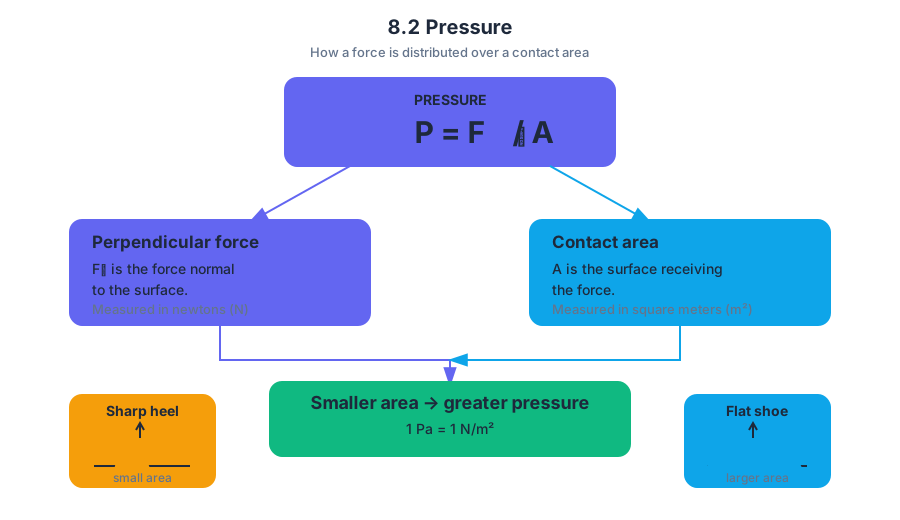
A sharp heel can hurt more than a flat shoe even when both support the same person because pressure depends on how much area receives a force.
8.2 Pressure
A sharp heel can hurt more than a flat shoe even when both support the same person because pressure depends on how much area receives a force. Pressure is the perpendicular force distributed over an area:
$$ P=\frac{F_{\perp}}{A} $$
Here, $P$ is pressure in pascals ($\text{Pa}$), $F_{\perp}$ is the component of force perpendicular to the surface in newtons, and $A$ is the contact area in square meters.
One pascal is one newton per square meter:
$$1\ \text{Pa}=1\ \text{N},\text{m}^{-2}$$
Force and area: the pressure tradeoff
For the same perpendicular force, decreasing area increases pressure. For the same area, increasing force increases pressure. The relationship is proportional in the numerator and inverse in the denominator:
| Change | Effect on pressure |
|---|---|
| Force doubles, area unchanged | Pressure doubles |
| Area doubles, force unchanged | Pressure is halved |
| Force and area both double | Pressure is unchanged |
| Area becomes one-fourth as large | Pressure becomes four times as large |
A $600\ \text{N}$ person stands on two shoes whose combined contact area is $0.040\ \text{m}^2$. The pressure on the floor is
$$ P=\frac{600\ \text{N}}{0.040\ \text{m}^2} =1.5\times10^4\ \text{Pa}. $$
If the person balances on one shoe with area $0.020\ \text{m}^2$, the force is still approximately $600\ \text{N}$, but the pressure becomes
$$ P=\frac{600\ \text{N}}{0.020\ \text{m}^2} =3.0\times10^4\ \text{Pa}. $$
The person has not become heavier; the same force is concentrated over half the area.
Misconception check: pressure is not force
A large force does not automatically mean a large pressure. A snowshoe can support a person with substantial downward force while reducing pressure on the snow because its large area spreads that force. Also, only the force component perpendicular to the surface contributes to the pressure in $P=F_{\perp}/A$; a force directed entirely along the surface does not compress it.
Pressure inside a fluid
A fluid—a liquid or gas—cannot maintain a fixed shape, so it presses on the walls and surfaces that contain it. At rest, fluid pressure acts perpendicular to any surface. Unlike a single contact force, pressure in a fluid is a scalar quantity: at a particular point, it does not have a separate “leftward” or “rightward” value.
In a fluid at rest, pressure increases with depth because deeper fluid must support the weight of the fluid above it. For a liquid of uniform density $\rho$, the pressure at depth $h$ is
$$ P=P_0+\rho gh, $$
where $P_0$ is the pressure at the fluid’s surface, $\rho$ is fluid density, $g$ is gravitational-field strength, and $h$ is vertical depth below the surface.
The term $\rho gh$ is the pressure increase caused by the liquid column. It depends on depth and density, not on the container’s shape. A narrow tube and a wide tank can produce the same pressure at the same depth if they contain the same fluid and have the same surface pressure.
Worked example: pressure below a lake surface
A diver is $5.0\ \text{m}$ below the surface of freshwater. Take $\rho=1.0\times10^3\ \text{kg},\text{m}^{-3}$, $g=9.8\ \text{m},\text{s}^{-2}$, and atmospheric pressure $P_0=1.0\times10^5\ \text{Pa}$. The water’s contribution is
$$ \rho gh
(1.0\times10^3)(9.8)(5.0)
4.9\times10^4\ \text{Pa}. $$
Therefore the total, or absolute, pressure is
$$ P
1.0\times10^5+4.9\times10^4
1.49\times10^5\ \text{Pa}. $$
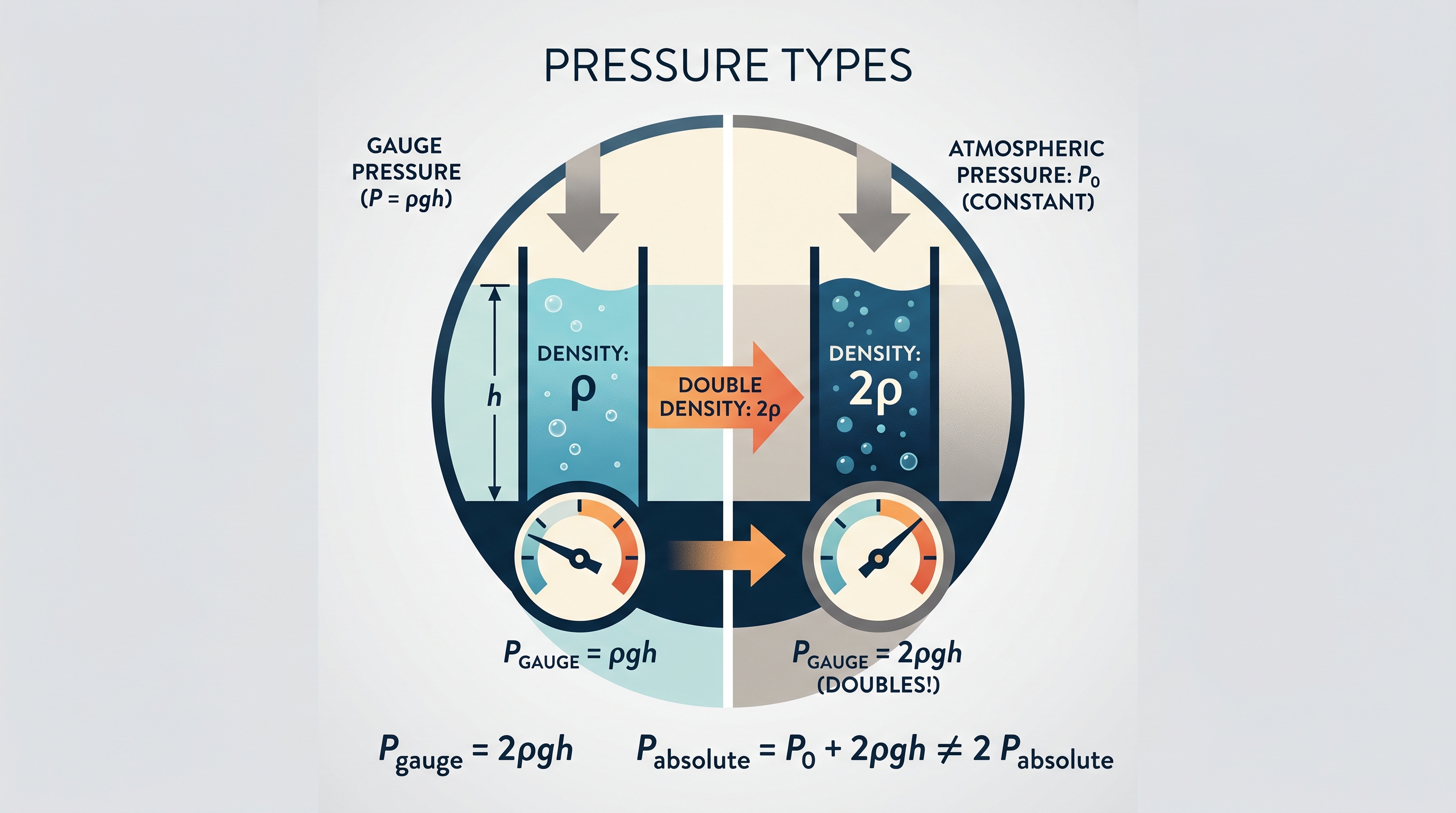
The pressure increase relative to the surface is $4.9\times10^4\ \text{Pa}$. This is called gauge pressure:
$$ P_{\text{gauge}}=\rho gh. $$
Misconception check: deeper does not mean “more force in every direction”
Greater depth means greater pressure at a point, not a one-way downward push. The fluid exerts pressure on the diver from all directions. The net force becomes upward when the pressure on the diver’s bottom surfaces exceeds the pressure on the top surfaces; that force is the subject of buoyancy in the next dynamics treatment.
A visual way to reason about pressure
When solving a pressure problem, identify three things before calculating:
- The surface: What area receives the force?
- The perpendicular force: Which component is normal to that surface?
- The pressure reference: Is the problem asking for gauge pressure, $\rho gh$, or absolute pressure, $P_0+\rho gh$?
These choices exercise Science Practice 1: Creating Representations when a situation is translated into a force-area diagram or depth model, and Science Practice 2: Mathematical Routines when proportional relationships and units are used consistently. A pressure investigation also uses Science Practice 3: Scientific Questioning and Argumentation when measurements of depth and pressure are used to support or challenge the model $P=P_0+\rho gh$.
Retrieval check
A liquid’s density doubles while the depth and surface pressure remain unchanged. Does the gauge pressure double? Yes, because $P_{\text{gauge}}=\rho gh$ and only $\rho$ changed. Does the absolute pressure necessarily double? No: absolute pressure includes the unchanged surface pressure, so it becomes $P_0+2\rho gh$, not $2(P_0+\rho gh)$.