From the free course AP Physics 1 on Lykke
1.5 Vectors and Motion in Two Dimensions
Key concepts: Vectors and vector components · Motion in two dimensions · Projectile motion · Predicting a projectile’s landing spot · Quantitative graphs from data · Applying physical laws to make claims · Newton’s second law · Circular motion · Conservation of energy · Relationships between physical quantities in different scenarios
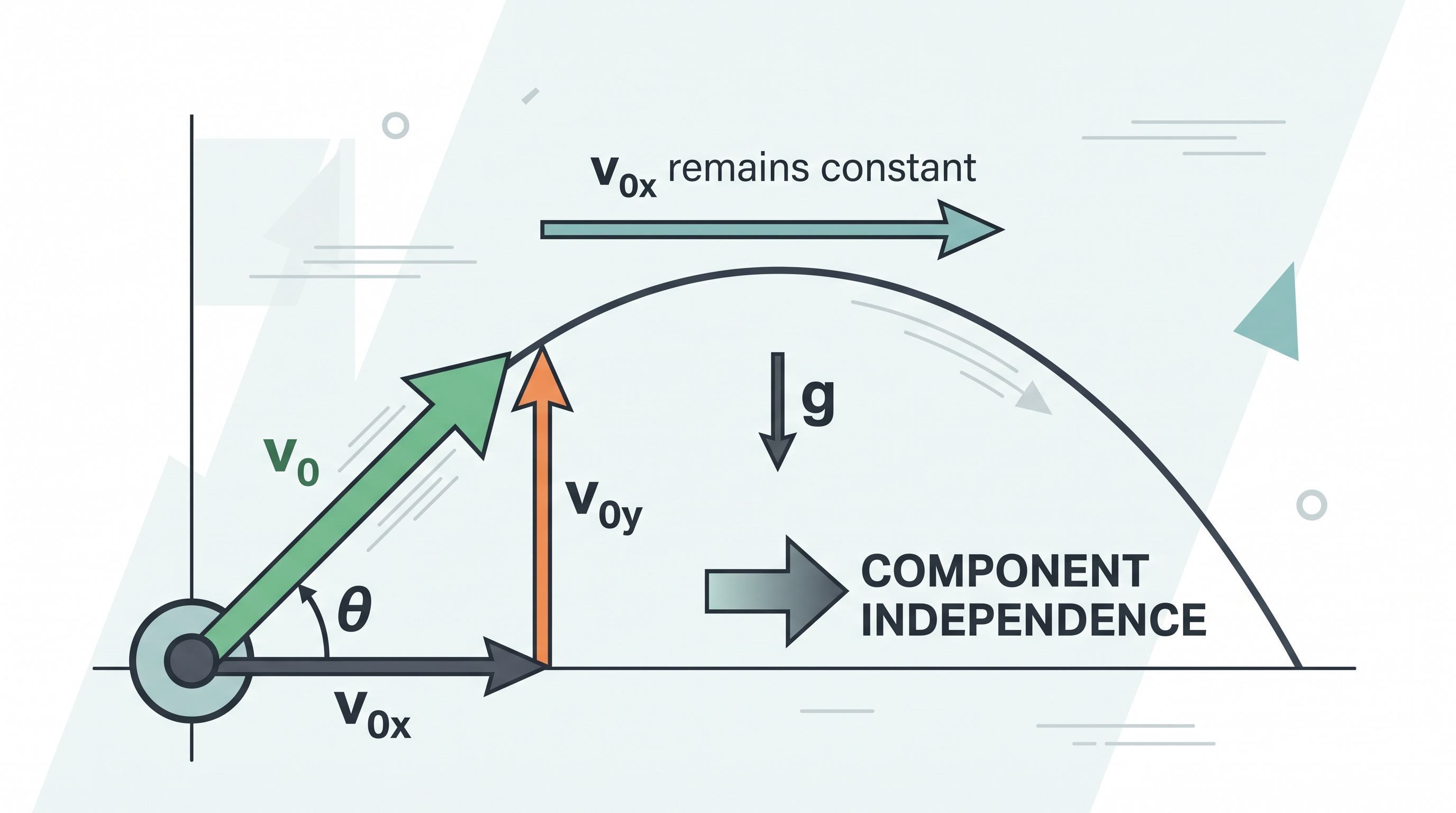
A projectile can move rightward while accelerating downward, because its motion has independent perpendicular components. Learning Objective 1.5.B: describe the motion of an object moving in two dimensions.
1.5 Vectors and Motion in Two Dimensions
A projectile can move rightward while accelerating downward, because its motion has independent perpendicular components. Learning Objective 1.5.B: describe the motion of an object moving in two dimensions.
Vectors: one motion, two perpendicular components
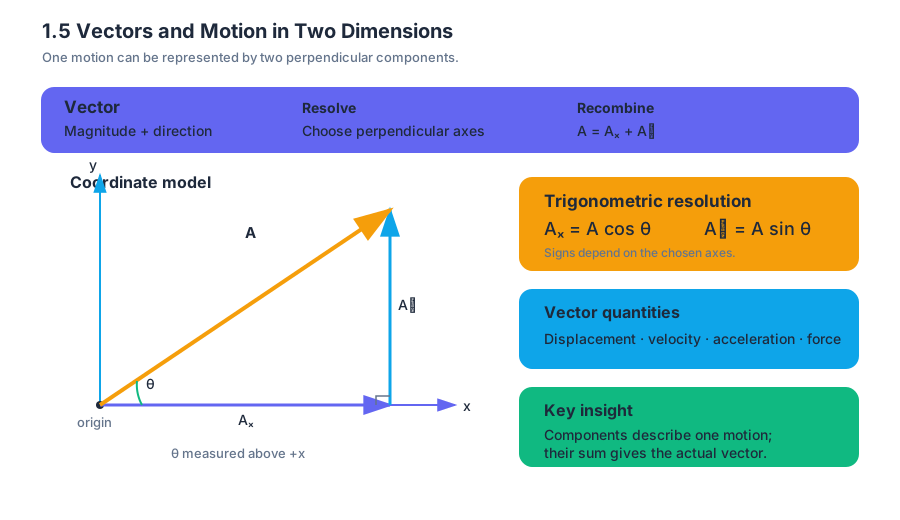
A vector is a quantity with both magnitude and direction. Displacement, velocity, acceleration, and force are vectors; time, mass, and temperature are scalars because they have magnitude but no direction. A two-dimensional vector can be modeled as the result of two perpendicular components.
For a vector $\vec{A}$ with magnitude $A$ and angle $\theta$ measured above the positive $x$-axis,
$$ A_x=A\cos\theta $$
$$ A_y=A\sin\theta $$
The signs of $A_x$ and $A_y$ depend on the chosen coordinate system. This is the essential idea behind 1.5.A.1: Vectors are modeled as the result of two perpendicular components, 1.5.A.2: Vectors are resolved into components based on a chosen coordinate system, and 1.5.A.3: Trigonometric functions are used to resolve vectors into perpendicular components.
Key insight: The components are not two separate motions replacing the original motion. They are two mathematically convenient descriptions whose vector sum gives the actual vector.
Worked example: launch velocity
A ball leaves a ramp at $12\ \text{m/s}$, directed $30^\circ$ above horizontal. Resolve its velocity into components:
$$ v_{0x}=(12)\cos 30^\circ\approx 10.4\ \text{m/s} $$
$$ v_{0y}=(12)\sin 30^\circ=6.0\ \text{m/s} $$
The ball initially moves right at $10.4\ \text{m/s}$ and upward at $6.0\ \text{m/s}$. Skill 2.A: Deriving symbolic expressions is used when these relationships are obtained from the geometry; 2.B: Calculate or estimate an unknown quantity with units from known quantities, by selecting and following a logical computational pathway is used when numerical values are calculated.
Misconception check — “the vertical velocity is the total velocity.” The vertical component is only one part of the velocity. The total speed is recovered from
$$ v=\sqrt{v_x^2+v_y^2}. $$
Projectile motion
Ignoring air resistance, a projectile has constant horizontal velocity and constant downward vertical acceleration:
$$ a_x=0,\qquad a_y=-g. $$
Therefore,
$$ x=x_0+v_{0x}t $$
and
$$ y=y_0+v_{0y}t-\frac{1}{2}gt^2. $$
The horizontal and vertical equations share the same time $t$. That shared time connects the two independent components into one two-dimensional path.
Predicting a landing spot
A projectile is launched horizontally from a platform $20\ \text{m}$ above level ground at $8.0\ \text{m/s}$. Its horizontal landing distance can be predicted without first finding its final speed.
Vertical motion determines the flight time:
$$ 20=\frac{1}{2}gt^2 $$
$$ t=\sqrt{\frac{40}{9.8}}\approx 2.02\ \text{s}. $$
Horizontal motion then gives
$$ \Delta x=v_xt=(8.0)(2.02)\approx 16.2\ \text{m}. $$
The predicted landing spot is approximately $16\ \text{m}$ from the platform’s edge. Skill 2.D: Predicting values based on functional dependencies appears here: the horizontal position depends linearly on time, while the vertical position depends quadratically on time.
Misconception check — “gravity makes the projectile move forward.” Gravity changes only the vertical component in this ideal model. The projectile continues moving horizontally because its horizontal velocity remains constant.
Graphs, data, and physical claims
A motion investigation can turn measured positions and times into a quantitative graph. For horizontal projectile motion, a graph of $x$ versus $t$ should be linear; its slope represents $v_x$. For vertical motion, a graph of $y$ versus $t^2$ is linear when the projectile starts with zero vertical velocity, with slope related to $-\frac{1}{2}g$.
Skill 1.B: Creating quantitative graphs from data requires selecting meaningful axes, labeling variables and units, plotting data, and identifying the relationship. Skill 3.C: Support claims with experimental evidence or physical principles requires more than saying “the graph looks right”: a claim should cite the pattern, slope, or relevant law.
For example, if measured horizontal positions increase by approximately equal amounts during equal time intervals, the data support the claim that $v_x$ is approximately constant. Skill 3.A: Designing experimental procedures enters when deciding how to measure time and position, how to repeat trials, and how to reduce uncertainty.
Connecting motion to force and energy
The acceleration components can be connected to forces using Newton’s second law:
$$ \sum \vec{F}=m\vec{a}. $$
For a projectile near Earth with negligible air resistance, the net force is its weight, so
$$ \sum F_y=-mg \quad\Rightarrow\quad a_y=-g. $$
This is a model-based claim: the force law explains the observed downward curvature.
Circular motion provides another important connection. At the top of a vertical loop, the minimum speed needed to maintain contact occurs when the normal force is just zero:
$$ \frac{mv^2}{r}=mg \quad\Rightarrow\quad v_{\min}=\sqrt{gr}. $$
If an object begins at height $h_i$ and must reach the top of the loop at height $h_t$ with this speed, conservation of energy gives
$$ mgh_i= mgh_t+\frac{1}{2}mv_{\min}^2. $$
Substituting $v_{\min}^2=gr$,
$$ h_i=h_t+\frac{r}{2}. $$
The mass cancels, allowing the required initial potential energy or starting height to be found by working backward from the needed speed.
Misconception check — “minimum speed means zero force.” At the top of the loop, the normal force is zero, but gravity is not. Gravity alone supplies the required centripetal acceleration.
Retrieval check
A ball is launched at angle $\theta$ with speed $v_0$. State the expressions for $v_{0x}$ and $v_{0y}$, identify which component changes during ideal projectile motion, and explain why a graph of horizontal position versus time is linear. A complete response should use the component model, Newton’s second law, and evidence from the graph rather than relying only on a numerical answer.