From the free course AP Physics 1 on Lykke
2.5 Newton’s Second Law
Key concepts: Newton’s Second Law relating net force, mass, and acceleration · Net force as the rate of change of momentum · Constant-mass form of Newton’s Second Law · Acceleration as the slope of a velocity-time graph · The relationship between net force and acceleration · The relationship between mass and acceleration · Using diagrams, tables, charts, or schematics to represent physical situations · Deriving symbolic expressions from known quantities · Applying Newton’s Second Law to motion on a rough inclined ramp · Experimental investigation of Newton’s Second Law using carts, tracks, and probeware
A velocity changes only when the net force—the vector sum of all external forces on a system—is nonzero. Newton’s Second Law turns that statement into a quantitative rule connecting force, mass, and acceleration.
2.5 Newton’s Second Law
A velocity changes only when the net force—the vector sum of all external forces on a system—is nonzero. Newton’s Second Law turns that statement into a quantitative rule connecting force, mass, and acceleration.
Learning Objective 2.5.A: Describe the conditions under which a system’s velocity changes.
From unbalanced forces to acceleration
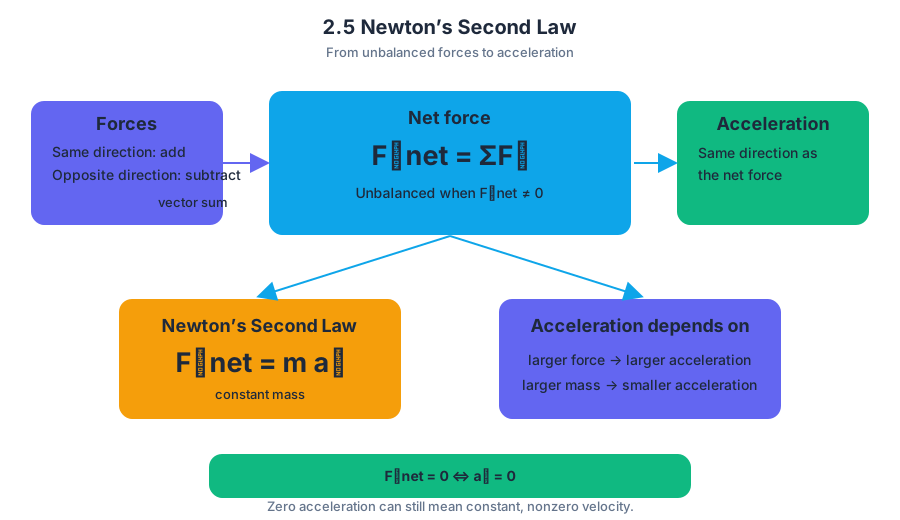
2.5.A.1: Unbalanced forces are a configuration of forces for which the net force on a system is not zero. Because force is a vector, forces pointing in opposite directions must be subtracted, while forces in the same direction add.
For a system with constant mass, Newton’s Second Law is
$$ \vec{F}_{\text{net}}=m\vec{a} $$
Equivalently,
$$ \vec{a}{\text{sys}}=\frac{\sum \vec{F}}{m{\text{sys}}} =\frac{\vec{F}{\text{net}}}{m{\text{sys}}}. $$
The acceleration points in the same direction as the net force. A larger net force produces a larger acceleration for the same mass; a larger mass produces a smaller acceleration for the same net force.
2.5.A.3: The velocity of a system’s center of mass changes only when a nonzero net external force acts on that system. Thus,
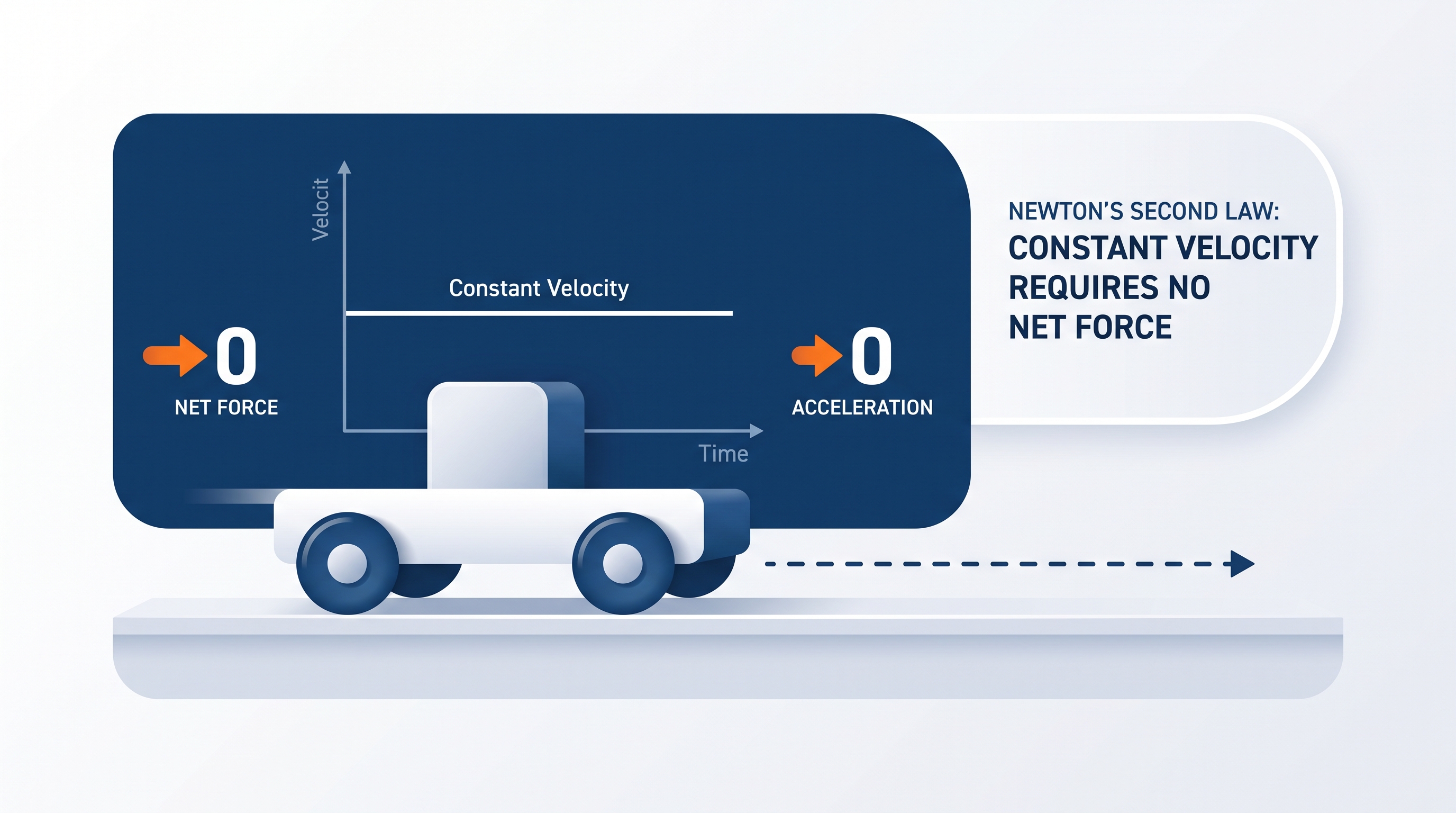
$$ \vec{F}_{\text{net}}=\vec{0} \quad\Longleftrightarrow\quad \vec{a}=\vec{0}, $$
provided the system’s mass is constant. Zero acceleration does not necessarily mean zero velocity: a cart moving at constant velocity has nonzero velocity but zero net force.
The momentum form—and the time-interval distinction
Momentum is defined as
$$ \vec{p}=m\vec{v}. $$
The change in momentum is the final momentum minus the initial momentum:
$$ \Delta\vec{p}=\vec{p}-\vec{p}_0. $$
The instantaneous, general form of Newton’s Second Law is
$$ \vec{F}_{\text{net}}=\frac{d\vec{p}}{dt}. $$
Over a finite time interval, however,
$$ \frac{\Delta\vec{p}}{\Delta t} $$
is the average net force during that interval, not necessarily the instantaneous force at every moment. If mass remains constant, then
$$ \vec{F}_{\text{net}} =m\frac{d\vec{v}}{dt} =m\vec{a}. $$
This distinction matters whenever force varies with time—for example, during a collision or while a motor gradually increases its thrust.
Reading acceleration from a velocity–time graph
Acceleration is the slope of a velocity-versus-time graph:
$$ a=\frac{\Delta v}{\Delta t} $$
for a straight segment, or the tangent slope at a particular instant on a curved graph. A horizontal segment has zero slope, so the acceleration and net force are zero at that time.
A graph that rises steadily represents constant positive acceleration and therefore a constant positive net force. A graph that slopes downward represents negative acceleration; the object may still be moving in the positive direction while slowing down.
Worked example: a block on a rough ramp
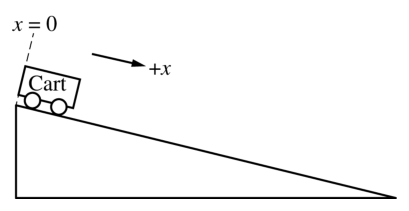
A block slides down a ramp of angle $\theta$ with kinetic-friction coefficient $\mu_k$. Choose down the ramp as positive. The forces parallel to the ramp are the downhill gravitational component $mg\sin\theta$ and the uphill friction force $f_k=\mu_k mg\cos\theta$.
The free-body representation gives
$$ \sum F_{\parallel}=mg\sin\theta-\mu_k mg\cos\theta. $$
Applying 2.5.A.2,
$$ ma=mg\sin\theta-\mu_k mg\cos\theta. $$
Divide by $m$:
$$ a=g\left(\sin\theta-\mu_k\cos\theta\right). $$
The mass cancels because both the gravitational and friction forces scale with mass. If $\theta=30^\circ$, $\mu_k=0.20$, and $g=9.8\ \text{m/s}^2$, then
$$ a=9.8\left(0.50-0.20(0.866)\right) \approx 3.2\ \text{m/s}^2. $$
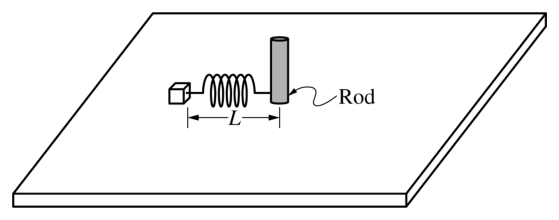
If the block starts from rest and travels distance $L$, a kinematic relationship can then give its speed:
$$ v_A=\sqrt{2aL} =\sqrt{2gL\left(\sin\theta-\mu_k\cos\theta\right)}. $$
The derivation demonstrates 2.A: Derive a symbolic expression from known quantities by selecting and following a logical mathematical pathway, rather than selecting a formula by appearance.
Proportional reasoning and evidence
Under 2.D: Predict new values or factors of change of physical quantities using functional dependence between variables, inspect
$$ a=\frac{F_{\text{net}}}{m}. $$
For fixed mass, doubling $F_{\text{net}}$ doubles $a$. For fixed net force, doubling $m$ halves $a$. Under 3.B: Apply an appropriate law, definition, theoretical relationship, or model to make a claim, Newton’s Second Law supports the claim that an object speeds up only when the net force has a component in its direction of motion.
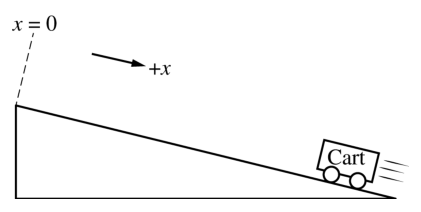
Under 1.A: Create diagrams, tables, charts, or schematics to represent physical situations, represent the situation with a force diagram, a data table, or a graph of $a$ versus $F_{\text{net}}$. A Newton’s Second Law laboratory uses carts, tracks, and probeware to vary net force and mass, measure acceleration, and test the predicted relationships. Under 3.C: Justify or support a claim using evidence from experimental data, physical representations, or physical principles or laws, the slope and pattern of the data become evidence for the model.
Misconception check
Misconception: “A force is required to keep an object moving.” A force is required to change velocity, not to maintain constant velocity. Another common error is treating $\Delta\vec{p}/\Delta t$ as the instantaneous law even when force varies; it is an interval average unless the force is constant.
Retrieval check: A cart’s velocity–time graph is horizontal at $t=4\ \text{s}$. What are its acceleration and net force at that instant? If its mass is tripled while the net force remains unchanged, what happens to its acceleration?
Answer: The graph’s zero slope means $a=0$, so $\vec{F}_{\text{net}}=\vec{0}$. Tripling the mass reduces the acceleration to one-third of its original value.
Source Materials
- Review the Exam Updates (.pdf)
- AP Physics 1: Algebra-Based Course and Exam Description
- AP Physics 1 Course Overview
- AP Physics 1 Course at a Glance
- AP Physics 1 Course at a Glance Poster
- Adopt AP Physics 1: Algebra-Based
- AP Physics 1: Algebra-Based
- AP Physics 1: Algebra-Based
- 1. (7 points, suggested time 13 minutes)
- (a) Students conduct an experiment to determine the acceleration a of a cart. The cart is released from rest at the
- iii. Using the line you drew in part (a)(ii), calculate an experimental value for the acceleration a of the cart
- The students want to confirm that the acceleration is the same whether the cart rolls up or down the ramp. The students start the cart at the bottom and give the cart a quick push so that it rolls up