From the free course AP Physics 1 on Lykke
6.3 Angular Momentum and Angular Impulse
Key concepts: Angular momentum · Angular impulse · Rotational impulse–momentum theorem · Torque as the source of angular impulse · Torque-versus-time graphs · Area under a torque–time curve · Change in angular momentum · Direction of torque and angular impulse · Angular impulse delivered to an object or rigid system
A brief twist of a wrench can change a wheel’s rotation, but the important quantity is not torque alone: a torque acting for a time interval delivers angular impulse, changing the object’s angular momentum.
6.3 Angular Momentum and Angular Impulse
A brief twist of a wrench can change a wheel’s rotation, but the important quantity is not torque alone: a torque acting for a time interval delivers angular impulse, changing the object’s angular momentum.
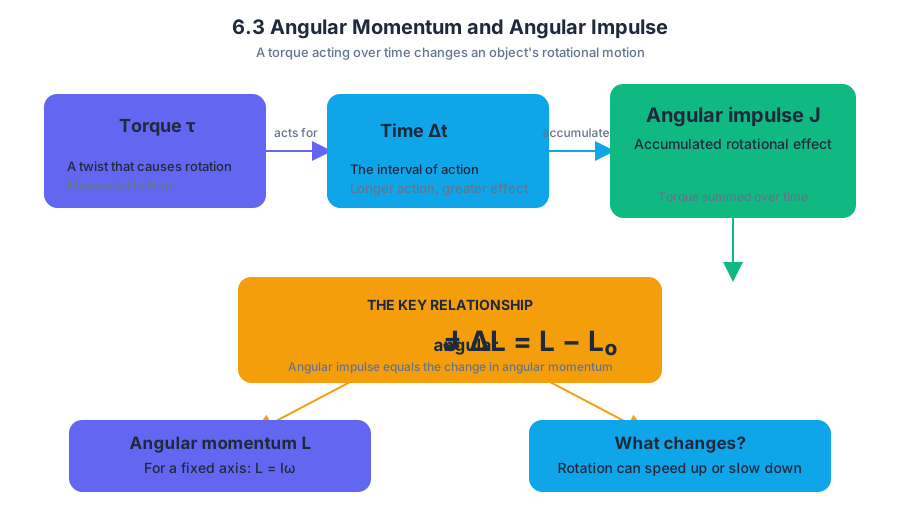
Angular impulse is the accumulated rotational effect of a torque over time. It equals the change in angular momentum:
$$J_{\text{angular}}=\Delta L=L-L_0$$
Here, $L_0$ is the initial angular momentum and $L$ is the final angular momentum. For a rigid object rotating about a fixed axis, angular momentum is often written as $L=I\omega$, where $I$ is rotational inertia and $\omega$ is angular velocity.
6.3.B Angular impulse: torque delivered over time
A torque is the rotational counterpart of a force. When the torque remains constant, its angular impulse is
$$J_{\text{angular}}=\tau\Delta t$$
where $\tau$ is the torque and $\Delta t$ is the interval during which the torque acts. The direction of angular impulse is the same as the direction of the applied torque: a torque that tends to increase counterclockwise rotation produces positive angular impulse if counterclockwise is chosen as positive.
For a torque that varies with time, multiplication is replaced by accumulation:
$$J_{\text{angular}}=\int \tau,dt$$
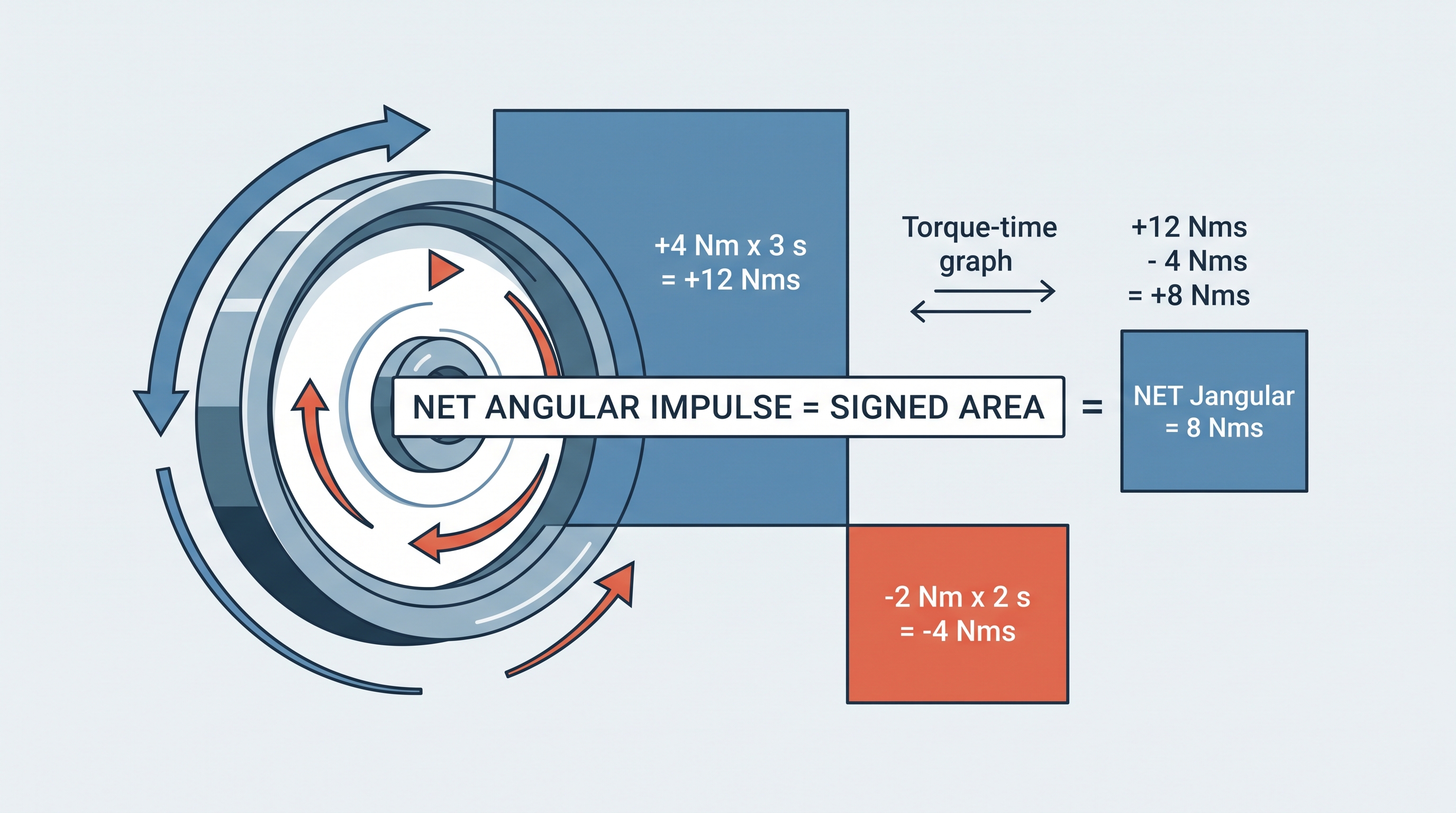
This integral has a powerful graphical meaning. On a graph of torque $\tau$ versus time $t$, the angular impulse is the signed area under the curve. Area above the time axis represents positive angular impulse; area below it represents negative angular impulse.
The units confirm the connection:
$$[\tau\Delta t]=\left(\mathrm{N,m}\right)\left(\mathrm{s}\right)=\mathrm{N,m,s}$$
Since angular momentum has units $\mathrm{kg,m^2,s^{-1}}$, and $\mathrm{N,m,s}$ reduces to the same dimensions, angular impulse and angular momentum can be related directly.
Reading a torque–time graph
A quantitative graph must have labeled axes, appropriate scales, and units. If a torque–time graph forms a rectangle, triangle, or trapezoid, calculate its area using geometry rather than trying to find a single “average torque” by inspection.
| Torque–time shape | Angular impulse magnitude |
|---|---|
| Rectangle | $J_{\text{angular}}=\tau\Delta t$ |
| Triangle beginning at zero | $J_{\text{angular}}=\frac{1}{2}\tau_{\max}\Delta t$ |
| Trapezoid | $J_{\text{angular}}=\frac{1}{2}(\tau_1+\tau_2)\Delta t$ |
For example, a motor applies a torque that rises linearly from $0\ \mathrm{N,m}$ to $6\ \mathrm{N,m}$ during $4\ \mathrm{s}$. The torque–time graph is a triangle, so
$$J_{\text{angular}}=\frac{1}{2}(6\ \mathrm{N,m})(4\ \mathrm{s})=12\ \mathrm{N,m,s}$$
If the wheel initially has angular momentum $L_0=5\ \mathrm{N,m,s}$ in the positive direction, then
$$L=L_0+J_{\text{angular}}=5+12=17\ \mathrm{N,m,s}$$
The graph’s area, not merely the maximum torque, determines the angular-momentum change.
6.3.C Rotational impulse–momentum theorem
Learning Objective 6.3.C is to relate the change in angular momentum of an object or rigid system to the angular impulse given to that object or rigid system. The rotational impulse–momentum theorem states
$$J_{\text{angular}}=\Delta L$$
and therefore
$$L-L_0=\int \tau_{\text{net}},dt$$
For constant net torque, this becomes
$$\Delta L=\tau_{\text{net}}\Delta t$$
If the rotational inertia is constant, then $L=I\omega$ gives
$$\tau_{\text{net}}=\frac{\Delta L}{\Delta t} =I\frac{\Delta\omega}{\Delta t} =I\alpha$$
The impulse–momentum form is especially useful when the torque acts briefly or changes during the interaction, while $\tau_{\text{net}}=I\alpha$ describes the instantaneous rotational dynamics.
Misconception check: “A larger torque always produces a larger angular impulse”
Not necessarily. Angular impulse depends on both torque and time. A torque of $10\ \mathrm{N,m}$ acting for $1\ \mathrm{s}$ delivers the same angular impulse as a torque of $2\ \mathrm{N,m}$ acting for $5\ \mathrm{s}$:
$$J_{\text{angular}}=(10)(1)=(2)(5)=10\ \mathrm{N,m,s}$$
For changing torque, compare graph areas. A tall, narrow pulse can deliver less angular impulse than a shorter, wider pulse.
AP skills in action
This topic most directly develops Science Practice 1: Creating Representations, especially 1.A Describe representations and models and 1.C Create representations of physical situations, when constructing and interpreting torque–time graphs. It also develops Science Practice 2: Mathematical Routines, especially 2.A Describe relationships mathematically and 2.B Apply mathematical relationships, when using $\Delta L$, $\tau\Delta t$, and geometric area. Science Practice 3: Scientific Questioning and Argumentation appears when a student justifies why two different torque histories produce the same angular-momentum change by comparing their signed areas.
Retrieval check
A torque–time graph has a constant positive torque of $4\ \mathrm{N,m}$ for $3\ \mathrm{s}$, followed by a constant negative torque of $2\ \mathrm{N,m}$ for $2\ \mathrm{s}$. What is the net angular impulse?
The signed area is
$$J_{\text{angular}}=(4)(3)-(2)(2)=8\ \mathrm{N,m,s}$$
So the object’s angular momentum increases by $8\ \mathrm{N,m,s}$ in the positive direction.