From the free course AP Physics 1 on Lykke
8.3 Fluids and Newton’s Laws
Key concepts: Pressure as force per unit area · Fluid pressure in a column · Dependence of fluid pressure on depth · Dependence of fluid pressure on density · Absolute (total) pressure versus pressure due to the fluid alone · Applying Newton’s laws to fluids · Using experimental data as evidence for a claim · Creating and interpreting graphs with appropriate scales and units · Deriving symbolic expressions from known quantities · Designing experimental procedures and comparing physical quantities
Pressure forces on a fluid surface can produce a net force, and that net force determines whether a fluid element accelerates, remains at rest, or pushes another object upward.
8.3 Fluids and Newton’s Laws
Pressure forces on a fluid surface can produce a net force, and that net force determines whether a fluid element accelerates, remains at rest, or pushes another object upward.
From pressure to net force
Pressure is already defined as perpendicular force per unit area, $P = F_{\perp}/A$. For a fluid element, the important question is not merely the pressure at one location, but whether pressures on opposite surfaces are equal. If the pressure force on one side is larger than the force on the other, the difference is a net force.
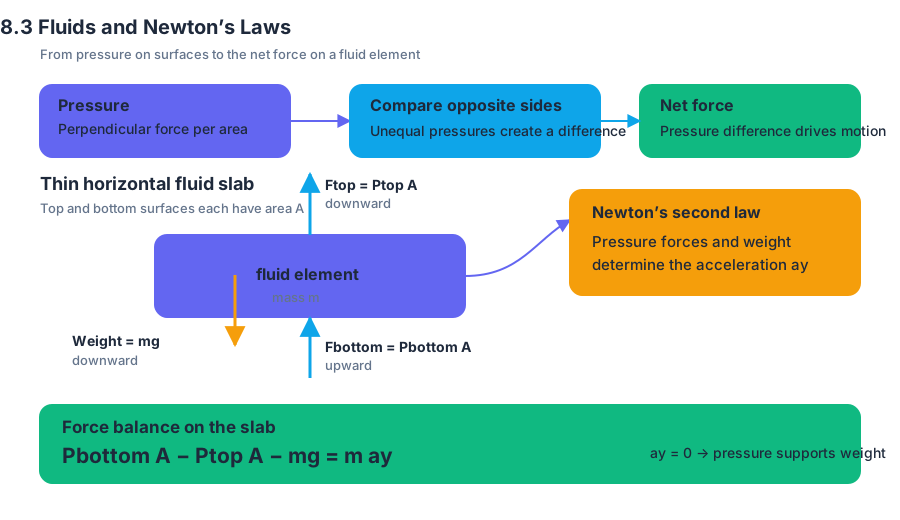
Consider a thin horizontal slab of fluid with top and bottom area $A$. If the pressure at the bottom is $P_{\text{bottom}}$ and the pressure at the top is $P_{\text{top}}$, the upward and downward pressure forces are
$$F_{\text{bottom}} = P_{\text{bottom}}A$$
and
$$F_{\text{top}} = P_{\text{top}}A.$$
The slab also has weight $mg$ downward. Newton’s second law gives
$$P_{\text{bottom}}A - P_{\text{top}}A - mg = ma_y.$$
For a stationary fluid element, $a_y=0$, so the pressure difference supports the element’s weight.
Why pressure increases with depth
The mass of a fluid slab with density $\rho$, area $A$, and height $h$ is $m=\rho Ah$. Substituting this into the equilibrium equation gives
$$P_{\text{bottom}}A-P_{\text{top}}A-\rho Ahg=0.$$
Dividing by $A$ produces
$$P_{\text{bottom}}-P_{\text{top}}=\rho gh.$$
Thus, the pressure increase through a vertical fluid column depends on the fluid’s density, gravitational field strength, and depth difference—not on the container’s shape.
The pressure caused by the fluid column alone is called gauge pressure:
$$P_{\text{gauge}}=\rho gh.$$
If the fluid’s upper surface is exposed to the atmosphere, the total, or absolute, pressure at depth $h$ is
$$P_{\text{abs}}=P_{\text{atm}}+\rho gh.$$
The atmospheric term is not produced by the added fluid column; it is the reference pressure already acting at the surface.
Misconception check — “More fluid means more pressure.” A wide, shallow container can hold more water than a narrow, deep container while producing less pressure at its bottom. At the same depth in the same fluid, pressure is the same because $\rho$, $g$, and $h$ are the same. The bottom force can still differ because $F=PA$ and the bottom areas differ.
Worked example: comparing fluids
A sensor is placed $0.80\ \text{m}$ below the surface in freshwater with $\rho_{\text{fresh}}=1.00\times10^3\ \text{kg},\text{m}^{-3}$ and in saltwater with $\rho_{\text{salt}}=1.10\times10^3\ \text{kg},\text{m}^{-3}$. Using $g=9.8\ \text{m},\text{s}^{-2}$,
$$P_{\text{gauge,fresh}}=(1.00\times10^3)(9.8)(0.80)=7.84\times10^3\ \text{Pa},$$
while
$$P_{\text{gauge,salt}}=(1.10\times10^3)(9.8)(0.80)=8.62\times10^3\ \text{Pa}.$$
The atmospheric pressure is added to both values when absolute pressure is requested, so the difference between the two absolute pressures is still $7.84\times10^2\ \text{Pa}$.
Newton’s laws in fluids
Pressure differences explain buoyant forces. The lower surface of a submerged object is deeper than its upper surface, so the upward pressure force is larger than the downward pressure force. The resulting net force is the buoyant force, directed upward. Newton’s second law then determines the object’s motion:
$$F_{\text{net},y}=F_B-mg=ma_y.$$
In a denser fluid, the same displaced volume produces a larger pressure difference and therefore a larger buoyant force, since $F_B=\rho_{\text{fluid}}V_{\text{displaced}}g$.
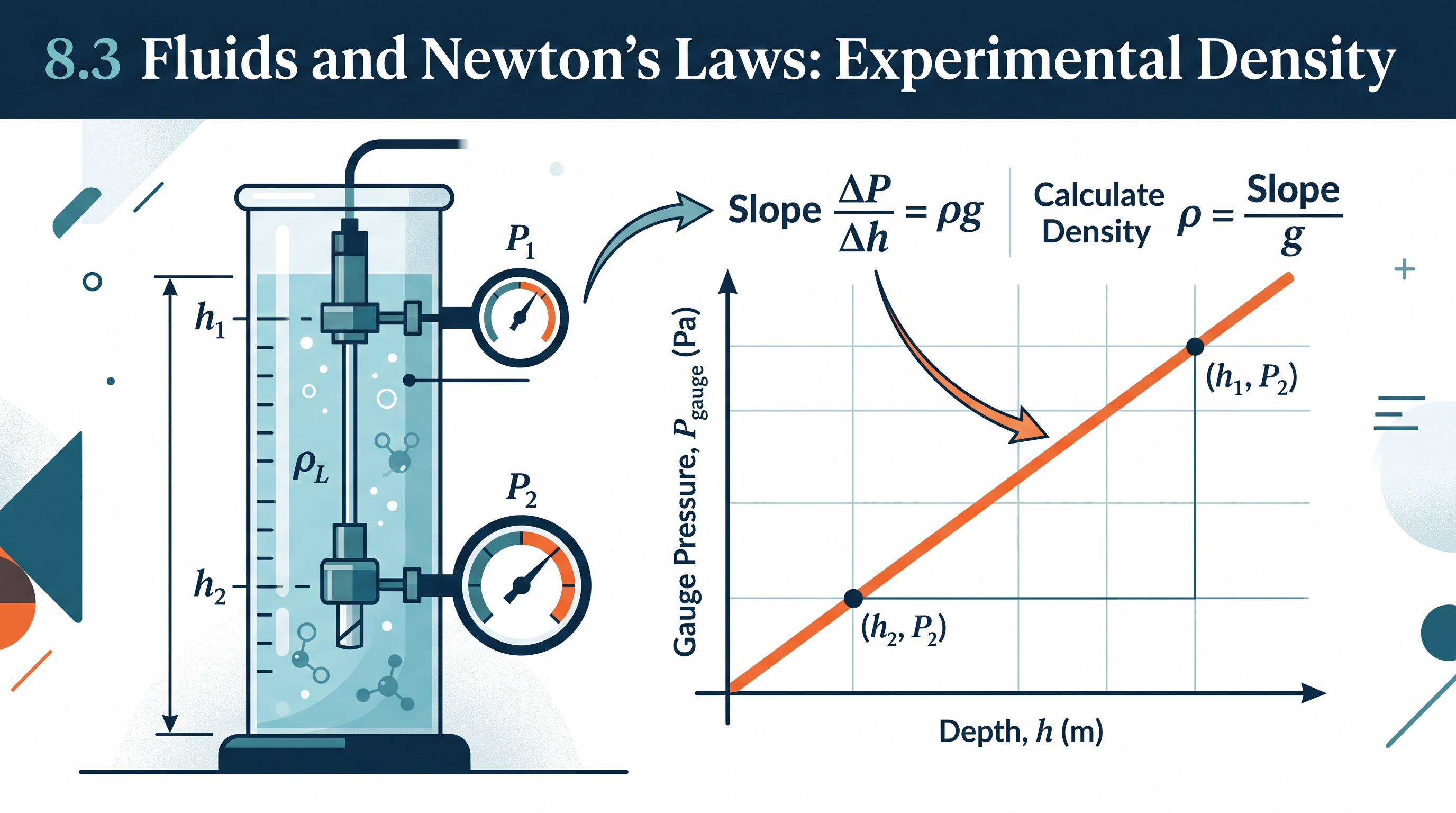
Skill connection: 1.A: Create diagrams, tables, charts, or schematics to represent physical situations is used in pressure-column and force diagrams. 2.A: Derive a symbolic expression from known quantities by selecting and following a logical mathematical pathway appears in the derivation of $\Delta P=\rho gh$. 2.D: Predict new values or factors of change of physical quantities using functional dependence between variables supports predictions such as “doubling depth doubles gauge pressure.” 1.B: Create quantitative graphs with appropriate scales and units, including plotting data applies when graphing pressure versus depth. A linear graph has slope
$$\frac{\Delta P}{\Delta h}=\rho g.$$
For an investigation, measure pressure at several known depths while keeping the fluid and sensor orientation fixed. Plot $P_{\text{gauge}}$ on the vertical axis in pascals and $h$ on the horizontal axis in meters; a best-fit line should pass near the origin, and its slope can be divided by $g$ to determine $\rho$. A strong procedure also repeats measurements, controls temperature and fluid composition, and justifies uncertainty reduction.
2.C: Compare physical quantities between two or more scenarios or at different times and locations in a single scenario asks for more than a numerical difference: identify which variable changed and use the model to explain the direction of change. 3.A: Create experimental procedures that are appropriate for a given scientific question and 3.B: Apply an appropriate law, definition, theoretical relationship, or model to make a claim connect measurements to Newton’s laws and the pressure model.
Retrieval check: At equal depth, which produces greater gauge pressure: freshwater or saltwater? If a submerged object has $F_B>mg$, what does Newton’s second law predict about its vertical acceleration?
Source Materials
- Review the Exam Updates (.pdf)
- AP Physics 1: Algebra-Based Course and Exam Description
- AP Physics 1 Course Overview
- AP Physics 1 Course at a Glance
- AP Physics 1 Course at a Glance Poster
- Adopt AP Physics 1: Algebra-Based
- AP Physics 1: Algebra-Based
- AP Physics 1: Algebra-Based
- Total for part (c) 4 points
- Total for part (d) 2 points
- Total for part (d) 2 points
- Total for part (c) 4 points