From the free course AP Physics 1 on Lykke
6.2 Torque and Work
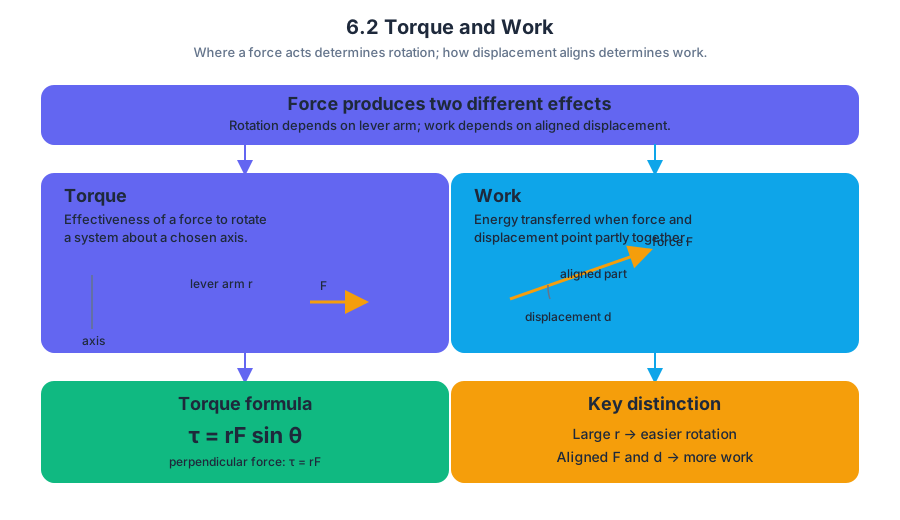
A force can make an object move without making it rotate, and it can make an object rotate without doing much translational work. The difference is where the force acts and which part of the displacement is aligned with the force.
6.2 Torque and Work
A force can make an object move without making it rotate, and it can make an object rotate without doing much translational work. The difference is where the force acts and which part of the displacement is aligned with the force.
Imagine opening a heavy door. Pushing near the hinges is difficult because your force has a small lever arm. Pushing at the handle is easier because the same force acts farther from the rotation axis. That rotational effectiveness is called torque.
Torque measures how effectively a force tends to rotate a system about a chosen axis.
For a force perpendicular to a radial line from the axis,
$$\tau = rF$$
where $\tau$ is torque, $r$ is the perpendicular distance from the axis to the force’s line of action, and $F$ is the force magnitude. More generally,
$$\tau = rF\sin\theta$$
where $\theta$ is the angle between the radius vector and the force.
Torque depends on the line of action
The distance that matters is not always the object’s physical radius. It is the lever arm, the shortest perpendicular distance from the rotation axis to the line along which the force acts.
A force directed through the axis has zero lever arm, so it produces no torque:
$$\tau = 0$$
A tangential force produces the greatest torque for a given $r$ and $F$ because $\theta = 90^\circ$ and $\sin 90^\circ = 1$.
Torque is measured in newton-meters, written $\mathrm{N \cdot m}$. Although this has the same base units as a joule, torque and energy are different physical quantities: torque describes rotational influence, while work describes energy transferred by a force.
Torque and rotational work
When a torque turns an object through an angular displacement, it can do rotational work. Work is energy transferred when a force causes displacement in the force’s direction. For constant torque,
$$W = \tau\Delta\theta$$
where $\Delta\theta$ must be measured in radians.
The equation follows from ordinary work. A point at radius $r$ moves through arc length
$$s = r\Delta\theta$$
so a tangential force does work
$$W = Fs = F(r\Delta\theta) = (rF)\Delta\theta = \tau\Delta\theta.$$
If the torque varies during the motion, the constant-torque equation cannot be used with one arbitrary value of $\tau$. The work is represented by the area under a torque-versus-angle graph:
$$W = \int \tau,d\theta.$$
At the algebra-based AP Physics 1 level, the central pattern is to identify whether the torque is constant and then connect rotational work to the change in rotational kinetic energy.
Worked example: turning a flywheel
A motor applies a constant tangential force of $12\ \mathrm{N}$ at the rim of a flywheel of radius $0.25\ \mathrm{m}$. The wheel turns through $8.0\ \mathrm{rad}$. How much work does the motor do?
First find the torque:
$$\tau = rF = (0.25\ \mathrm{m})(12\ \mathrm{N}) = 3.0\ \mathrm{N \cdot m}.$$
Then use the angular work relation:
$$W = \tau\Delta\theta$$
$$W = (3.0\ \mathrm{N \cdot m})(8.0\ \mathrm{rad}) = 24\ \mathrm{J}.$$
The answer is positive because the motor’s torque and the flywheel’s angular displacement point in the same rotational direction. If friction applies an opposing torque, its work is negative and reduces the net energy transferred to the flywheel.
Connecting work to rotational kinetic energy
The work–energy relationship for rotation is
$$W_{\text{net}} = \Delta K_{\text{rot}}.$$
For a rigid object rotating about a fixed axis,
$$K_{\text{rot}} = \frac{1}{2}I\omega^2,$$
so
$$W_{\text{net}} = \frac{1}{2}I\omega_f^2-\frac{1}{2}I\omega_i^2.$$
This connects directly to the rotational kinetic energy model: net torque transfers energy by changing the object’s angular speed.
For constant net torque, combining $W_{\text{net}}=\tau_{\text{net}}\Delta\theta$ with the energy equation gives
$$\tau_{\text{net}}\Delta\theta
\frac{1}{2}I\omega_f^2-\frac{1}{2}I\omega_i^2.$$
This method is often useful when the problem gives angular displacement but not time.
Misconception check: “Torque is rotational force”
Correction: torque is not a separate kind of force. Torque is the rotational effect of an ordinary force about a specified axis. The same force can produce different torques about different axes, and a force can have zero torque about one axis but nonzero torque about another.
A second common error is using degrees in $W=\tau\Delta\theta$. Since arc length satisfies $s=r\theta$, the angle must be in radians. For example, $180^\circ=\pi\ \mathrm{rad}$, not $180$ in the equation.
AP science practices in Topic 6.2
This topic particularly develops Science Practice 1: Creating Representations, including 1.A. Create diagrams, tables, charts, or schematics to represent physical situations. A strong solution sketches the axis, force line of action, lever arm, angular displacement, and positive rotational direction.
It also develops Science Practice 2: Mathematical Routines: 2.A. Derive a symbolic expression from known quantities by selecting and following a logical mathematical pathway, 2.B. Calculate or estimate an unknown quantity with units from known quantities, by selecting and following a logical computational pathway, and 2.C. Compare physical quantities between two or more scenarios or at different times and locations in a single scenario.
For example, doubling $r$ doubles torque, while doubling the angle through which the same torque acts doubles the work. These comparisons require distinguishing the roles of force, lever arm, torque, and angular displacement rather than treating all rotational quantities as interchangeable.
Retrieval check
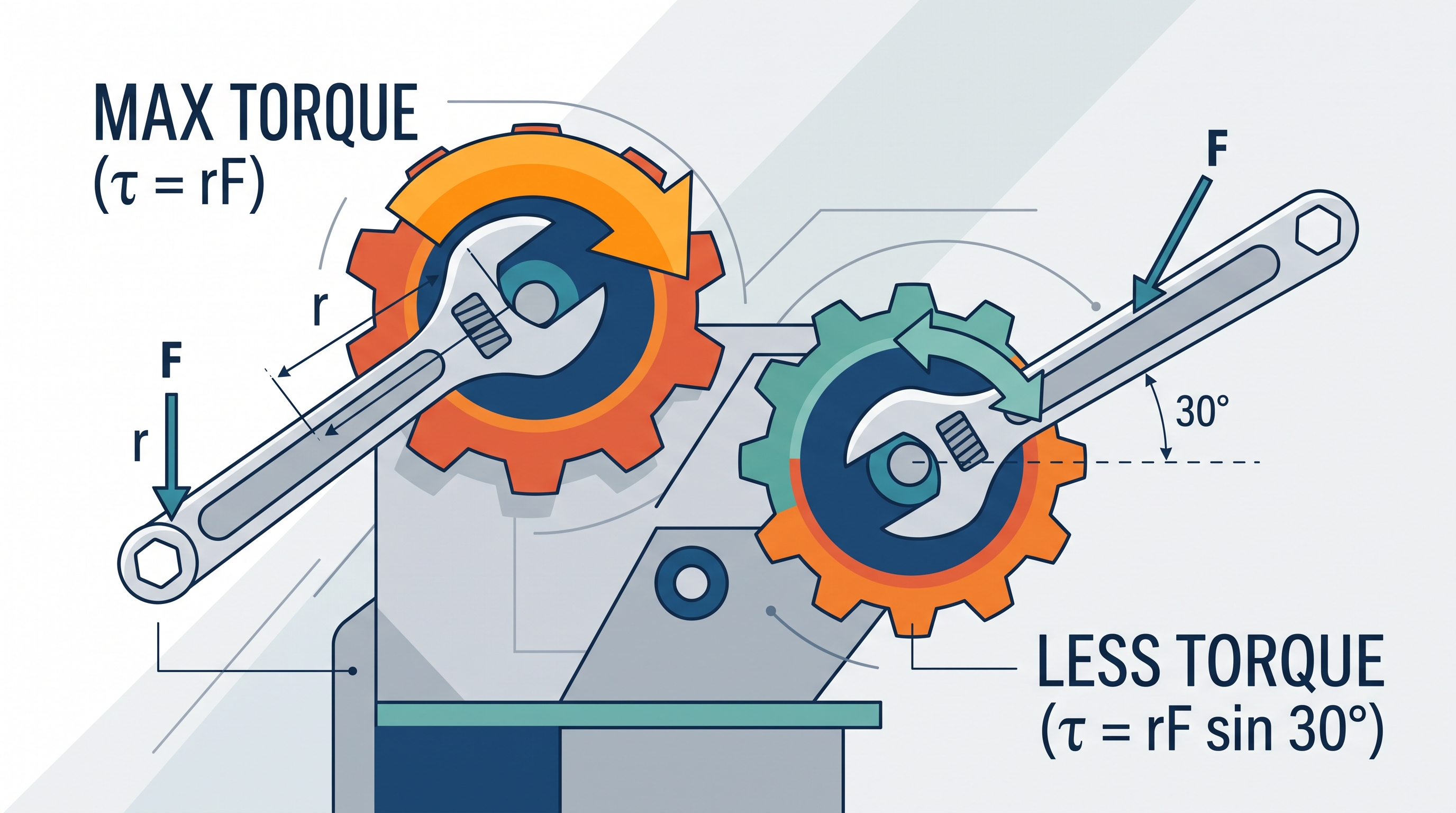
A wrench is pushed with force $F$ at radius $r$, first perpendicular to the wrench and then at an angle of $30^\circ$ to it. Which case produces greater torque, and by what factor?
The perpendicular case produces
$$\tau_{\perp}=rF,$$
while the angled case produces
$$\tau_{30^\circ}=rF\sin30^\circ=\frac{1}{2}rF.$$
Therefore, the perpendicular push produces twice as much torque.