From the free course AP Physics 1 on Lykke
5.5 Rotational Equilibrium and Newton’s First Law in Rotational Form
Key concepts: Rotational equilibrium · Newton’s First Law in rotational form · Translational equilibrium · Net force as a vector sum · Free-body diagrams · Force diagrams · Torque · Forces and torques exerted on an object · Learning objectives and essential knowledge · Science practices: deriving symbolic expressions and applying laws
A rigid object can have zero net torque and still accelerate through space, or have zero net force and still begin rotating. The key is that translational and rotational equilibrium are separate conditions.
5.5 Rotational Equilibrium and Newton’s First Law in Rotational Form
A rigid object can have zero net torque and still accelerate through space, or have zero net force and still begin rotating. The key is that translational and rotational equilibrium are separate conditions.
Learning Objective 5.5.A: Describe the conditions under which a system’s angular velocity remains constant.
Essential Knowledge 5.5.A.1: A system may exhibit rotational equilibrium without being in translational equilibrium, and vice versa.
Two kinds of equilibrium
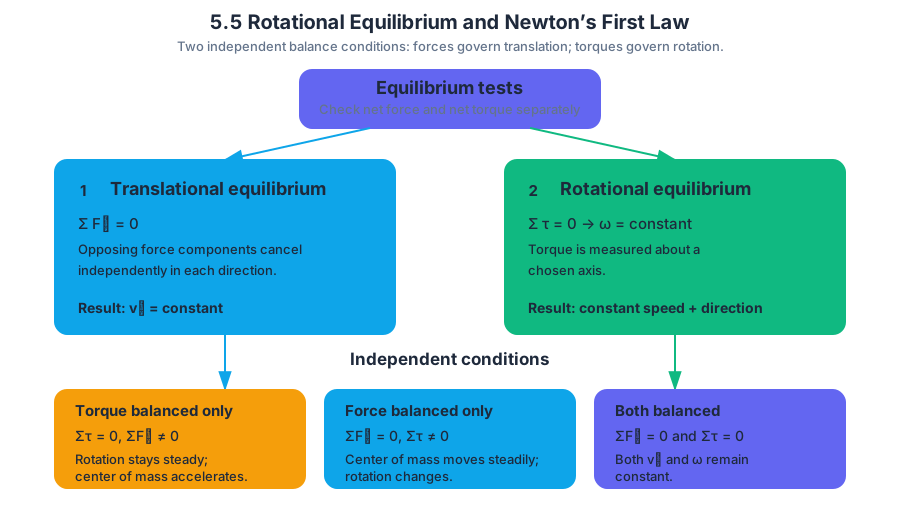
Translational equilibrium means that the vector sum of all forces on a system is zero:
$$\sum_i \vec{F}_i=\vec{0}$$
Because force is a vector, opposing components cancel separately. Newton’s First Law then says that the system’s velocity remains constant. “Constant” includes both being at rest and moving at constant velocity.
Rotational equilibrium means that the sum of the torques about a chosen axis is zero:
$$\sum_i \tau_i=0$$
The rotational form of Newton’s First Law states that the system’s angular velocity remains constant when the net torque is zero:
$$\sum_i \tau_i=0 \quad \Longrightarrow \quad \omega=\text{constant}$$
Here, constant angular velocity means constant rotational speed and direction about the selected axis.
The two conditions are logically independent:
| Condition | Mathematical test | What remains constant? |
|---|---|---|
| Translational equilibrium | $\sum \vec{F}=\vec{0}$ | Linear velocity $\vec{v}$ |
| Rotational equilibrium | $\sum \tau=0$ | Angular velocity $\omega$ |
| Both | $\sum \vec{F}=\vec{0}$ and $\sum \tau=0$ | Both $\vec{v}$ and $\omega$ |
A system can therefore have $\sum \tau=0$ but $\sum \vec{F}\neq\vec{0}$: it rotates at constant angular velocity while its center of mass accelerates. Conversely, $\sum \vec{F}=0$ but $\sum \tau\neq0$ allows the center of mass to move at constant velocity while the object’s rotation changes.
Reading forces and torques from diagrams
A free-body diagram represents every external force acting on the selected system. A force diagram can additionally emphasize where those forces act and therefore whether they create clockwise or counterclockwise torque. The diagram is not an artistic picture: it is a model of the interaction that must be analyzed.
For each force, ask two questions:
- Does it contribute to the vector sum $\sum \vec{F}$?
- Does its line of action produce a torque about the chosen axis?
A force whose line of action passes through the axis has zero lever arm and therefore produces zero torque about that axis, even though it may contribute substantially to the net force.
Worked example: a balanced beam
A horizontal beam is supported at its center. A person pushes downward with force $120\ \text{N}$ at a point $0.50\ \text{m}$ to the left of the support. Another person pushes downward with force $60\ \text{N}$ at a point $1.00\ \text{m}$ to the right.
Choose counterclockwise torque as positive. The left force produces counterclockwise torque, while the right force produces clockwise torque:
$$\tau_{\text{left}}=(120\ \text{N})(0.50\ \text{m})=60\ \text{N}\cdot\text{m}$$
$$\tau_{\text{right}}=-(60\ \text{N})(1.00\ \text{m})=-60\ \text{N}\cdot\text{m}$$
Therefore,
$$\sum\tau=60-60=0$$
The beam is in rotational equilibrium. If it was initially at rest, it remains at rest rotationally; if it was already rotating, its angular velocity remains constant.
However, the two downward forces add rather than cancel:
$$\sum F_y=-120\ \text{N}-60\ \text{N}=-180\ \text{N}$$
The support must exert an upward force of $180\ \text{N}$ for translational equilibrium. With that support force included, both $\sum \vec{F}=0$ and $\sum\tau=0$.
A common misconception
Misconception: “If the net force is zero, the object cannot rotate.” Zero net force controls the motion of the center of mass, not the rotational motion. Two equal and opposite forces applied along different lines can produce a couple: their forces cancel, but their torques reinforce, so $\sum \tau\neq0$ and the object’s angular velocity changes.
Misconception: “If an object is not rotating, it must be in rotational equilibrium.” An object can be momentarily at rest while experiencing nonzero net torque. In that case, its angular velocity is currently $\omega=0$, but it is about to change. Equilibrium requires $\sum\tau=0$, not merely instantaneous zero angular velocity.
AP skills in this topic
Topic 5.5 is assessed through the Unit 5 progress check and especially develops:
- Science Practice 1—Creating Representations, Skill 1.A: represent the system with a force diagram or free-body diagram, including force locations and torque directions.
- Science Practice 2—Mathematical Routines, Skill 2.B: derive a symbolic expression from a known relationship, such as solving $\sum\tau=0$ for an unknown force or distance.
- Science Practice 3—Scientific Questioning and Argumentation, Skill 3.B: apply an appropriate law, definition, theoretical relationship, or model to make a claim about constant angular velocity.
The AP boundary is deliberate: AP Physics 1 does not expect simultaneous analysis of rotation in multiple planes. Work in one rotational plane, select a clear axis, assign a sign convention, and use the torque sum consistently.
Retrieval check
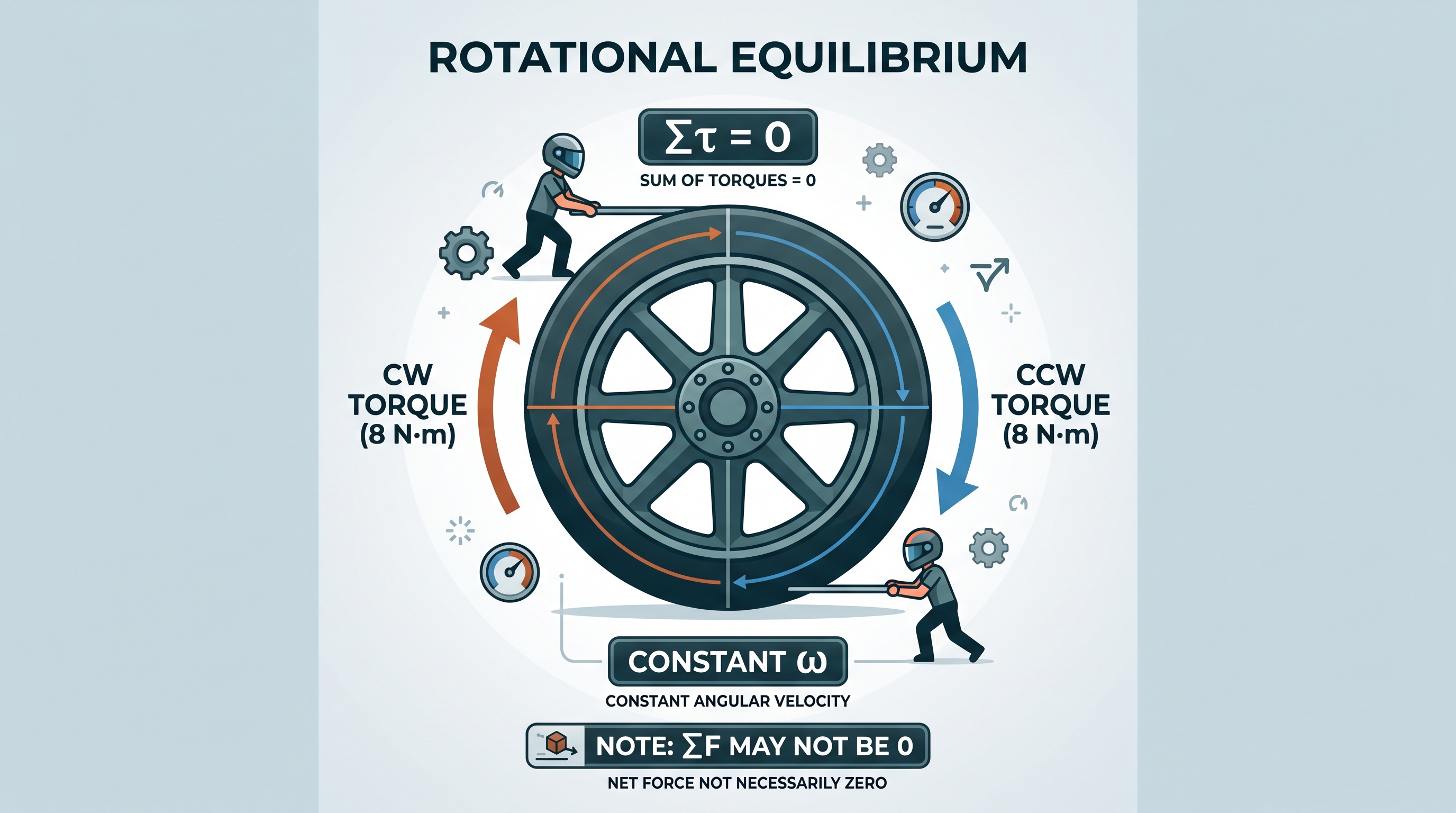
A wheel experiences a clockwise torque of $8\ \text{N}\cdot\text{m}$ and a counterclockwise torque of $8\ \text{N}\cdot\text{m}$. Is it in rotational equilibrium? What additional information is needed to decide whether it is also in translational equilibrium?
Answer: Yes, because $\sum\tau=0$, so its angular velocity remains constant. The forces themselves must be added as vectors to determine whether $\sum\vec{F}=0$; torque balance alone cannot answer that question.