From the free course AP Physics 1 on Lykke
3.5 Power
Key concepts: Power
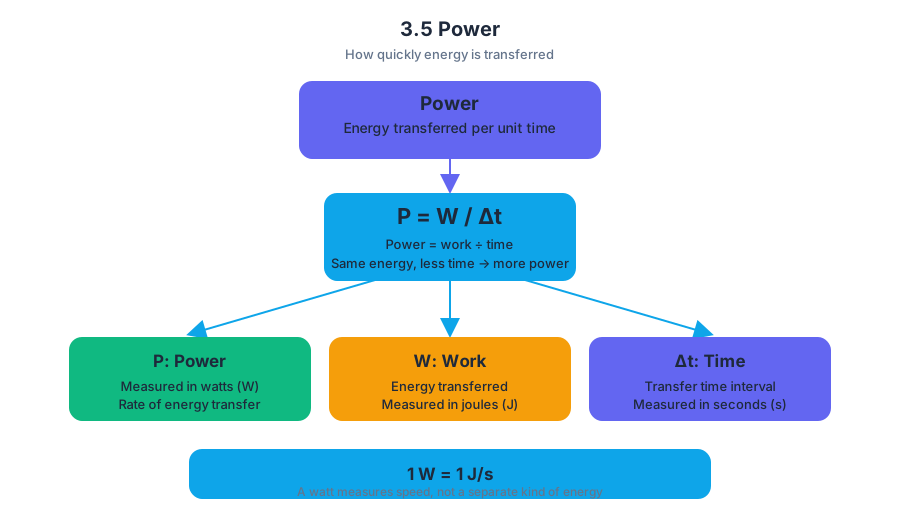
A machine that transfers the same amount of energy in less time is more powerful. Power measures the rate at which work is done, or equivalently the rate at which energy is transferred.
3.5 Power
A machine that transfers the same amount of energy in less time is more powerful. Power measures the rate at which work is done, or equivalently the rate at which energy is transferred.
Power is the amount of energy transferred per unit time.
The power formula is
$$ P=\frac{W}{\Delta t} $$
Here, $P$ is power, measured in watts; $W$ is work, or energy transferred, measured in joules; and $\Delta t$ is the time interval over which the transfer occurs, measured in seconds.
$$ 1\ \mathrm{W}=1\ \mathrm{J/s} $$
A watt is therefore not a separate kind of energy. It tells us how quickly energy is transferred. A $1000\ \mathrm{W}$ motor and a $100\ \mathrm{W}$ motor could each transfer $5000\ \mathrm{J}$, but the $1000\ \mathrm{W}$ motor does so in one-tenth the time.
Energy transferred versus power
Imagine two students carrying identical boxes through the same vertical distance. If both students do the same amount of work on their boxes, they transfer the same amount of energy. The student who finishes first produces the greater average power.
| Physical quantity | Meaning | Typical unit |
|---|---|---|
| Work, $W$ | Total energy transferred by a force | Joule, $\mathrm{J}$ |
| Time interval, $\Delta t$ | How long the transfer takes | Second, $\mathrm{s}$ |
| Power, $P$ | Rate of energy transfer | Watt, $\mathrm{W}$ |
The word average matters because the rate of transfer may vary. The formula gives the average power over the chosen interval. If a motor transfers $2400\ \mathrm{J}$ during an $8.0\ \mathrm{s}$ interval, its average power is
$$ P=\frac{W}{\Delta t} =\frac{2400\ \mathrm{J}}{8.0\ \mathrm{s}} =300\ \mathrm{W}. $$
This result means that, averaged over those $8.0\ \mathrm{s}$, the motor transfers energy at a rate of $300\ \mathrm{J/s}$. It does not mean that the motor transfers only $300\ \mathrm{J}$ total; the total transfer is still $2400\ \mathrm{J}$.
A contextual example: lifting a load
An elevator raises a $60\ \mathrm{kg}$ load vertically upward by $4.0\ \mathrm{m}$ in $8.0\ \mathrm{s}$. Ignore changes in kinetic energy and use $g=10\ \mathrm{m/s^2}$. What average power is required to increase the load’s gravitational potential energy?
The upward lift transfers energy against the gravitational force. The force needed for constant speed is approximately the load’s weight:
$$ F_g=mg =(60\ \mathrm{kg})(10\ \mathrm{m/s^2}) =600\ \mathrm{N}. $$
The work done during the lift is
$$ W=Fd =(600\ \mathrm{N})(4.0\ \mathrm{m}) =2400\ \mathrm{J}. $$
Now divide the energy transferred by the elapsed time:
$$ P=\frac{2400\ \mathrm{J}}{8.0\ \mathrm{s}} =300\ \mathrm{W}. $$
If the same load rises through the same distance in $4.0\ \mathrm{s}$, the work remains $2400\ \mathrm{J}$, but the power becomes
$$ P=\frac{2400\ \mathrm{J}}{4.0\ \mathrm{s}} =600\ \mathrm{W}. $$
The shorter time doubles the power. This proportional relationship is often the fastest way to reason: for a fixed amount of work, $P$ is inversely proportional to $\Delta t$.
Misconception check: “more power means more energy”
Misconception: A more powerful device always transfers more energy.
Correction: Power describes the rate of transfer, not the total transfer. A high-power device can transfer a fixed amount of energy quickly. A lower-power device can transfer that same amount more slowly. Total energy depends on both quantities:
$$ W=P\Delta t. $$
For example, a $500\ \mathrm{W}$ device operating for $6.0\ \mathrm{s}$ transfers
$$ W=(500\ \mathrm{W})(6.0\ \mathrm{s}) =3000\ \mathrm{J}. $$
A $1000\ \mathrm{W}$ device operating for only $3.0\ \mathrm{s}$ transfers the same $3000\ \mathrm{J}$. The devices have different powers but equal energy transfers.
Quick interpretation check
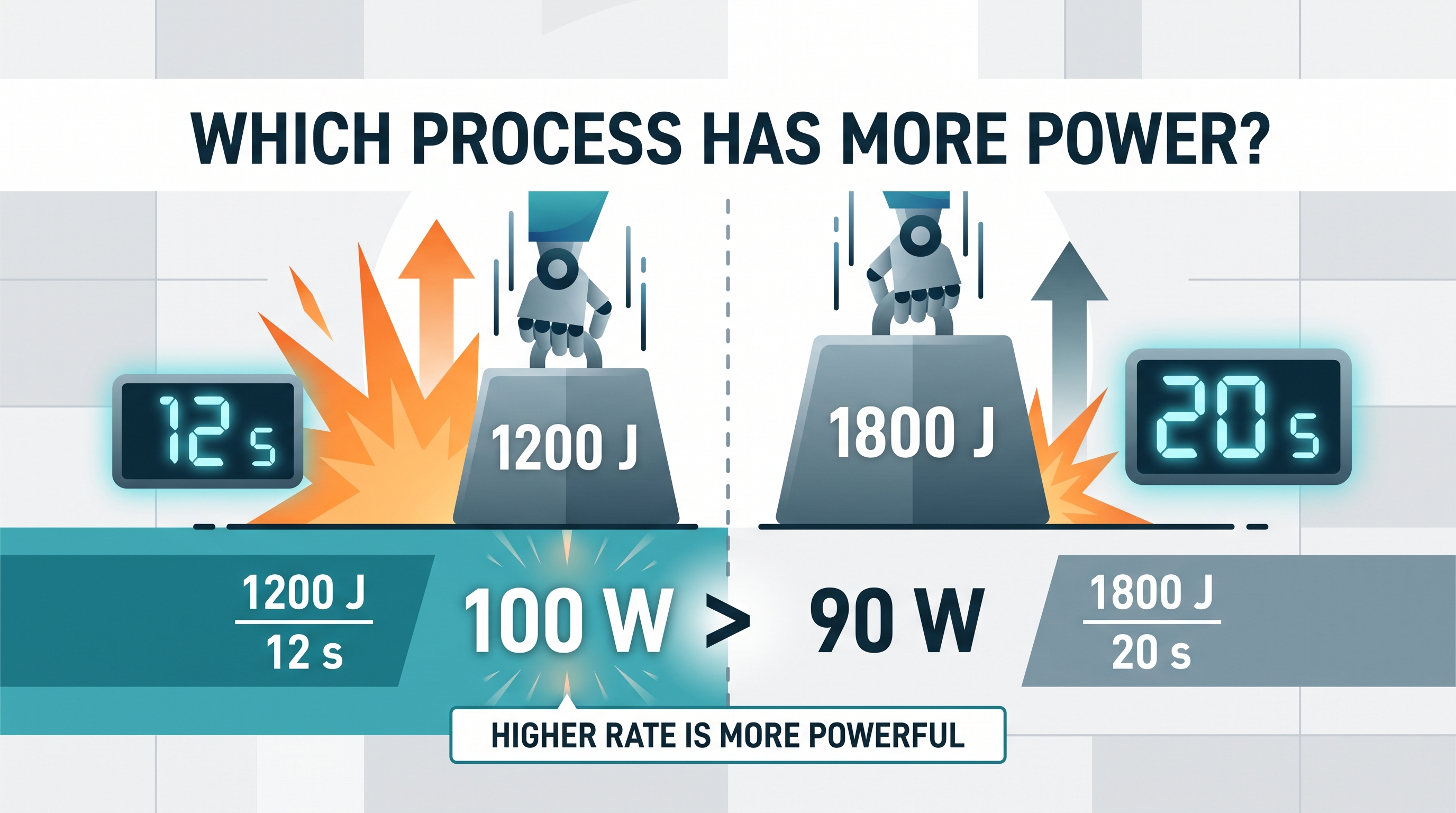
A student claims that completing $1200\ \mathrm{J}$ of work in $12\ \mathrm{s}$ is more powerful than completing $1800\ \mathrm{J}$ in $20\ \mathrm{s}$. Is the claim correct?
Calculate both rates:
$$ P_1=\frac{1200\ \mathrm{J}}{12\ \mathrm{s}}=100\ \mathrm{W}, \qquad P_2=\frac{1800\ \mathrm{J}}{20\ \mathrm{s}}=90\ \mathrm{W}. $$
Yes. The first process has the greater average power, even though it transfers less total energy. Always compare the ratio $\frac{W}{\Delta t}$ rather than comparing work alone.